The Jim Thorpe Memorial
After exploring the town that carries his name, we came to the Jim Thorpe Memorial. The simple red and gold entrance sign leads into a quiet wooded park, but what lies beyond it tells the story of one of the most remarkable athletes in American history.
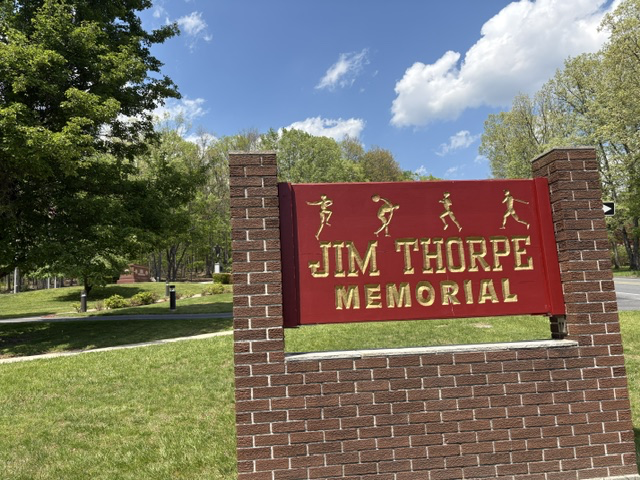
Throughout the grounds, Jim Thorpe’s life unfolds, from his childhood in Oklahoma and his years at the Carlisle Indian Industrial School to his extraordinary performance at the 1912 Olympic Games and the long struggle to restore the Olympic honors that were taken from him.
Thorpe was born in Indian Territory, now Oklahoma, in 1887. His Sac and Fox name, Wa-Tho-Huk, is commonly translated as “Bright Path” or associated with a path illuminated by lightning. His childhood included considerable loss. His twin brother, Charlie, died when the boys were young, and Thorpe later lost both of his parents before reaching adulthood.
Eventually he was sent to the Carlisle Indian Industrial School in Pennsylvania. Carlisle was one of the federal boarding schools created to assimilate Native American children into white American society, often at enormous personal and cultural cost to the students. Yet it was at Carlisle that Thorpe’s extraordinary athletic abilities became impossible to overlook.
Under coach Glenn “Pop” Warner, Thorpe became a football star, but football represented only a fraction of his ability. He ran sprints and distance events, hurdled, jumped and threw. He competed in an extraordinary range of track-and-field events and excelled at nearly all of them.
His greatest moment came at the 1912 Olympic Games in Stockholm. Thorpe competed in both the pentathlon and decathlon, grueling all-around competitions requiring proficiency in running, jumping and throwing. He dominated both and won two gold medals. His performance was so extraordinary that King Gustav V of Sweden famously praised him as the world’s greatest athlete.
Yet triumph was followed by injustice. It was discovered that Thorpe had previously received a small amount of money for playing minor-league baseball. Under the rigid amateur regulations of the era, he was stripped of his Olympic titles in 1913. For decades, supporters argued that Thorpe had been treated unfairly and that the rules had been applied inconsistently. His Olympic recognition was partially restored in 1982, and in 2022 the International Olympic Committee finally recognized Thorpe as the sole gold medalist in both the pentathlon and decathlon.
Thorpe’s athletic career extended far beyond the Olympics. He played professional baseball and football and became the first president of the American Professional Football Association, the organization that evolved into today’s NFL. His range of athletic accomplishments is why he continues to be remembered not merely as a great football player or Olympian, but as one of America’s greatest all-around athletes.
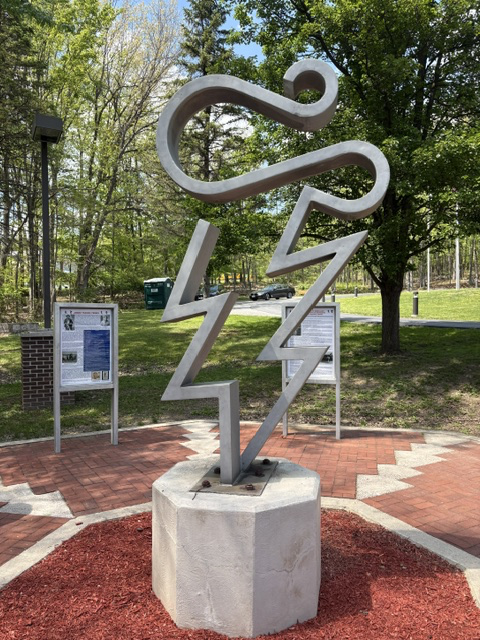
At the center of this part of the memorial is the striking abstract sculpture in our photograph. Called “The Spirit of Thunder and Lightning,” it evokes the lightning associated with Thorpe’s Native American name. The sculpture was constructed by students of the Carbon County Area Vocational Technical School and dedicated on May 23, 1998.
I particularly like that this sculpture was created by local students. By 1998, Jim Thorpe had been gone for 45 years and the town had carried his name for more than four decades. Yet another generation of young people was contributing something of its own to the memorial.
Around the park are displays chronicling the different chapters of his life: his youth, his father James Francis Thorpe, the Carlisle years, the 1912 Olympics and the decades-long effort to restore his Olympic accomplishments. Elsewhere on the grounds are his tomb and the larger-than-life bronze sculptures portraying him playing football and throwing the discus. The football statue was unveiled in 2007 and the discus statue followed in 2011.
Together, these elements make the park much more than a burial place. They tell the story of a Native American child growing up in Oklahoma, a young man sent to Carlisle, an athlete whose abilities astonished the world in Stockholm, and a champion who endured the loss of the very honors he had earned.
The town bears his name, his remains rest here, and this quiet memorial park continues to introduce new generations to the complicated and extraordinary life of Jim Thorpe—Wa-Tho-Huk, the man whose path was illuminated by lightning.
Read More From Nancy
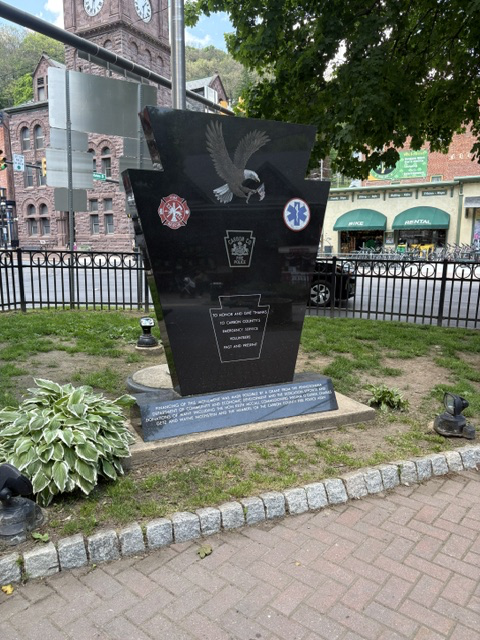
Carbon County Emergency Services Memorial
While so much of Jim Thorpe tells the story of coal, railroads, industrialists and nineteenth-century Mauch Chunk, this memorial brought us into a much more recent chapter of the community’s history. Standing in the small park across from the Carbon County Courthouse is a polished black granite monument dedicated to the men and women who […]
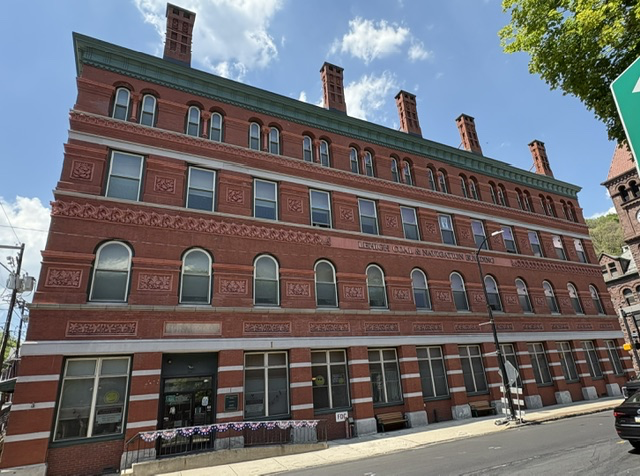
The Lehigh Coal & Navigation Building
Standing prominently near the center of Jim Thorpe is the former headquarters of the Lehigh Coal & Navigation Company. After seeing the enormous piece of anthracite displayed nearby, this building helps complete the story. The coal beneath the mountains created the opportunity, but the Lehigh Coal & Navigation Company developed the transportation system that helped […]
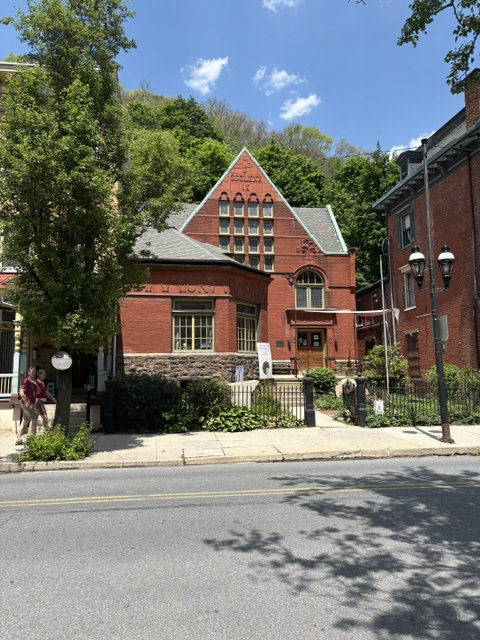
The Dimmick Memorial Library
Among the beautiful buildings lining Broadway in Jim Thorpe, the Dimmick Memorial Library immediately stands out. Its red brick, steep gables, large arched windows and decorative terra-cotta details give it a character very different from the houses surrounding it. But after seeing the Dimmick House, the library becomes even more interesting because the two buildings […]

