The Dennison Manufacturing Company
These red-brick buildings along Howard Street in Framingham are remnants of a company that once played an enormous role in the town’s economy and in the everyday lives of generations of local families. Today portions of the former industrial property have been adapted to new uses, but for most of the twentieth century this was the home of the Dennison Manufacturing Company.
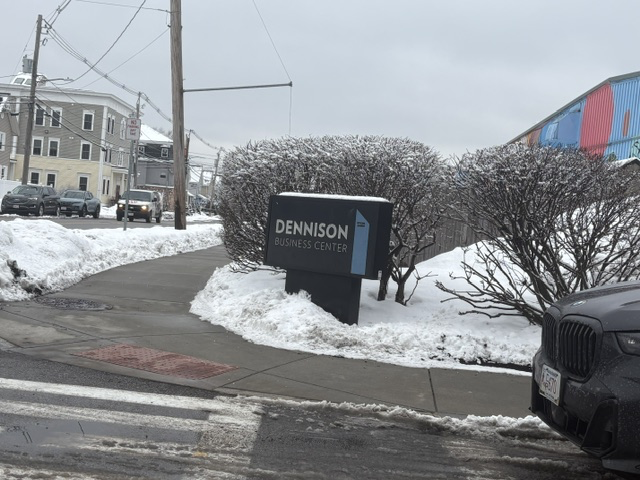
The company’s history began well before it arrived in Framingham. Dennison was founded in 1844, when Andrew Dennison began making paper forms for jewelry boxes in Maine. The business expanded into boxes, merchandise tags, labels and an extraordinary variety of paper products, eventually becoming one of the country’s most innovative manufacturers in its field.
In 1897, Dennison centralized its headquarters and manufacturing operations in Framingham. What developed here was not simply a factory building, but an enormous industrial complex covering approximately 16 acres. The Dennison works filled essentially an entire block bounded by Howard, Bishop, Clinton and Grant Streets. Numerous interconnected factory, warehouse, office and service buildings made up the complex, with additional structures added as the company expanded. The railroad ran along the southern edge of the property, and rail spurs actually entered the factory grounds, allowing raw materials to arrive and finished products to be shipped throughout the country.
The number of buildings changed over the years as Dennison continually enlarged and reorganized its plant, so it is difficult to assign one accurate building count to its entire history. Historic photographs show a dense collection of substantial brick manufacturing buildings rather than the single structure we might imagine when we hear the word “factory.” The company even moved its power plant across Bishop Street so that additional buildings could be constructed within the main industrial triangle.
Inside these buildings an extraordinary variety of products was manufactured. Dennison made jewelry boxes and cases, shipping and merchandise tags, gummed labels, sealing wax, crepe paper, holiday decorations, toys, books, games and numerous other paper goods. By 1939 its product line included some 9,000 different items.
Some of those products became part of everyday American life. Dennison’s tags and labels were used by stores and businesses throughout the country, while its colorful crepe paper, holiday decorations, stickers and craft materials found their way into homes and schools. At one time, machines inside the Framingham plant were capable of producing as many as one million tags a day. But the importance of Dennison to Framingham went far beyond what it manufactured. It was one of the largest employers in the entire area. At its height, the Framingham operation employed as many as 3,000 people—an extraordinary number for the community at that time. The Framingham History Center notes that this was roughly equivalent to one-third of the town’s population.
Dennison was also known for unusually progressive employment practices for its time. The company developed employee programs and facilities and became nationally recognized for innovative approaches to management and labor relations. Its extensive surviving company records reveal how seriously Dennison studied working conditions, productivity and the relationship between a company and its employees.
One of the most important figures in the company’s later history was Henry S. Dennison, who became nationally known for his ideas about business management and labor relations. His influence extended well beyond Framingham, and his writings and ideas attracted attention in the developing field of modern business management.
Dennison remained one of Framingham’s major employers for much of the twentieth century. The company’s presence here lasted from the consolidation of its operations in 1897 until its 1990 merger with Avery International, which created Avery Dennison. The corporate headquarters subsequently moved to California, bringing to an end nearly a century of Dennison manufacturing in Framingham.
Read More From Nancy
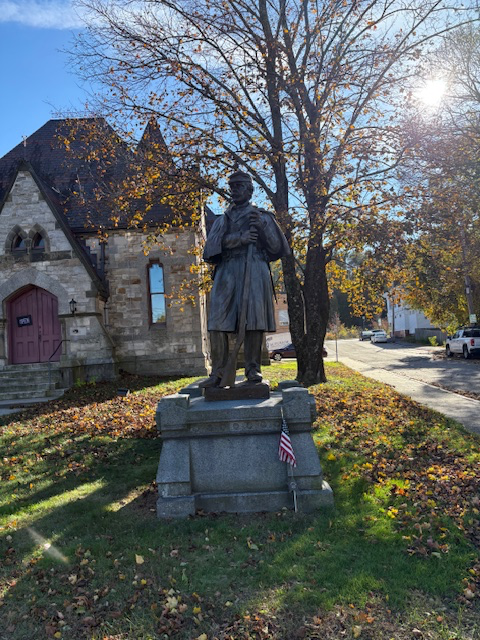
Millmore’s Confederate Statue
Standing outside the Framingham History Center is a powerful piece of the town’s history: a Civil war memorial sculpture created by the noted nineteenth century artist Martin Millmore. Millmore, an Irish-born sculptor who became one of Massachusetts’ more prolific creators of war memorial, is known for honoring ordinary citizens who answered extraordinary calls to service. His works appear in communities across […]
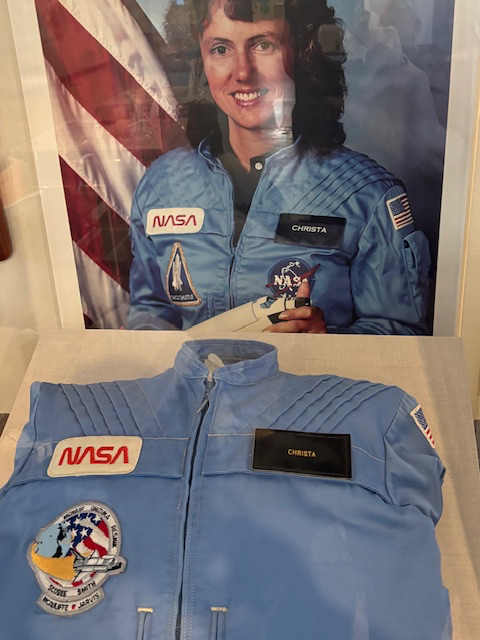
Christa McAuliffe
The story of Christa McAuliffe and Framingham is not one of birthplace, but of professional roots and purpose, a connection grounded in education, which defined her life and ultimately shaped her legacy. Before she became known to the nation as the teacher chosen to travel into space, McAuliffe was, first, an educator. She attended Framingham State […]
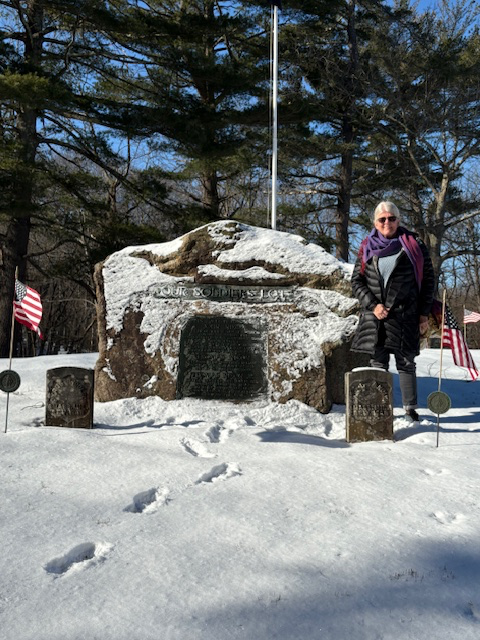
Old Soldier’s Lot
I drove to the Framingham Cemetery to discover the stone monument marking a section known as the Old Soldier’s Lot. Monuments like this quietly ask us to stop and remember. At the top of the plaque are the words: “This tablet in honor of John Nixon“. The monument recognized John Nixon, a Framingham native who played an important […]

