The Adin Ballou House
Every town has a founder. Few can still point to the home of the person whose ideas shaped its very identity.
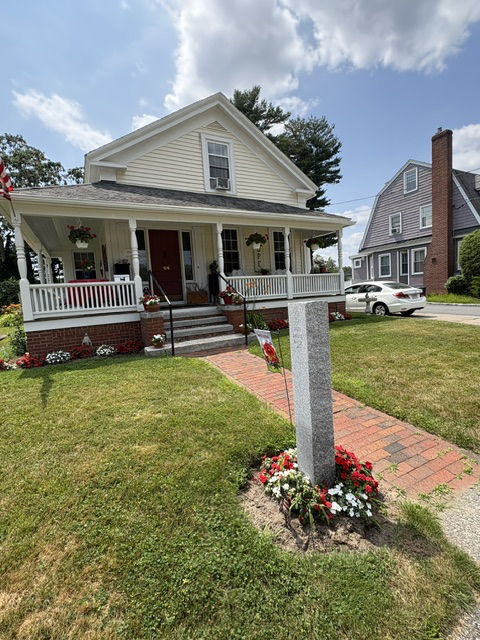
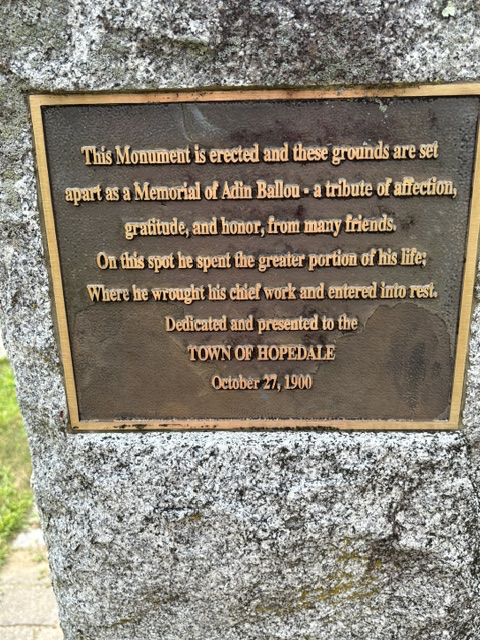
This modest house on Dutcher Street was the home of Reverend Adin Ballou, the visionary minister who founded the Hopedale Community in 1842. Although the house stands in a different location today, it originally occupied a prominent place at the center of the utopian community. In 1900, it was carefully moved to its present site to make way for Adin Ballou Park, preserving one of the town’s most important historic buildings.
Built around 1841, the simple wood-frame home reflects the practical values of the community Ballou established. Rather than constructing grand residences, the members of the Hopedale Community believed in modest living, shared responsibility, and placing the needs of the community above personal wealth. The house is a reminder that Ballou practiced the principles he preached.
From this home, Ballou preached, wrote, and guided one of the longest-lasting utopian communities in nineteenth-century America. Here he edited and published The Practical Christian, the community’s newspaper, and developed the philosophy he called Practical Christianity: the belief that faith should be demonstrated through everyday actions rather than simply expressed in words. Members of the community embraced abolition, equal rights for women, temperance, education, cooperative labor, and the radical principle of nonviolence.
Ballou’s ideas reached far beyond Hopedale. Decades before nonviolent resistance became associated with Mahatma Gandhi or Dr. Martin Luther King Jr., Ballou argued that violence could never produce lasting justice. His writings on Christian nonresistance were later read by the Russian author Leo Tolstoy, whose work influenced Gandhi’s philosophy of peaceful resistance. Through that remarkable chain of influence, ideas developed in this modest New England home eventually helped shape some of the most important social justice movements of the twentieth century.
The Hopedale Community itself lasted until 1856, when financial realities brought the cooperative experiment to an end. Yet Ballou chose to remain in Hopedale for the rest of his life. He continued to minister, write, and serve the town as it entered a new era under the leadership of the Draper family and the Hopedale Machine Company. While the community changed, Ballou’s presence remained a constant reminder of its founding ideals.
Standing before this house today, there is little to suggest that it was once the center of a movement that challenged many of the accepted beliefs of its time. It is neither large nor ornate. Its quiet appearance reflects the humility of the man who lived here and the values he hoped would define the community around him
As I stood on the front walk, I couldn’t help but think that this is where Hopedale truly began. Before the mills, before the impressive churches, before the Community House and the library, there was this simple home. Within these walls, Adin Ballou imagined a different kind of society, one built on peace, equality, cooperation, and service to others. While the utopian community itself lasted only a few years, the values it inspired continued to shape Hopedale for generations. In many ways, the story of this house is the story of the town itself.
Read More From Nancy
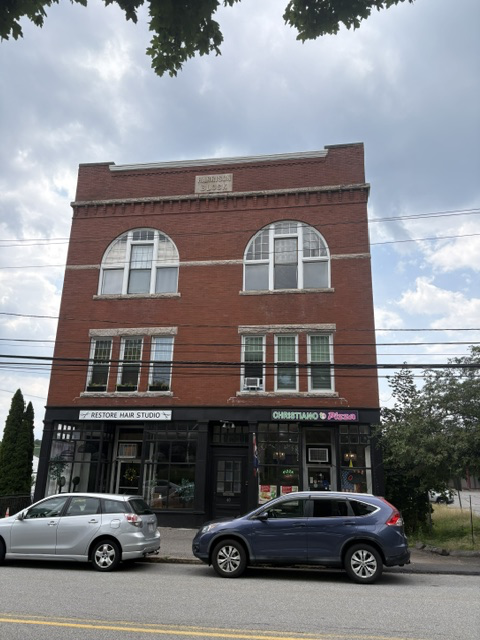
The Harrison Block
As I walked along Hopedale Street, this handsome brick building immediately caught my attention. While much of Hopedale’s story is told through its churches, library, parks, and former mill complex, this building reminds us that every thriving community also depends on places where everyday life unfolds. Built in 1889 by General William Franklin Draper, the […]
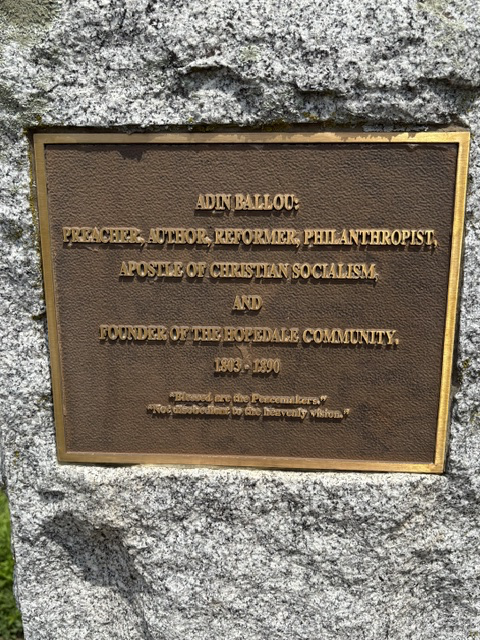
The Founder
The first plaque introduces us to the man whose vision gave birth to Hopedale. It identifies Adin Ballou as a preacher, author, reformer, philanthropist, “Apostle of Christian Socialism,” and founder of the Hopedale Community. Those titles reflect a remarkable life devoted not simply to preaching, but to putting faith into practice. Ballou believed Christianity should […]
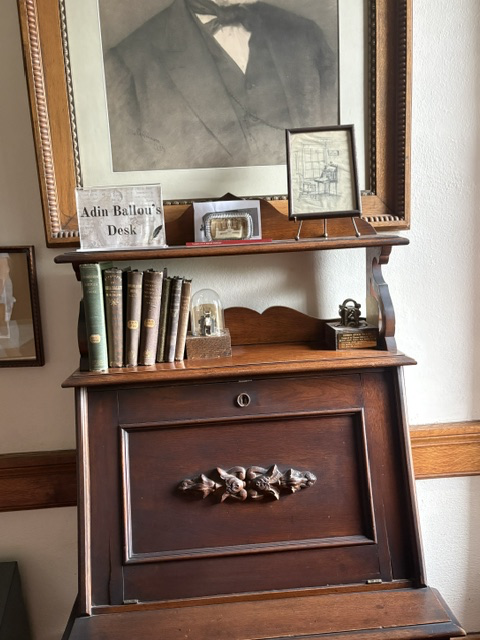
Adin Ballou’s Desk
Among the many artifacts preserved at the Bancroft Memorial Library, none seems more fitting than Adin Ballou’s writing desk. Unlike a monument or a portrait, this was a place of daily work, a quiet space where ideas were transformed into words. The desk itself is modest in both size and design. Built for function rather […]

