Edward A. Filene Plague
Walking along the fence surrounding the Boston Common, I came across this bronze plaque honoring Edward A. Filene. While many people recognize the Filene name from the famous Boston department store, few realize the tremendous influence he had beyond retail. Filene believed that ordinary working families deserved access to affordable credit and financial opportunity. His vision and financial support helped establish the credit union movement in the United States, forever changing the way millions of Americans save and borrow money.
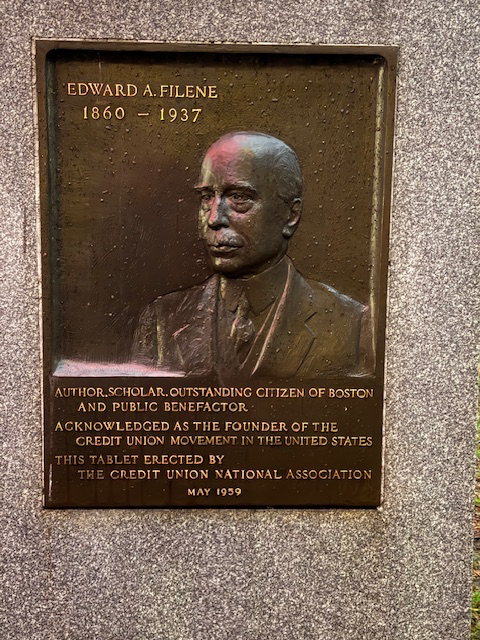
This memorial held a special significance for me. When I was eighteen years old, I worked at the original Filene’s Basement in downtown Boston as part of a business internship. Long before discount retailing became commonplace, Filene’s Basement was famous for its “automatic markdown” system, where prices were reduced according to a fixed schedule until the merchandise sold. It was an exciting place to learn about merchandising, customer service, and the fast-paced world of retail. At the time, I knew the Filene name as a successful Boston business. Only years later did I come to appreciate the remarkable legacy of the man behind it.
Born in Salem, Massachusetts, in 1860, Edward Filene transformed his family’s department store into one of the country’s most innovative retailers. He championed fair treatment of employees, encouraged education and civic responsibility, and believed that business success carried with it an obligation to improve society. His philanthropy supported education, scientific research, public health, and countless civic projects throughout Boston and beyond.
Standing before this plaque, I found myself reflecting on an unexpected connection between my own life and Boston’s history. What began as a summer internship at Filene’s Basement became, many years later, a reminder that the people whose names appear on buildings and memorials often leave a legacy far greater than the businesses they founded. Edward Filene’s greatest achievement was not simply creating a successful department store. It was helping create opportunities that allowed ordinary people to build stronger financial futures, a legacy that continues to benefit communities today.
Read More From Nancy
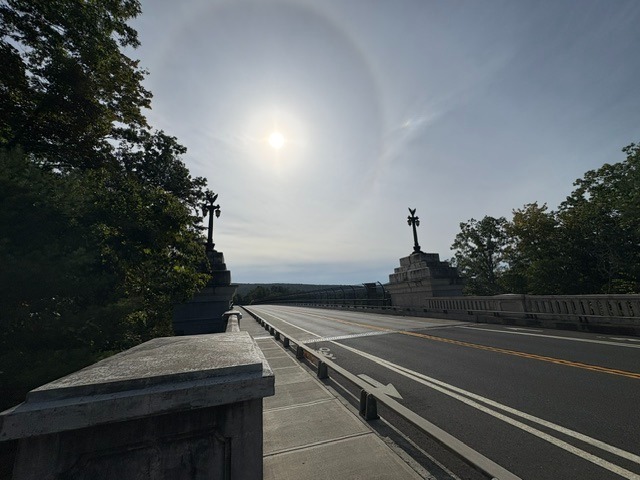
The French King Bridge
Driving west along Route 2, I stopped at the French King Bridge mainly for the view. Below, the Connecticut River curved between wooded banks, with hills stretching into the distance. The setting was magnificent, but the bridge itself, with its substantial stone approaches and ornamental lamps, gave me another reason to pause. Opened on September […]
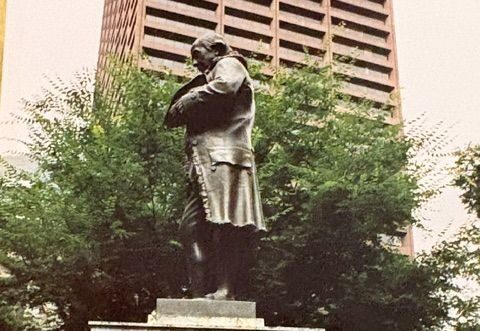
Benjamin Franklin Statue
In the courtyard of Boston’s Old City Hall, a bronze statue of Benjamin Franklin stands above a granite pedestal decorated with scenes from his life. Our photograph captures a family visit to this landmark on School Street, where Franklin’s story connects with the history of the city in which he was born. Franklin was born […]
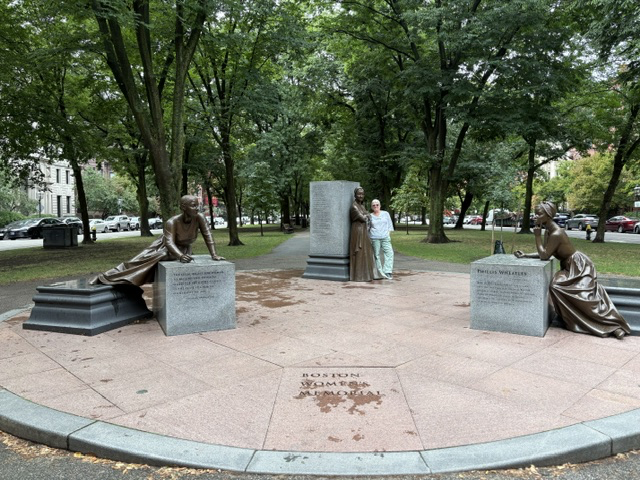
Boston Women’s Memorial
Located on the Commonwealth Avenue Mall, the Boston Women’s Memorial honors Abigail Adams, Lucy Stone and Phillis Wheatley, three women whose words challenged the political, social and intellectual boundaries of their times. Created by sculptor Meredith Bergmann, the bronze-and-granite memorial was dedicated by the City of Boston on October 25, 2003. The idea for the […]

