Jackson’s Great Train Raid of 1861
Established, 1778, by Gen. Adam Stephen. Named for Col. Thomas Martin, nephew of Lord Fairfax. Home of Admiral Charles Sterling and Admiral Charles B. Caldwell. In Jackson’s raid, 1861, captured 8,500 locomotives and 300 miles of railway.
This marker is referring to a remarkable railroad operation of the Civil War, commonly known as Stonewall Jackson’s Great Train Raid of 1861.
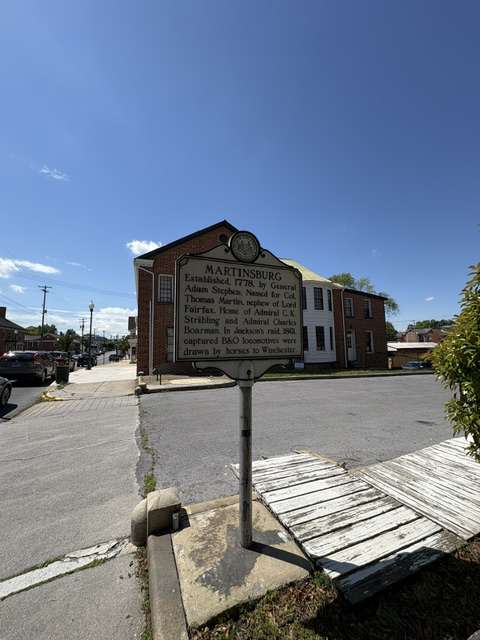
In the spring of 1861, shortly after Virginia seceded from the Union, Confederate Colonel Thomas “Stonewall” Jackson was ordered to secure the Shenandoah Valley and disrupt Union transportation. At that time, Martinsburg was a major hub on the Baltimore and Ohio Railroad, one of the most important rail lines in the United States, connecting Washington and Baltimore with the Ohio River and the West.
Jackson understood that control of the railroad was vital to the Union war effort. In May and June of 1861, his troops occupied Martinsburg and captured large numbers of locomotives and railroad cars. Because Confederate tracks were of a different gauge and there was no direct rail connection south, Jackson devised a solution. Teams of horses pulled the captured locomotives and cars over ordinary roads from Martinsburg to Strasburg, Virginia, where they could be transferred to Confederate rail lines.
Over several months, Confederate forces removed or destroyed 56 locomotives and more than 300 railroad cars, severely disrupting Union transportation. Although the numbers given on some historical markers vary, historians regard the Great Train Raid as a successful act of railroad warfare during the Civil War.
For Martinsburg, the raid was only the beginning of four years of upheaval. Because of its location, the town changed hands numerous times during the war and suffered repeated occupations. The railroad eventually recovered, and Martinsburg emerged after the war as a great railroad center of the East.
Read More From Nancy
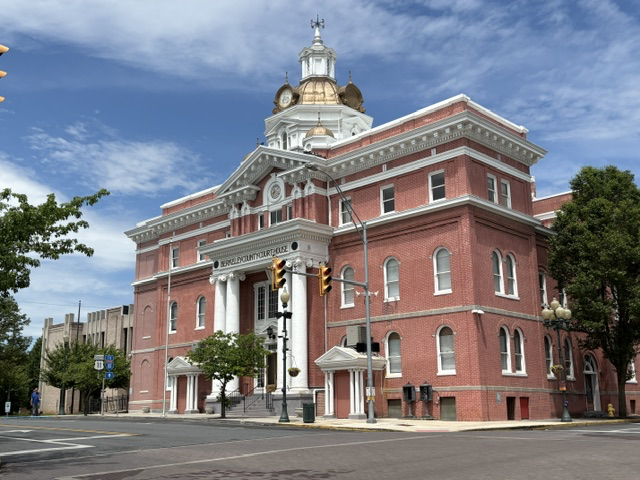
Berkeley County Courthouse
As I walked around Martinsburg, I tried to stop and capture the landmarks that would have been familiar to my father. One such building was the impressive Berkeley County Courthouse, with its stately columns, red brick exterior and distinctive dome. It stands as one of the architectural treasures of the city. Completed in 1908 in the Beaux-Arts style, […]
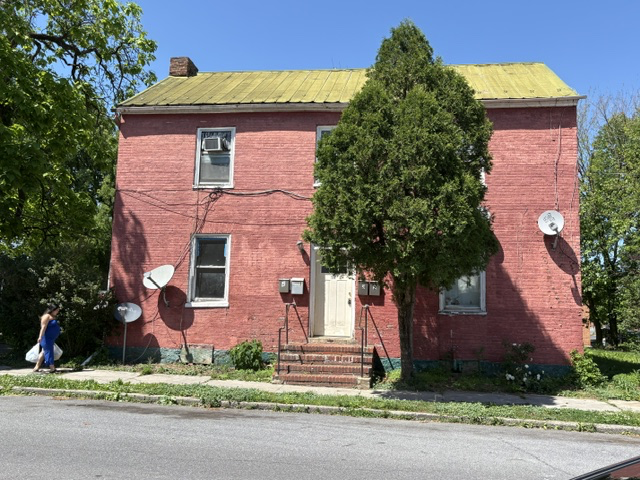
506 West John Street
This address appears on so many envelopes preserved in my parents’ papers that I felt compelled to include it in my exploration of Martinsburg. During my visit, I made a point of finding 506 West John Street and taking a photograph of the house. From the outside, I saw no obvious connection to my father, […]
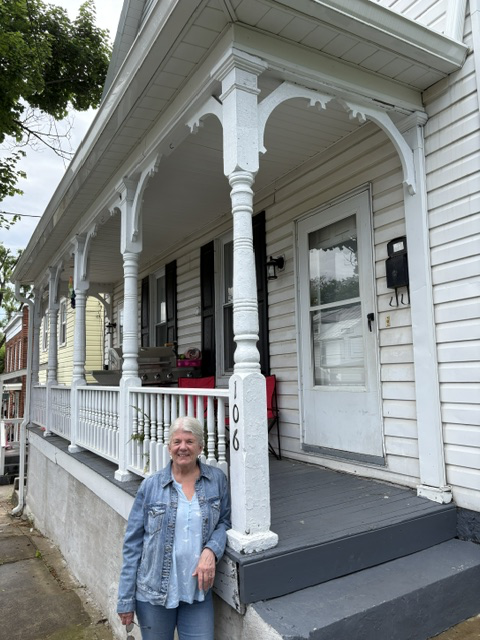
106 South St.
This house at 106 South Street in Martinsburg, West Virginia, was the first place I wanted to visit. 106 South was the address of so many of the letters I have read between my father and his mother. Long before I ever visited the town. This address was familiar. This represented my father’s beginnings and the home […]

