Joan of Arc Statue
This gold statue of Joan of Arc in Paris is the Equestrian Statue of Joan of Arc, located in the Place des Pyramides.
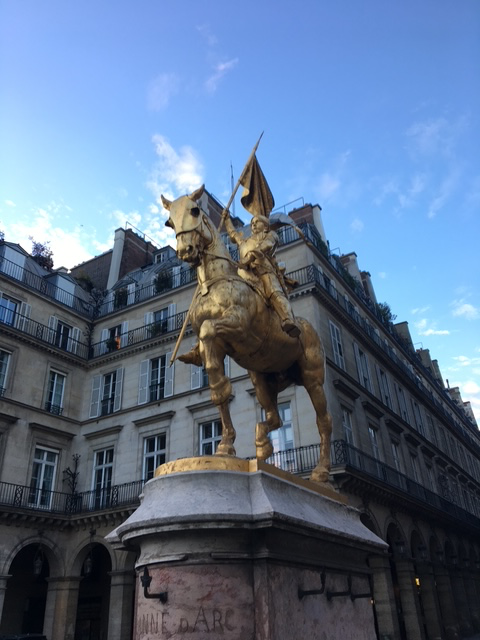
Created by sculptor Emmanuel Fremiet in 1874, this gilded statue depicts Joan of Arc on horseback, holding her banner as she leads forward. The gold leaf covering catches the light in a way that makes it stand out even among the grand architecture of Paris.
Joan of Arc was a young French peasant girl, born around 1412, who believed she was guided by divine voices to help France during the Hundred Years War. At just 17 years old, she convinced the future king, Charles VII, to allow her to accompany French troops. She plates a key role in lifting the Siege of Orleans in 1429, a turning point in the war that restored confidence in the French army.
Her story is not a simple victory. She was later captured, tried for heresy, and executed in 1431 at the age of 19. Years later, her conviction was overturned, and in 1920 she was canonized as a saint by the Catholic Church.
The location of the statue is meaningful. This area is near where she was wounded during her attempt to liberate Paris in 1429. The monument stands in connection to her actual presence in the city.