Jan Karski
While walking through Warsaw, I came upon a bronze monument that drew my attention. Unlike many statues where the figure stands high on a pedestal, this one shows a man quietly seated in a chair, holding a document in his hand. The plaque tells the story of Jan Karski, one of the most remarkable witnesses of the Second World War.
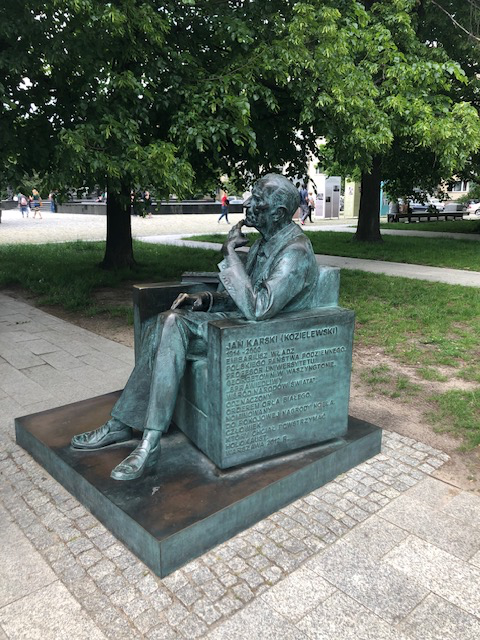
The monument stands near the Museum of the History of Polish Jews, in a part of the city that was once the site of the Warsaw Ghetto. It is a fitting location, because Karski’s story is deeply tied to the tragic events that took place here.
During the German occupation of Poland, Karski joined the Polish underground resistance and served as a courier, carrying secret reports from occupied Poland to the Polish government in exile and the Allied leaders in the West. In 1942, members of the Jewish resistance arranged for him to enter the Warsaw Ghetto in disguise so that he could witness the conditions there for himself. Later he was also smuggled into a Nazi transit camp. His mission was to see, remember and carry the truth of what was happening to the outside world.
Risking capture and execution, Karski traveled across occupied Europe and eventually reached London and then the United States. There he delivered his eyewitness reports to diplomats, journalists and leaders, including Franklin Roosevelt. He described the systematic destruction of the Jewish population that we now recognize as the Holocaust. Despite his efforts, many people at the time struggled to believe that such crimes were possible on such a vast scale.
Standing there in Warsaw, near the place where so much suffering once occurred, the figure of Jan Karski reminds us of the courage required not only to witness injustice but to speak the truth about it, even when the world is not ready to listen.

