Iscle Soler
In Plaça de Sant Agustí, a bronze bust honors Iscle Soler i Samsot, an actor closely associated with the growth of Catalan theater. Raised above a stone pedestal, his portrait preserves the memory of a performer whose working life unfolded largely at the nearby Teatre Romea.
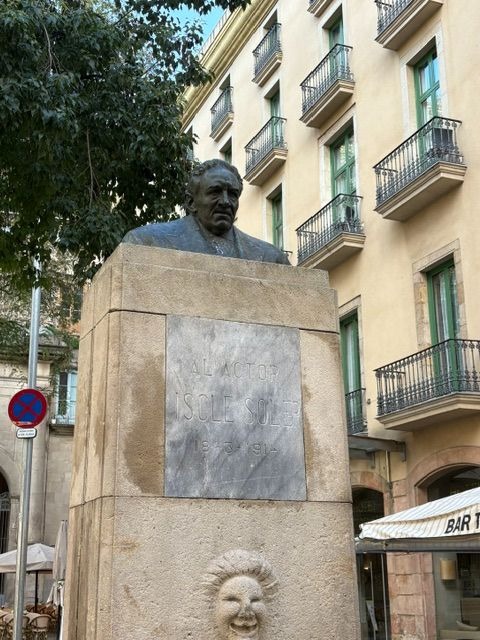
Born in Barcelona in 1843, Soler trained as a silversmith before establishing himself professionally on the stage. He studied acting at the Conservatori de Declamació associated with the Teatre Odéon and gained experience in several Barcelona theaters.
A decisive opportunity came during the 1867–1868 season, when playwright Frederic Soler, known as Serafí Pitarra, engaged him for the Catalan theater company at the Romea. Despite sharing a surname, the playwright and actor were different figures, each contributing to the theater’s success.
Iscle Soler became known for character and comic roles. Apart from tours and a season elsewhere, he remained associated with the Romea for roughly four decades, helping bring Catalan plays to successive generations of audiences.
Read More From Nancy
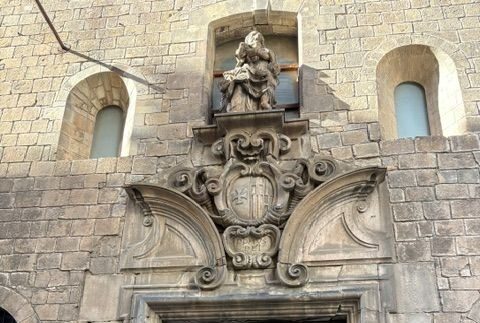
La Capella
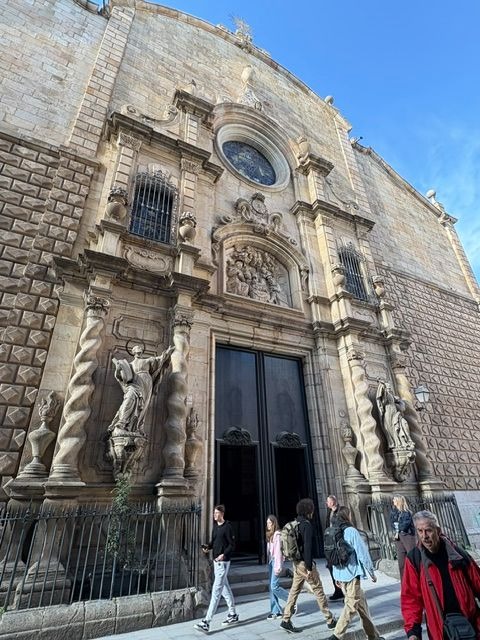
Above the entrance to La Capella, a sculpted figure represents Charity. Created by Pere Costa in 1730, it recalls the building’s original role as the chapel of Barcelona’s Hospital de la Santa Creu. Today, the doorway opens into a space devoted to contemporary art. The chapel was completed in 1444, incorporating an earlier structure associated […]
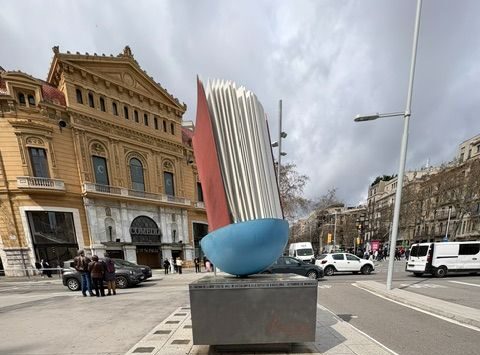
Homage to the Book
At a busy intersection in Barcelona, an oversized book rises above the pavement. Its red cover opens around a fan of pale pages, balanced on a blue rounded base. Surrounded by traffic, pedestrians, and substantial stone buildings, it brings an unexpected touch of playfulness to the street. Looking more closely reveals that this unusual sculpture […]

The Door of the Passion Façade
While most visitors are naturally drawn to the soaring towers of the Sagrada Família, I found myself stopping to study one of its bronze entrance doors. At first, it appears to be nothing more than a collection of letters, but looking more closely, I realized that every letter has been carefully placed to tell a […]

