Exeter Town Hall
At the corner of Front and Water Streets, Exeter Town Hall has been a center of public life since 1855. Architect Arthur Gilman designed the red-brick building to accommodate town meetings, court proceedings, and community gatherings. Its prominent location and substantial architecture reflected the importance of these responsibilities within a growing New England town.
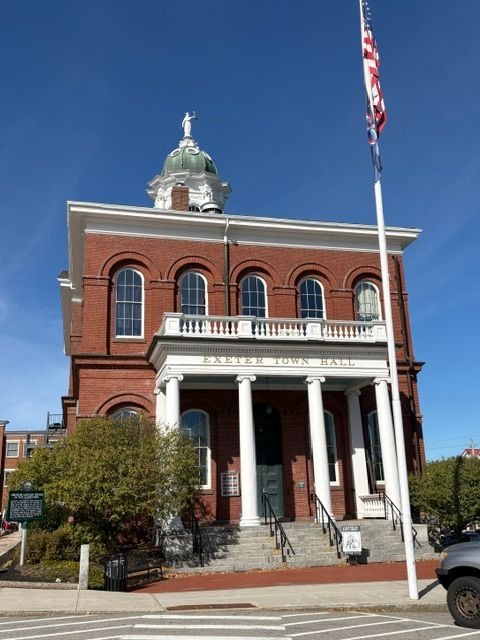
The building’s white columned entrance, tall arched windows, and roof-top cupola give it a distinctive presence. Gilman, a descendant of one of Exeter’s founding families, created a civic building whose appearance conveyed permanence and public purpose. Its combination of town hall and county courthouse brought local government and judicial business beneath the same roof.
Lady Justice stands above the cupola, recalling the building’s original courthouse function. The statue formed part of Gilman’s design when the hall was constructed. Positioned high above the streets, the figure made the administration of justice a visible part of the town center.
Exposure to New England weather has required repairs and replacement over the years. The original statue was lowered for repairs following a storm in 1917. After Hurricane Bob severely damaged it in August 1991, a replacement matching its appearance was installed in July 1992, maintaining the familiar silhouette above the building.
Beyond government and court business, the hall has provided a place for public expression and shared activity. Its main gathering space continues to accommodate meetings, plays, and other events. That continuing use connects the building with its nineteenth-century purpose: a place where residents come together to discuss concerns, conduct business, and participate in the life of Exeter.
Read More From Nancy
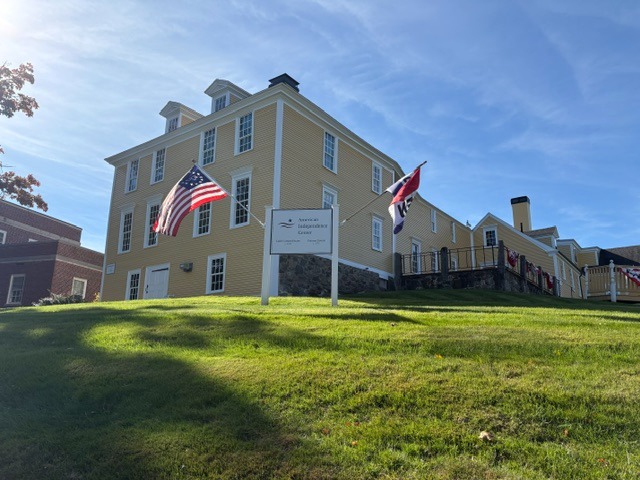
American Independence Museum
In 1985, a rare document rediscovered in the attic of Exeter’s Ladd-Gilman House brought renewed attention to the town’s connection with American independence. It was a Dunlap broadside, one of the first printed copies of the Declaration of Independence. The discovery helped inspire the creation of the American Independence Museum, which opened to the public […]
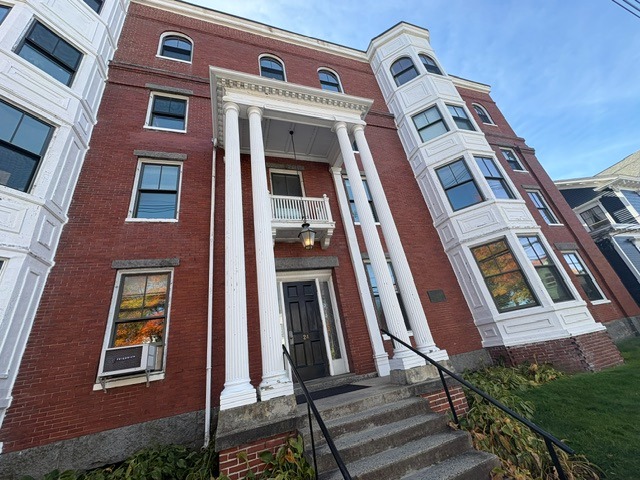
The Squamscott House
The substantial brick building at 24 Front Street has served Exeter as a hotel, student residence and place of political gathering. Known historically as the Squamscott House and later as Gorham Hall, it connects the town with the organizing efforts that preceded the emergence of the Republican Party. The present building dates to 1851. Abraham […]
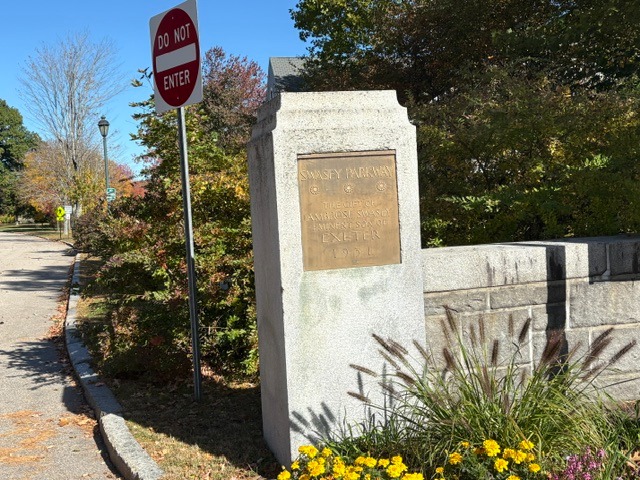
Swasey Parkway
Along the Squamscott River, Swasey Parkway preserves a landscape transformed through one resident’s generosity. Dedicated in November 1931, the parkway was a gift from inventor and industrialist Ambrose Swasey, who wanted to improve Exeter’s waterfront and create a welcoming public space near the town center. This shoreline had once been a working part of Exeter’s […]

