An Early State House Seal
A painted wooden sign in the New Hampshire Historical Society’s collection preserves a connection to the beginnings of the State House in Concord. Made in 1819 by John S. Blunt, it was intended to hang inside the newly completed building. Its circular center bears New Hampshire’s state seal, while a tablet below reads “Built 1816”.
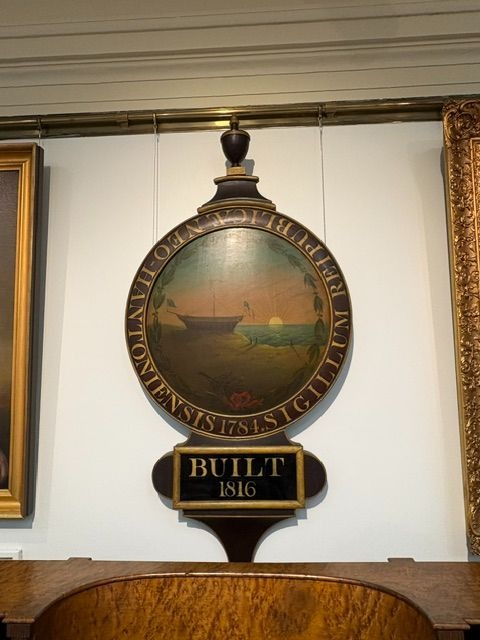
Blunt was a young artist from Portsmouth whose work crossed the boundaries between practical decoration and fine art. Trained in the Boston workshop of John Ritto Penniman, he learned skills used to ornament furniture, clocks, signs, and other objects. After completing his apprenticeship in 1819, he traveled up the Merrimack River with fellow artist William P. Codman. During that journey, Blunt painted the seal for the new State House.
The central scene shows a ship under construction beside the water, with the sun rising beyond it. For Blunt, who came from a family of Portsmouth mariners, this was imagery rooted in a familiar landscape. Shipbuilding and maritime commerce formed an important part of the state’s economy, making the waterfront scene an appropriate expression of New Hampshire’s identity.
Around the picture runs a Latin inscription identifying the seal of the State of New Hampshire, accompanied by the date 1784. The lettering, painted scene, and ornamental frame bring official symbolism together with the handwork of an individual craftsman. Rather than a printed emblem, this was an object shaped and painted for a particular public setting.
Preserved beyond its original purpose, the sign connects the State House with the people who furnished and decorated it. It also records an early moment in Blunt’s career, when the skills of a sign painter helped give visual form to the identity of a state.
Read More



Read More From Nancy
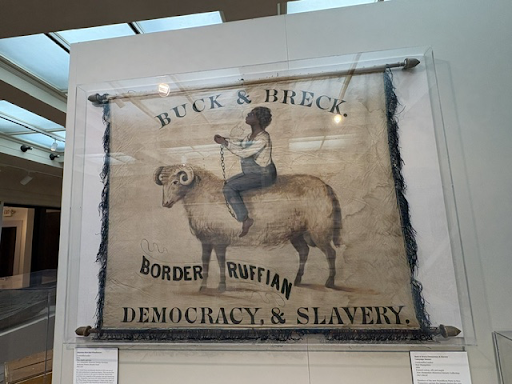
Campaign Banner from the Election of 1860
One of the exhibits that caught my attention was this colorful campaign banner from the presidential election of 1860. While political campaigns often seem like a modern phenomenon, Americans have been using banners, posters, and political imagery to influence voters for generations. This banner was created by members of the Republican Party in New Hampshire […]
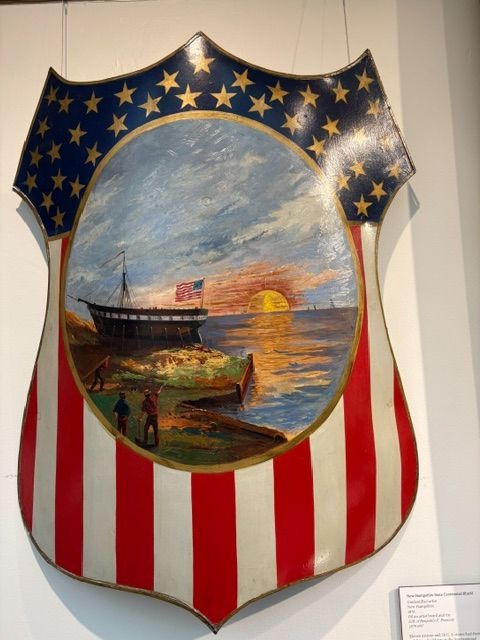
New Hampshire’s Centennial Shield
A shield decorated with stars, stripes, and a maritime scene preserves New Hampshire’s participation in the nation’s hundredth anniversary. Painted in 1876, it hung inside the New Hampshire Building at the Centennial Exhibition in Philadelphia. Now in the New Hampshire Historical Society’s collection, it survives as an artifact of how the state presented itself during […]
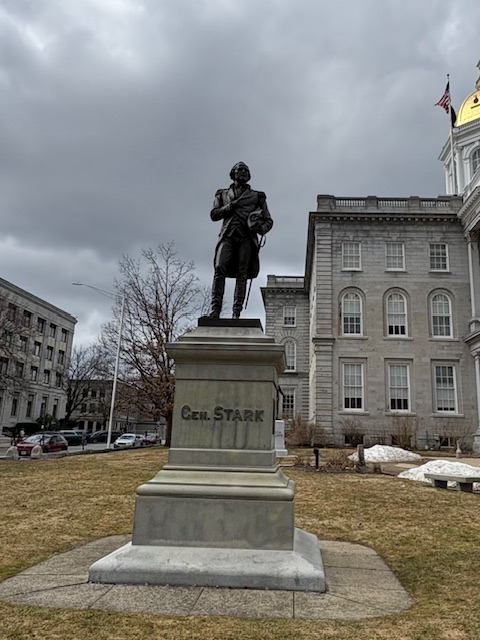
General John Stark
In wanting to share more of my hometown, I will continue exploring more of the statues on the State House lawn. It is clear from the attire of this statue that this man lived at a different time than the rest. The figure is John Stark, dressed in the uniform of the Revolutionary War, setting him […]

