The Dockyard Clock
At Chebucto Landing on Halifax’s waterfront, the Dockyard Clock stands above the boardwalk in a blue-shingled tower supported by an open framework. Its public setting is relatively recent, but the timepiece dates to 1767. Made in London, England, it was installed in Halifax’s naval dockyard in 1772, where it served generations of sailors and civilian workers for more than two centuries.
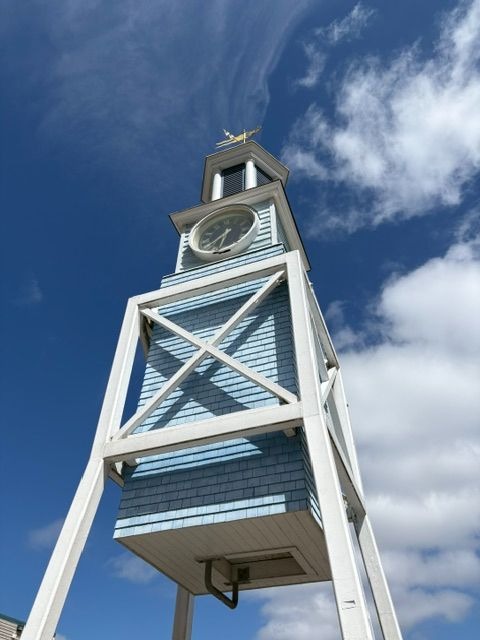
The clock originally occupied the cupola of the dockyard’s sail loft, later known as the Hauser Stores. This building belonged to the early Royal Navy establishment that helped make Halifax an important naval port. Positioned above the working yard, the clock provided a shared reference for time amid the daily business of maintaining ships and preparing them for service. When the building was demolished in 1941, the clock was preserved and moved to the dockyard fire hall. It continued serving the naval community until 1993.
Its heritage value extends beyond its age. The handmade mechanism includes a nine-foot pendulum driven by a two-hundred-pound weight, while its bell bears the date 1797. These components reflect the craftsmanship required to build a large mechanical clock long before electric motors and electronic timekeeping. Halifax’s heritage designation recognizes both that workmanship and the clock’s survival as a rare physical remnant of the original naval dockyard.
In 1996, the Navy presented the clock to Halifax Regional Municipality as a tribute to the relationship between the naval service and the surrounding community. Its refurbished cupola was mounted within a new supporting structure at the foot of George Street, near the ferry terminal. The relocation brought an object once associated with a military workplace into a public waterfront setting, preserving its connection to the harbour while making it accessible to residents and visitors.
Read More From Nancy
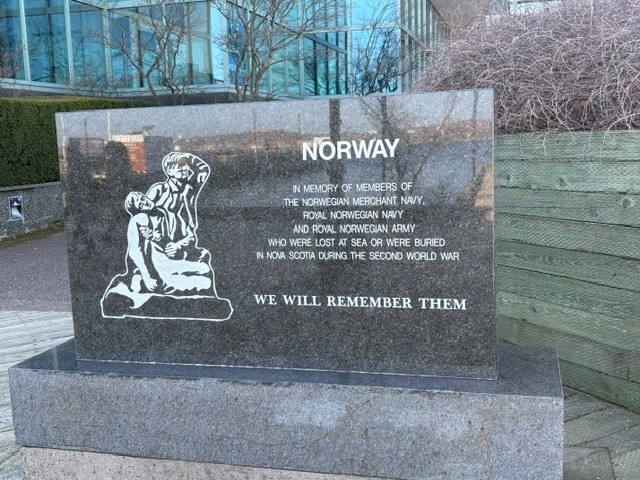
Norwegian Memorial
On Halifax’s waterfront, the Norwegian Memorial honours members of Norway’s Merchant Navy, Royal Navy and Royal Army who were lost at sea or buried in Nova Scotia during the Second World War. Unveiled on November 11, 1998, the monument commemorates a wartime connection between two countries separated by the Atlantic. Its stone, larvikite, was brought […]

Joseph Howe Monument
The Joseph Howe monument honors a Halifax-born journalist and political reformer whose work helped shape Canadian public life. Created by sculptor Louis-Philippe Hébert and erected in 1904, the bronze figure portrays Howe standing with one arm extended, recalling his reputation as a persuasive public speaker. His name is carved into the tall stone pedestal beneath […]

Sitamuk Kjipuktuk Cultural Post
On Halifax’s waterfront, the Sitamuk Kjipuktuk Cultural Post provides a place for Mi’kmaw and other Indigenous artists to share and sell their work. Developed by the Mi’kmaw Native Friendship Centre as a social enterprise, the post connects cultural expression with economic opportunity, bringing Indigenous art and craftsmanship into one of the city’s most visited public […]

