The Halifax Town Clock
On the eastern slope of Citadel Hill, the Halifax Town Clock overlooks Brunswick Street and the downtown streets below. Its white tower, blue clock faces and copper dome form one of the city’s most recognizable landmarks. The clock began keeping time on October 20, 1803, providing a public reference for both the military garrison and Halifax’s residents.
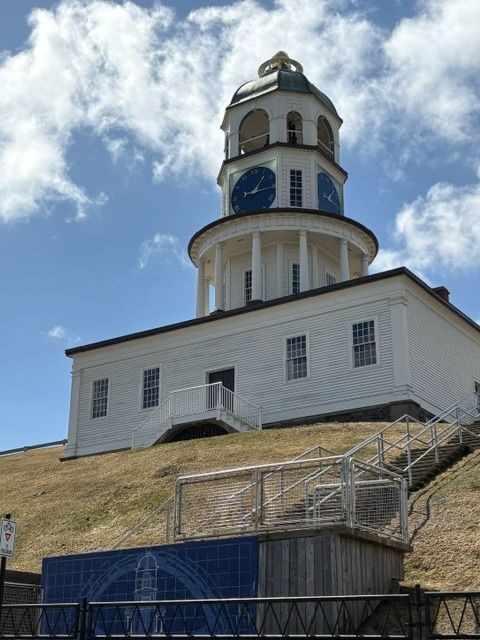
The project originated with Prince Edward, Duke of Kent, who commanded British forces in the region before returning to England in 1800. Concerned with punctuality, he instructed his engineer to prepare plans for a large clock that soldiers and townspeople could consult. The mechanism was made in London by the House of Vulliamy, a family of royal clockmakers, and shipped to Halifax for installation.
The building gave that practical purpose a distinctive architectural form. A symmetrical rectangular base supports a tower arranged in three stages: an open colonnade, an octagonal clock storey and an arcaded upper section beneath the dome. Classical proportions and white wooden cladding create a light appearance, while its elevated position makes the clock visible from the streets below.
Inside, the timepiece works through a system of suspended weights, cables and drums. Winding raises the weights; their gradual descent turns the drums and powers the mechanism. Parks Canada maintains the original clockworks and winds them twice weekly to reduce stress on the machinery. This continuing care preserves a working piece of early nineteenth-century craftsmanship.
The surrounding structure has required substantial renewal. Between 1960 and 1962, it was largely reconstructed to reproduce the earlier building while retaining the historic mechanism. Its heritage value therefore includes both the original timepiece and an important chapter in Halifax’s conservation history. The familiar tower preserves the appearance of the 1803 landmark, while the clock within it continues the task for which it was commissioned.

Read More From Nancy
William Annand
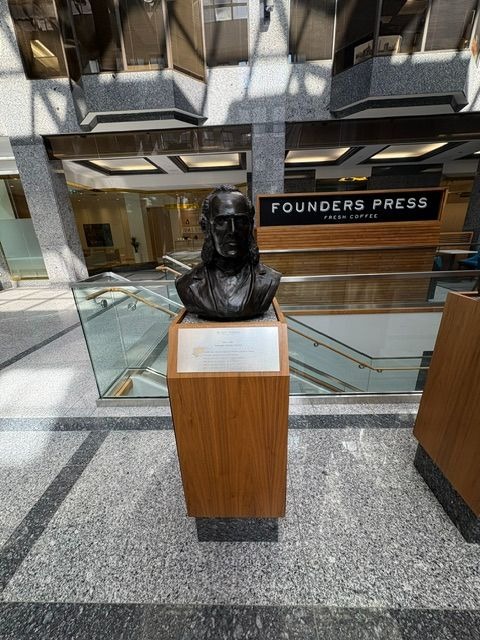
A portrait bust in Halifax’s Founders Square commemorates William Annand, a newspaper publisher and political leader whose career spanned Nova Scotia’s struggle for responsible government and its contested entry into Confederation. Born in Halifax in 1808, Annand was first elected to the provincial House of Assembly in 1836, where he supported demands for a government […]
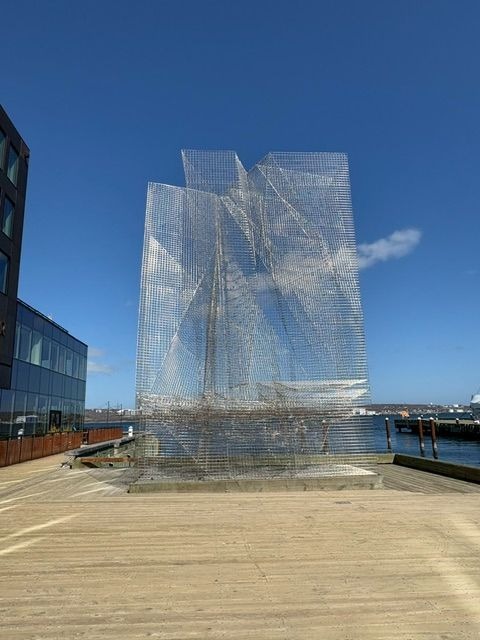
Sail
At the foot of Prince Street on Halifax’s waterfront, a ship appears to rise from a lattice of metal and light. Sail, by Italian artist Edoardo Tresoldi, is a twenty-foot-high wire-mesh sculpture at Queen’s Marque. Its transparent form evokes a ghost ship, recalling the vessels that once filled the harbour while allowing the present waterfront […]
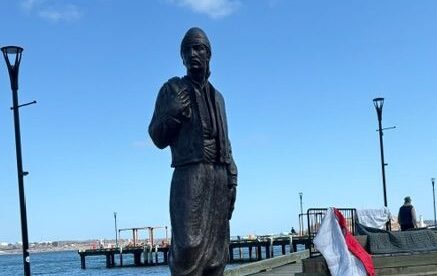
The Lebanese Emigrant Statue
On Halifax’s waterfront, a bronze figure honours the Lebanese emigrants who crossed the ocean to establish new lives in Nova Scotia. Installed in September 2018, the Lebanese Emigrant Statue recognizes their pioneering spirit and the contributions of generations of Lebanese Canadians to the province’s communities, businesses and professions. Lebanese migration to Nova Scotia began in […]

