Norwegian Memorial
On Halifax’s waterfront, the Norwegian Memorial honours members of Norway’s Merchant Navy, Royal Navy and Royal Army who were lost at sea or buried in Nova Scotia during the Second World War. Unveiled on November 11, 1998, the monument commemorates a wartime connection between two countries separated by the Atlantic. Its stone, larvikite, was brought from Norway, and its reverse records the names of Norwegians buried in Nova Scotia cemeteries.
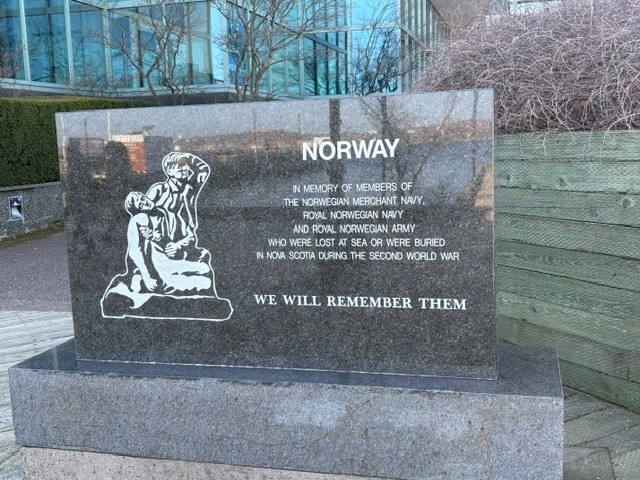
When Germany invaded Norway in April 1940, Norwegian merchant ships outside the country became an essential resource for the Allies. Norway’s government in exile organized their operation through the Norwegian Shipping and Trade Mission, known as Nortraship. These vessels carried fuel and supplies to Britain, sustaining a country heavily dependent on overseas shipping. The work came at a devastating cost: nearly 4,000 Norwegian merchant seamen died during the war.
Halifax became an important centre for these displaced sailors. In the spring of 1940, Norway’s Antarctic whaling fleet arrived with approximately 2,000 men aboard. Norwegian naval and shipping offices, a hospital, a seamen’s church and a club were established in the city. For men whose homeland was under occupation, Halifax provided a place to receive care, await orders and prepare for further service.
The memorial brings that history back to individual lives. The names on its reverse include men buried in Halifax, Sydney and Lunenburg, some still in their teens when they died. Others commemorated by the monument were lost at sea. Beside the harbour from which Norwegian sailors departed, the stone gives a permanent place of remembrance to men whose service carried them far from home.
Read More

Read More From Nancy
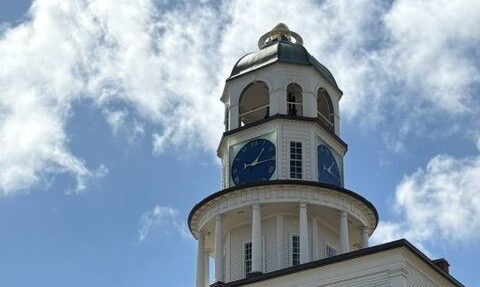
The Halifax Town Clock
On the eastern slope of Citadel Hill, the Halifax Town Clock overlooks Brunswick Street and the downtown streets below. Its white tower, blue clock faces and copper dome form one of the city’s most recognizable landmarks. The clock began keeping time on October 20, 1803, providing a public reference for both the military garrison and […]
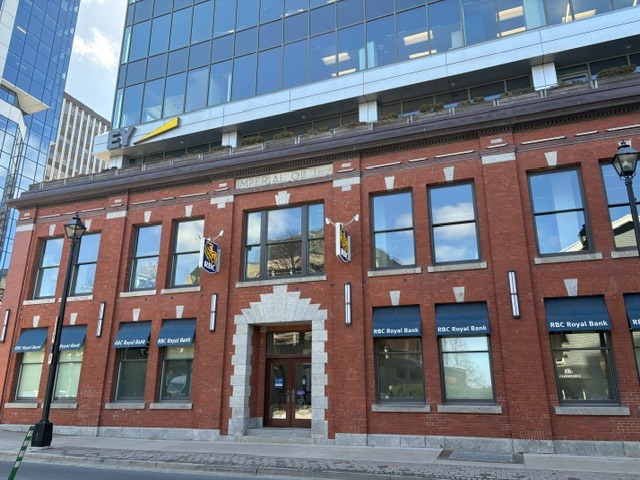
The Imperial Oil Building
At the corner of Duke and Upper Water Streets, the Imperial Oil Building records a twentieth-century chapter in Halifax’s waterfront commerce. Completed in 1926, the two-storey brick building provided office space for Imperial Oil Limited. The company’s name, carved above the central entrance, preserves its original identity. The property’s history reaches further back. It was […]
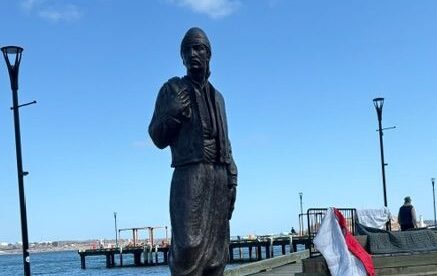
The Lebanese Emigrant Statue
On Halifax’s waterfront, a bronze figure honours the Lebanese emigrants who crossed the ocean to establish new lives in Nova Scotia. Installed in September 2018, the Lebanese Emigrant Statue recognizes their pioneering spirit and the contributions of generations of Lebanese Canadians to the province’s communities, businesses and professions. Lebanese migration to Nova Scotia began in […]

