Movement and Reflexes
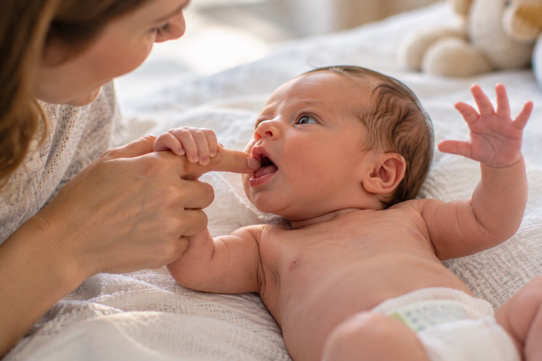
Babies are born with automatic responses called primitive reflexes. These early reflexes support important activities such as feeding, responding to touch, and reacting to sudden changes in position. They give us a glimpse into how the newborn nervous system functions before a baby has developed more intentional control of movement.
You may recognize some of these responses without knowing their names. Touching a newborn’s cheek can prompt them to turn toward that touch and open their mouth. This is the rooting reflex that helps them find the breast or bottle. Placing a finger against their palm may bring an immediate grasp. A sudden change in support can produce the familiar Moro response, with the arms extending and then drawing inward.
As parents, these responses can be fascinating to watch. As chiropractors and educators, we also appreciate what they reveal about early development. A newborn’s grasp around our finger feels like a moment of connection, even while we understand that the initial response is automatic.
As the nervous system develops, many of these early responses gradually become less prominent, while more organized and intentional movements emerge. The hand that initially closes reflexively around a finger eventually reaches toward a chosen toy. That change reflects the growing ability to bring attention, sensation, and movement together.
Think about the progression from lifting the head to rolling, sitting, moving across the floor, standing, and walking. Each emerging ability gives a child new opportunities to experience the world. Their view changes, their reach expands, and they gain more choices about where to direct their attention.
During awake, supervised tummy time, a baby practices lifting and turning their head and supporting their body against gravity. These experiences help build the strength and control needed for later movement. Getting down at their level, talking to them, and offering short opportunities to practice can make this part of your time together.
When babies roll, they begin coordinating movement across different parts of their bodies. When they reach, grasp, and explore, they gather information about distance, texture, position, and movement. A toy just beyond their hand offers something to look toward and attempt to reach. Their repeated efforts are part of learning and building a healthy neurological foundation even before they succeed to complete the action.
Watching our own daughters helped us appreciate those attempts. It was easy to celebrate the first completed roll or the first steps. We also learned to value what came before: the shifting of weight, the reaching, and the pauses as they worked out what to do next.
Reflexes are one part of that larger picture. Their interpretation belongs within a developmental assessment, alongside the child’s history, movement, and other abilities. Parents do not need to provoke or test reflexes at home; everyday observation provides useful information.
This is why developmental milestones deserve our attention. They give us more than dates for a chart or baby book. They help us understand how a child’s nervous system is maturing and how we can provide time, space, and support for the learning already underway. Understanding these developmental stages help set the stage for those touchstones and turning points that will shape the rest of their lives.


Read More From Nancy

Every Journey Shapes a Child
Looking at this photograph of our family in Florence brings back so many wonderful memories. Like so many of our travels, this trip wasn’t simply about seeing famous places. t was about experiencing the world together. We explored museums, walked ancient streets, crossed historic bridges, discovered new cultures, and shared countless conversations along the way. […]
Birth: The Beginning of Your Child’s Neurological Journey
When I think about my pregnancies and the birth of my children, I remember their first cries, the first time I held each of them, and the realization that our lives had changed forever. But with each birth, something equally extraordinary was happening within their developing nervous systems. I was in professional school during my […]
Like Every Mother
Like every mother, I watched my children closely. I noticed how they slept.How they nursed.How they rolled.How they cried and laughed and smiled. Sometimes things were “just a phase” and sometimes they were not. That is why our book: It’s All in the Head feels so personal to me. Over years, Marty and I have […]

