Crazy Horse Memorial
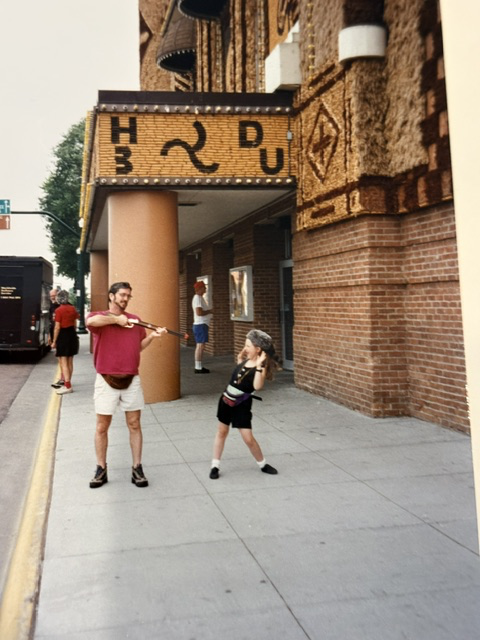
We visited Crazy Horse Memorial during our family travels about thirty years ago. One of the things we learned was that this enormous undertaking was supported through private donations and visitor admissions, without federal or state funding. It was a project intended to honor Crazy Horse, an Oglala Lakota leader, and to create a lasting place for Native American history and culture.
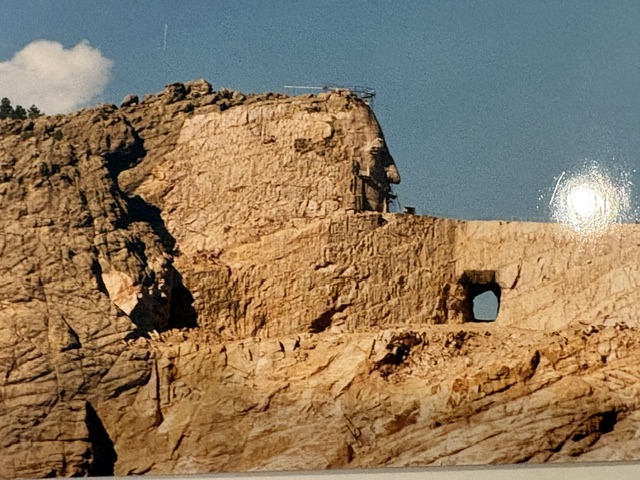
The memorial began with the determination of Henry Standing Bear, a Lakota elder who wanted Native American heroes represented in the Black Hills. He invited sculptor Korczak Ziolkowski to create a monument to Crazy Horse. Their vision extended beyond a mountain carving to include a museum and educational opportunities. Work on the mountain formally began with the first blast on June 3, 1948.
Crazy Horse was known for his leadership in defending his people’s land and way of life against expanding United States settlement and military pressure. In 1876, he helped lead the forces that defeated General George Crook at the Battle of the Rosebud and participated in the Battle of the Little Bighorn. The following year, with food supplies diminishing and military pressure continuing, he surrendered. He died at Fort Robinson in September 1877.
The proposed sculpture depicts Crazy Horse on horseback, with an arm extended toward the land. The model helped us understand the intended composition, while the mountain revealed the extraordinary amount of work required to achieve it. Rather than adding material, the sculptors had to remove immense quantities of rock while preserving what would become the figure.
Progress continued across generations. Korczak died in 1982, and his wife Ruth took responsibility for continuing the project with members of their family. She shifted the immediate emphasis from the horse’s head to Crazy Horse’s face, which was dedicated on June 3, 1998, fifty years after the first blast. Our photographs preserve an earlier stage in that long process.
The memorial’s broader mission includes the Indian Museum of North America and the Indian University of North America, connecting the carving with cultural preservation and education. The mountain is one part of an undertaking intended to support living communities as well as commemorate the past.