Homestake Mining Company Compressed-Air Locomotive
During one of our family trips through the West, we stopped in Lead, South Dakota, a town whose history is inseparable from the Homestake Gold Mine. Here Emily and Erin are standing beside one of the unusual locomotives used by the Homestake Mining Company. At first glance it looks a little like a steam locomotive without its smokestack, but the large, riveted cylinder tells a different story. This locomotive was powered not by steam, but by compressed air.
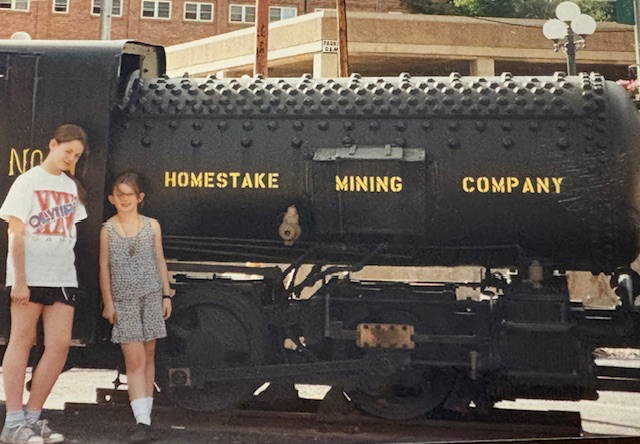
Compressed-air locomotives were particularly well suited to mining. Instead of carrying a fire and burning fuel, the locomotive carried highly compressed air in its large cylindrical tank. As the air was released, it powered the engine and moved the locomotive along its narrow-gauge tracks. With no fire, smoke or combustion exhaust, these engines offered obvious advantages in and around mining operations, where ventilation and fire were constant concerns.
Homestake used locomotives like these as part of an enormous transportation system. Ore had to be moved from the mine to the mills, while equipment and supplies continually traveled through an industrial operation that grew far beyond the image of an individual prospector searching for gold. These compact locomotives were built to pull heavy loads over narrow-gauge tracks and work in spaces where conventional railroad equipment could not.
The mine they served had begun during the Black Hills gold rush. Gold was discovered in the area in 1876, and in 1877 mining entrepreneur George Hearst and his partners purchased the Homestake claim. Hearst, the father of future newspaper publisher William Randolph Hearst, recognized that extracting the area’s gold would require capital, machinery and large-scale organization. Homestake developed into one of the greatest gold-mining enterprises in American history.
The mine transformed Lead. Generations of families depended upon it, and the company became central to the economic and social life of the community. Beneath the town, miners followed the ore increasingly deeper into the earth. Eventually the underground workings reached more than 8,000 feet below the surface. During more than a century of operation, Homestake produced roughly 40 million troy ounces of gold.
Homestake continued operating until 2002, making it one of the longest-lived major gold mines in the United States. But closing the mine did not end the story of what lay beneath Lead.
Its tremendous depth offered something scientists wanted: protection from the cosmic radiation constantly reaching Earth’s surface. Beginning in the 1960s, physicist Raymond Davis Jr. conducted a pioneering experiment deep inside Homestake to detect neutrinos produced by the sun. His work helped transform our understanding of particle physics and contributed to his receiving a share of the 2002 Nobel Prize in Physics.
Today the former Homestake site is home to the Sanford Underground Research Facility, where researchers continue experiments deep beneath the Black Hills. The underground world created in the search for gold has become a place for investigating neutrinos, dark matter and some of the fundamental questions about the universe.
That makes this strange little locomotive a wonderful piece of a much larger story. Its massive air tank and narrow wheels were designed for the practical problem of moving material through a gold mine. Yet the mine it served would operate for more than 125 years, help build an entire community and eventually provide scientists with a laboratory thousands of feet beneath the earth.
When Emily and Erin stood beside this Homestake locomotive, they were standing beside a machine from an earlier industrial world—one created to help people search deep beneath the Black Hills for gold.