The Louvre Museum
The exterior of the Louvre reveals the long history of a building that was never created according to a single plan. Its courtyards, wings, pavilions and richly ornamented façades developed over centuries as successive rulers altered and expanded the structure to reflect their own needs and ambitions.
The story began around 1190, when King Philip II ordered the construction of a fortified castle near the Seine. Positioned along the western edge of medieval Paris, the fortress was intended to protect the city from attack. Its thick walls, defensive towers and central keep bore little resemblance to the palace that stands today.
During the fourteenth century, Charles V transformed the fortress into a royal residence. A more dramatic change began under Francis I, who ordered the medieval keep demolished in 1528 and began replacing the old defensive complex with a Renaissance palace. Later monarchs continued the work, creating an increasingly elaborate royal residence and connecting the Louvre with the nearby Tuileries Palace.
When Louis XIV moved the royal court to Versailles in 1682, the Louvre ceased to serve as the principal residence of the French monarchy. Parts of the palace were used by artists, scholars and royal academies. Following the French Revolution, the Louvre opened as a public museum in 1793, allowing works once associated with the monarchy to become part of a national collection.
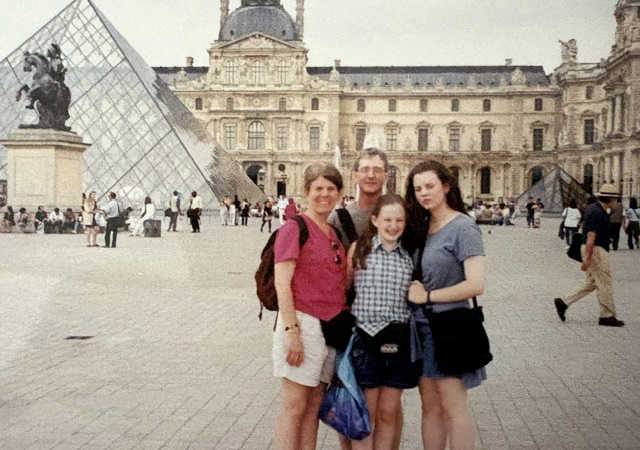
The most striking modern addition appeared nearly two centuries later. As part of President François Mitterrand’s Grand Louvre project, Chinese American architect I. M. Pei was selected to redesign the museum’s central entrance. His glass-and-metal pyramid opened in 1989 in the Cour Napoléon.
The pyramid created a spacious underground entrance from which visitors could reach the museum’s different wings. Its transparent geometric form also introduced a deliberate contrast with the sculpted stone façades of the former royal palace. Initially controversial, it gradually became one of the most recognizable architectural landmarks in Paris.
The Louvre’s exterior now brings together the remains of a medieval fortress, the grandeur of a royal palace, the symbolism of a national museum and the innovation of modern architecture. Its buildings record more than eight centuries of change while continuing to serve as the entrance to one of the world’s most extensive collections of art and history.