Sandwich Town Hall
Standing prominently in the center of Sandwich, the Town Hall represents an important change in the relationship between religion and government in Massachusetts. Before it was constructed, Sandwich conducted its civic business in the Congregational meetinghouse, where religious services and town meetings took place beneath the same roof. This arrangement had been common throughout colonial New England, where the church and local government were closely connected.
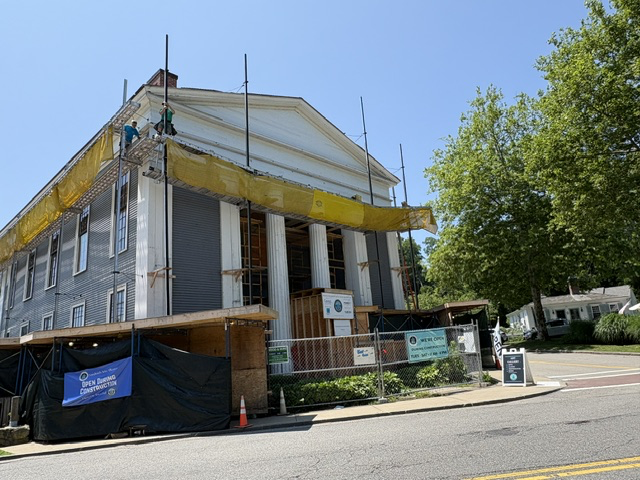
That began to change in 1833, when Massachusetts voters approved an amendment formally ending the state-supported religious system and strengthening the separation of church and government. The following year, Sandwich authorized the construction of a building devoted specifically to civic affairs. Completed in 1834, Sandwich Town Hall became one of the earliest purpose-built town halls in Massachusetts. Its location near the First Church of Christ makes the transition especially visible: the church and the town government remained neighbors, but they now occupied separate buildings and served distinctly different purposes.
Master builder Ellis Howland constructed the two-story building in the Greek Revival style, an architectural form frequently chosen for public buildings in the young American republic. Its symmetry, triangular pediment and two massive cypress columns reflected the architecture of ancient Greece and the democratic principles associated with it. The building was designed to accommodate as many as 500 people, with government and commercial spaces on the first floor and a large public meeting hall above.
During a major restoration that began in 2009, preservationists discovered that the original entrance doors were still in place. Written in chalk across them was the name of Solomon C. Howland, the son of Ellis Howland, who had made the doors in 1834. The project also preserved the original ceiling beams, restored the nineteenth-century decorative stenciling in the upper hall and repaired the stage and later additions. In 2011, the Massachusetts Historical Commission recognized the restoration with a Preservation Award.
Sandwich Town Hall has continued to serve as the seat of local government since its completion. It is therefore more than a carefully preserved nineteenth-century building. It remains a working part of the community, carrying forward the civic purpose for which it was constructed nearly two centuries ago. Its survival allows us to see how a major constitutional change was expressed at the local level through a community’s decision to create a separate and permanent home for representative government.
Read More From Nancy
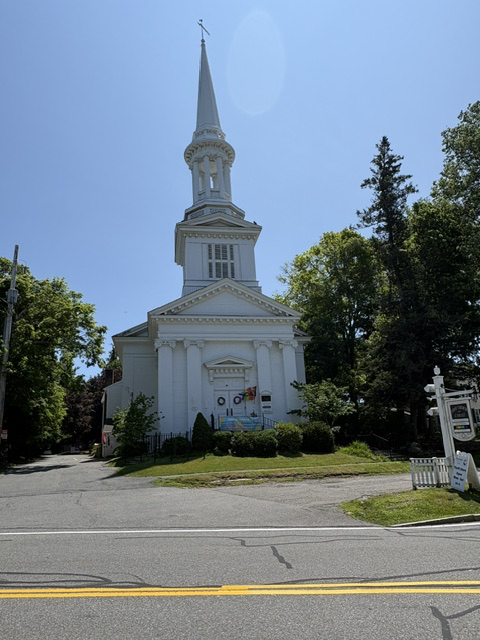
First Church of Christ
Standing prominently in the center of Sandwich is the First Church of Christ, its tall white steeple visible above the surrounding village. The building I photographed dates to 1848, but the Congregational tradition it represents reaches much further back into the earliest history of Sandwich. The first English settlers arrived in Sandwich in 1637, and […]
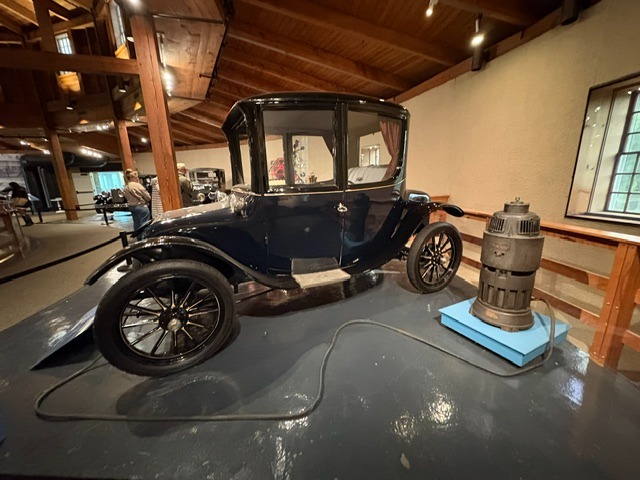
The 1917 Milburn Light Electric
The 1917 Milburn Light Electric at Heritage Museums & Gardens preserves a chapter of motoring that can seem surprisingly familiar. More than a century ago, manufacturers were already addressing questions about battery charging, convenience, and how electric vehicles could fit into daily life. Built by the Milburn Wagon Company of Toledo, Ohio, this automobile has […]
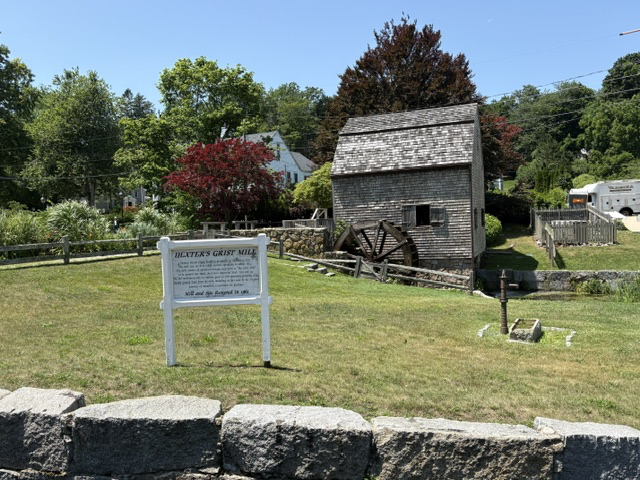
Dexter’s Grist Mill
Standing beside Lower Shawme Pond, Dexter’s Grist Mill preserves the story of one of the earliest and most essential industries in Sandwich. Thomas Dexter began developing a mill at this location soon after the town was settled in 1637. The mill seen here began operating around 1654, using the flowing water from Shawme Pond to […]

