Saint John Coat of Arms
Mounted high upon the wall inside the Saint John City Market is the city’s historic coat of arms. Surrounded by two antlered moose and topped by a crown, the emblem brings together symbols representing the natural resources, maritime industries, and British institutions that shaped Saint John.
The shield is divided into sections containing images associated with the city’s early economy. The sailing ship represents Saint John’s harbor, its connection to international trade, and the shipbuilding industry that became one of the foundations of its nineteenth-century prosperity. The fish refers to the waters of the Bay of Fundy and the importance of fishing, while the trees recall the forests of New Brunswick and the timber trade that supplied both local shipyards and overseas markets.
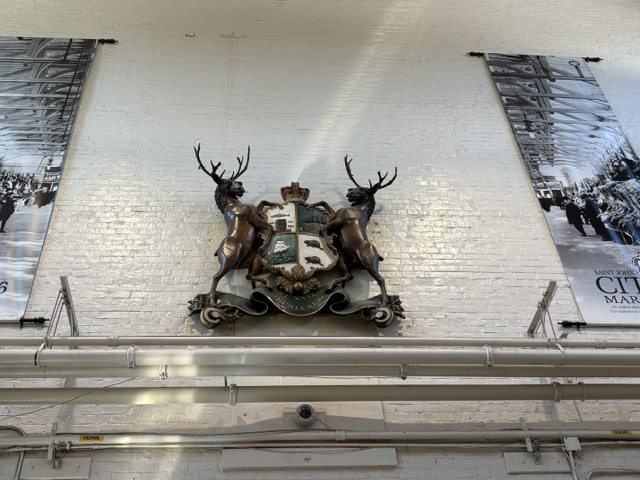
The two moose supporting the shield represent the wildlife and forests of New Brunswick. Above the shield is a crown, reflecting Saint John’s establishment under British authority. The city was incorporated by royal charter in 1785, uniting the settlements of Parrtown and Carleton on opposite sides of the harbor and making Saint John the first incorporated city in what is now Canada.
Beneath the shield appears the Latin motto “O Fortunati Quorum Jam Moenia Surgunt.” Drawn from Virgil’s Aeneid, it is commonly translated as “O fortunate ones, whose walls are now rising.” In the poem, the words are spoken as Aeneas looks upon the construction of a new city. The motto would have carried particular meaning for the Loyalists who arrived after the American Revolution and began constructing a new community at the mouth of the Saint John River.
Its placement inside the City Market is appropriate. Public markets had been part of Saint John since the city received its charter in 1785, and the present market building has served the community since 1876. The coat of arms overlooks a space where the city’s maritime connections, local products, commerce, and civic traditions continue to come together.
Read More From Nancy
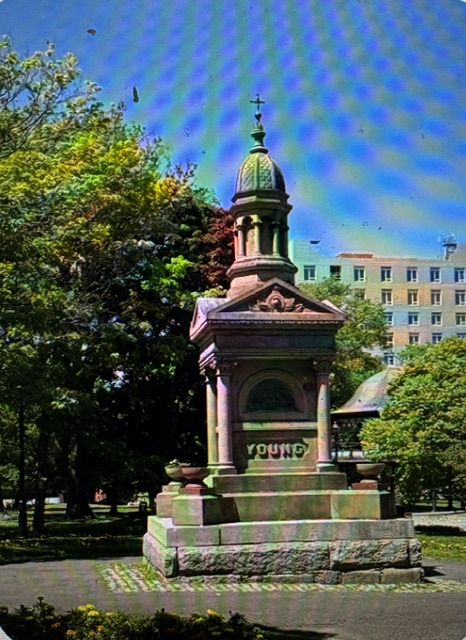
Young Memorial
The Young Memorial in King’s Square remembers an ordinary young man whose final act became part of Saint John’s civic history. John Frederick Young was only nineteen years old when he drowned in Courtenay Bay in 1890 while attempting to rescue ten-year-old Frederick E. “Freddie” Mundee. Young was a factory worker who had come to […]
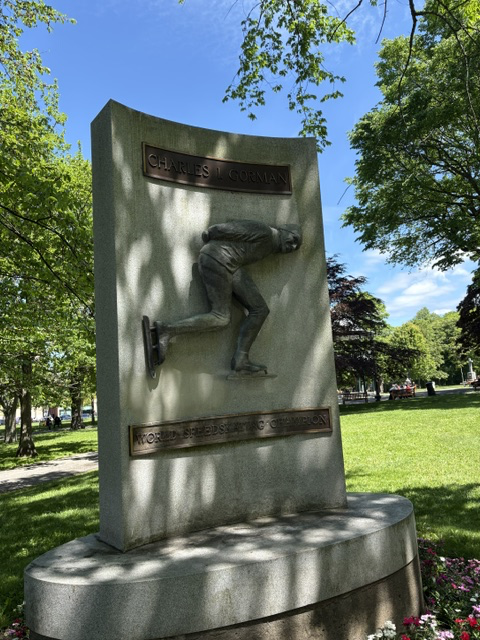
Charles Gorman Memorial
The figure on this monument is not shown standing triumphantly on a podium. Instead, Charles Gorman is captured at the beginning of a race with his body bent forward, one skate braced behind him, and every muscle prepared for the explosive first stride that made him one of the fastest skaters of his generation. Born […]
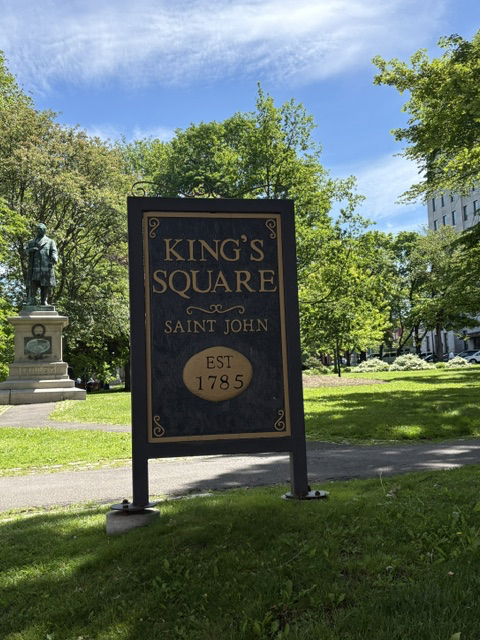
King’s Square
At the center of Uptown Saint John is King’s Square, a public space that has served the city since its earliest years. Named for King George III, the land was granted to Saint John through the royal charter that incorporated the city in 1785. Its history therefore began alongside that of Saint John itself, which […]

