William Lloyd Garrison Memorial
I love walking along Commonwealth Avenue in Boston and stopping at the different sculptures and memorials placed along its tree-lined central mall. Each one introduces another person or event connected with the city’s history. Among them is the seated bronze figure of William Lloyd Garrison, one of the nation’s most influential voices against slavery.
Born in Newburyport, Massachusetts, in 1805, Garrison became a journalist, reformer, and uncompromising abolitionist. In 1831, he began publishing The Liberator in Boston, using its pages to demand the immediate abolition of slavery. Two years later, he helped establish the American Anti-Slavery Society. His outspoken position brought threats and public opposition, but he continued publishing until slavery was abolished in 1865.
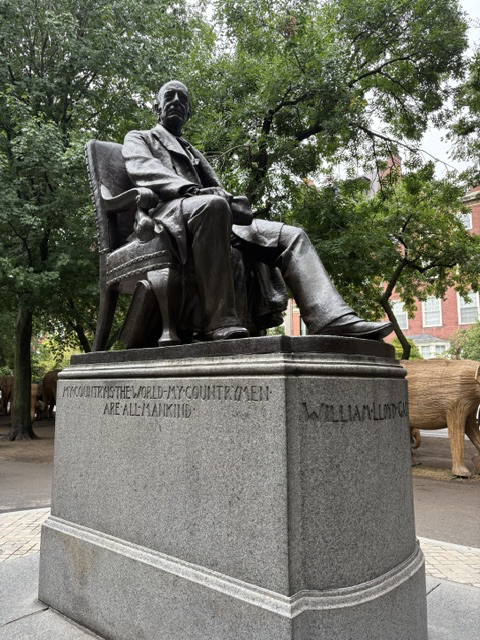
The bronze memorial was created by sculptor Olin Levi Warner and dedicated in 1886. Garrison is portrayed seated in a chair, appearing thoughtful but resolute. Inscribed on the monument are words that express the principles that guided his work: “My country is the world; my countrymen are all mankind.” Another side carries his declaration that he would not retreat “a single inch” and would be heard.
Walking Commonwealth Avenue offers more than an opportunity to enjoy one of Boston’s most beautiful public spaces. Its monuments turn an ordinary walk into an encounter with the people and ideas that shaped the city and the nation. Stopping before Garrison’s memorial is a reminder that some of the most important changes in history began with individuals willing to speak when silence would have been easier.
Read More From Nancy
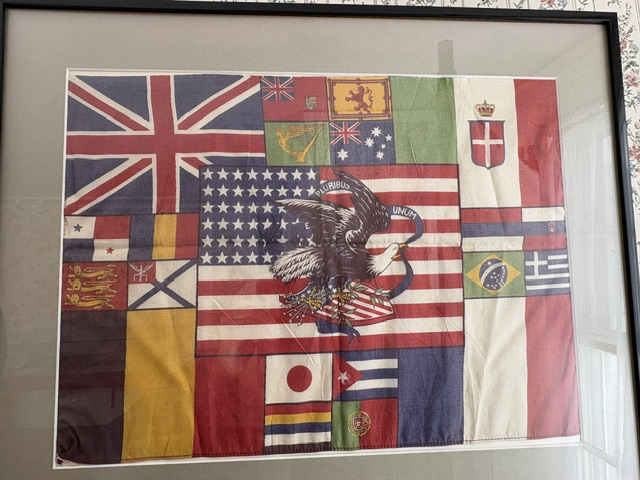
The 1917 Allies Flag
This unusual silk flag, preserved by the Needham History Center & Museum, tells a story not only about World War I, but about how Americans were encouraged to understand the nation’s entry into the conflict. By 1917, Europe had already been at war for nearly three years. The United States had remained officially neutral, but […]
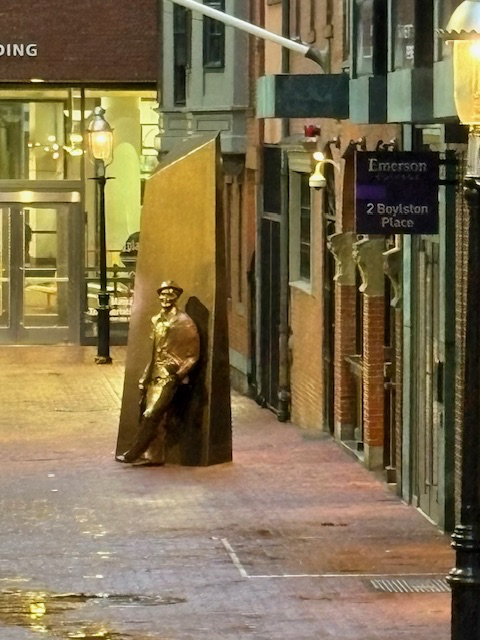
Norman Lear Statue
Heading back to our car, I stopped to grab this photo in the alley near Emerson College. It is one of those narrow Boston passageways that I might have easily walked past without a thought but tucked into this space is something special: a life-size bronze statue of Norman Lear. Lear attended Emerson in the early 1940s, enrolling […]
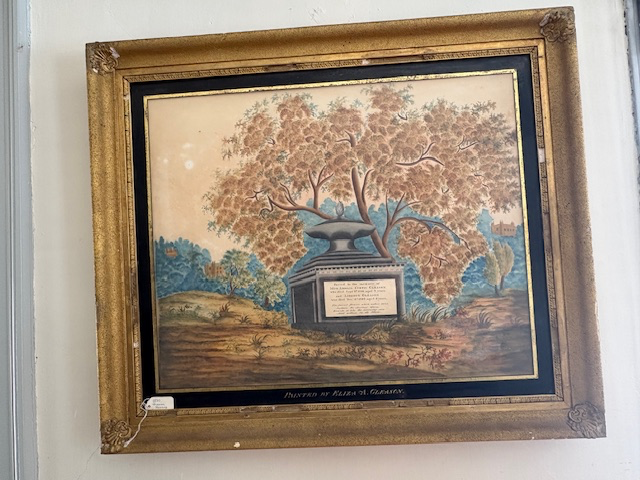
Mourning Painting
One of the unexpected discoveries during our visit to the Dedham Museum was this small watercolor known as a mourning painting. At first glance, it appears to be a peaceful landscape—a willow tree shading a funerary urn and memorial tablet. Looking more closely, however, it becomes a deeply personal expression of love and loss. The […]

