Wartime Rails
July 6, 1944Dearest Reader,
On Thursday, July 6, 1944, my grandmother sat at her typewriter once again to write to my father. It seems she wrote every day with letters mixed of small local happenings, the weather and some words of advice for her only son. In this letter her daily life intersects with the larger rhythm of a country at war.
She was anxious for news about his discharge, writing: “I am most anxious to know”
She wanted to travel to Boston to say goodbye to a man named Dick but hesitated. She worried that leaving Martinsburg might cause her to miss word of her son’s release. Even more, she was uncertain if she would be permitted to travel at all:
“The government has issued an order to the railroads to dump any civilian off the train or to take over whole train any time they need the facilities to move wounded man, or troops, and of course, that’s as it should be.”
Her words offer a window into wartime America, when even a mother’s wish to visit a friend or relative was bound by the necessities of war.
By mid-1944, the railroads were the arteries of the American war effort. Every major line was mobilized for military use. The Office of Defense Transportation, established in 1942, coordinated this vast system to move troops, supplies and the wounded coming home from overseas.
Train schedules changed without notice with civilians often left behind at stations. My grandmother’s acceptance of this: “and of course, that’s as it should be” reflects both her practicality and her sense of patriotic duty.
Across the country, hospital trains became a familiar sight. These rolling wards carried men to hospitals like the Fort Geroge Wright in Spokane, Washington, where my father was recovering. Converted passenger cars held rows of stretchers instead of seats. Between 1942 and 1945, more than a million wounded servicemen were transported across the United States this way.
My grandmother’s words remind me that even those far from the battlefields lived under the constant presence of war. We know that these trains rolling past would be just one sign of the weight of a nation’s sacrifice.
Dr. Nancy Watson
Rambling With Nan
Washington
Read More From Nancy
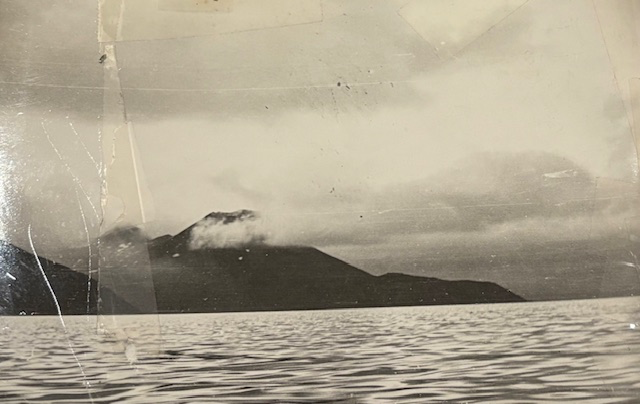
Eider Point on Unalaska Island – Aleutian Island
This photograph my father sent home is of water, land and sky and without the words on the back, I would not know where this was located. My father wrote on the back: “LOOKING FROM ISLAND AMAKNAK, DUTCH HARBOR ACROSS TO EIDER POINT ON UNALASKA ISLAND, EIDER POINT KNOWN AS FORT LEANARD OF “B” BTRY 264 CA” […]
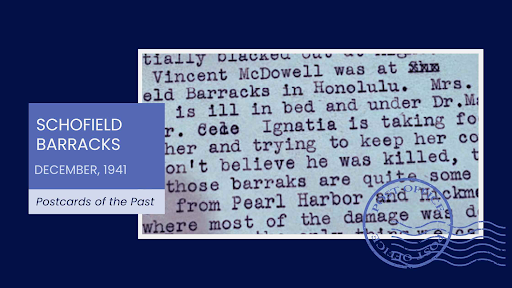
Schofield Barracks
Schofield Barracks sits in the center of Oahu, inland from the coast. Established in 1908 and named for Lt. Gen John M Schofield, the post was deliberately placed away from the shoreline to function as a permanent U.S. Army installation. It was designed for training, housing and command and not for naval operations. By 1941, Schofield […]
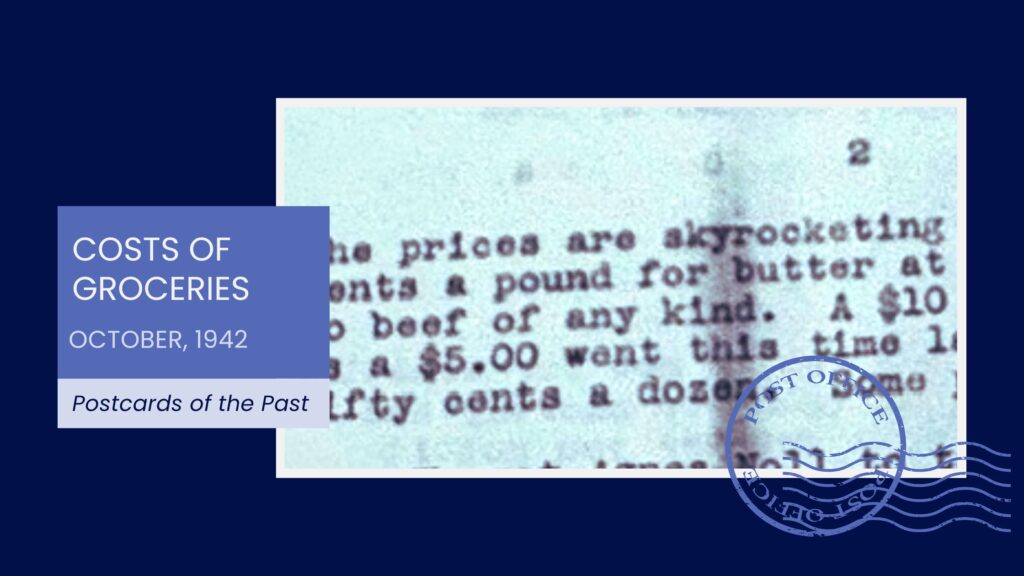
Costs of Groceries
In October 1942, as my father was stationed in Washington State, my grandmother wrote to him describing how profoundly life on the home front had changed. Her letter reflects a nation fully mobilized for war, where shortage, rationing and rising prices had become part of everyday reality. What she shared was not abstract, but lived […]

