Titanic Belfast
While we were in Belfast, Erin and I visited Titanic Belfast. Like most people, I already knew the story of the Titanic’s maiden voyage, the iceberg, and the terrible loss of life in April 1912. What I had never fully appreciated was how much of the story belonged to Belfast. Visiting the museum took us back before the tragedy and introduced us to the city, the shipyard, and the thousands of people who created what was then one of the most extraordinary ships in the world.
By the beginning of the 20th century, Belfast had become one of the great industrial cities of the world, and shipbuilding was central to its success. Harland & Wolff had grown from a relatively small operation into an enormous shipyard employing thousands of workers. It was here that the White Star Line’s three great Olympic-class liners: Olympic, Titanic, and Britannic, were constructed.
The Titanic was not simply assembled in Belfast. She was conceived, designed, engineered, and built here. The Harland & Wolff Drawing Offices, where Titanic and hundreds of other ships were designed, still survive nearby. Enormous slipways had to be reconstructed to accommodate Titanic and her sister ship Olympic, and a massive steel gantry was erected above them to allow workers to reach the increasingly immense hulls.
That was one of the things the museum helped me understand. We tend to begin the Titanic story when the passengers boarded the ship, but thousands of individual stories had already taken place before a single passenger stepped aboard. There were designers and engineers, riveters and platers, carpenters and electricians, painters and laborers. Titanic represented not only the ambition of the White Star Line but the skill and industrial capacity of Belfast itself.
The location of the museum makes that history particularly powerful. Titanic Belfast doesn’t simply tell the story of a ship built somewhere else. The building stands at the head of the actual slipways where Titanic and Olympic were constructed and launched. Nearby are the Harland & Wolff Drawing Offices and Hamilton Graving Dock. You are standing within the landscape where the story began.
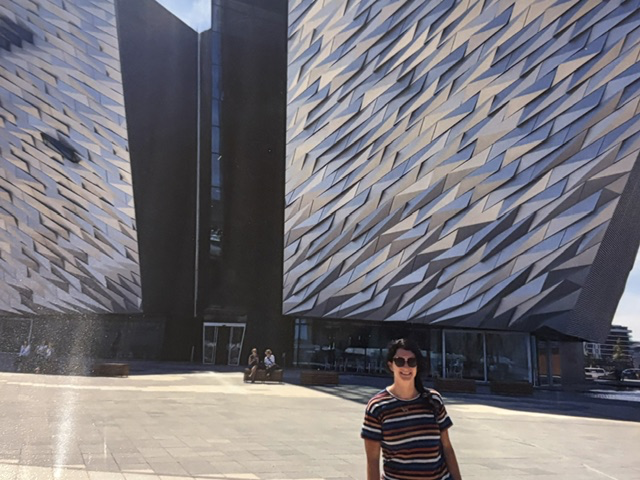
Even the museum building was designed to make us think about ships and the sea. Opened on March 31, 2012, just before the centennial of Titanic’s sinking, its four enormous projecting forms suggest the bows of ships. The architects incorporated other maritime references into the design, including water crystals and the emblem of the White Star Line. The exterior is covered with 3,000 folded silver-anodized aluminum panels, creating the striking, almost crystalline surface that we captured in our photograph.
Inside, the story begins with Belfast itself rather than with the disaster. The exhibits explore the city’s industrial growth and the shipbuilding industry before moving into Titanic’s design and construction. From there, the story follows the launch, fitting out of the ship, life aboard, the maiden voyage, the collision with the iceberg, the sinking, and eventually the discovery of the wreck on the floor of the North Atlantic.
There is something especially meaningful about learning history in the place where it happened. Erin and I weren’t simply visiting a museum containing exhibits about Titanic. We were walking through the former Harland & Wolff shipyard, looking at the ground from which Titanic first entered the water and learning about a Belfast whose workers once built some of the largest and most sophisticated ships in the world.