The Throne Room
There are certain rooms that immediately command your attention, not because of their size, but because every detail has meaning. The Throne Room at Rosenborg Castle is one of those places. It was designed not simply as a beautiful room, but as a visual statement of royal authority, where every object, color, and symbol reinforced the power and dignity of the Danish monarchy.
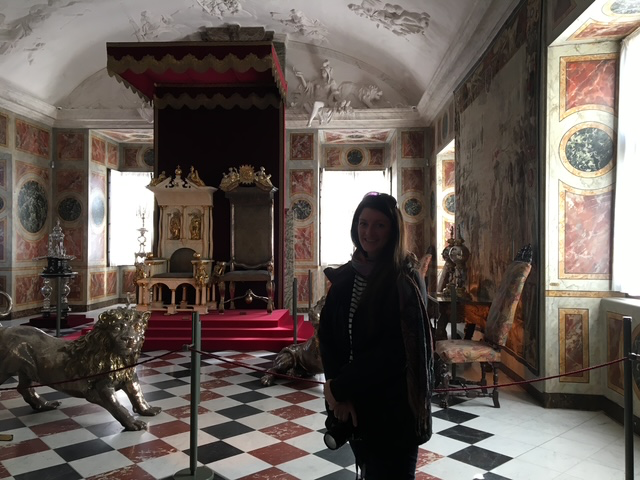
At the center of the room are Denmark’s Coronation Thrones, commissioned by King Christian V in the late seventeenth century following the establishment of absolute monarchy. Unlike ordinary royal furniture, these thrones were created specifically for the coronation ceremony. The King’s throne is made from narwhal tusk, a material once believed to be the horn of the mythical unicorn. In the seventeenth century, unicorn horns were thought to possess extraordinary powers of purity and protection, making narwhal tusk one of the most prized materials in Europe. Beside it stands the Queen’s silver throne, equally magnificent in its craftsmanship but intentionally distinct from the King’s.
Guarding the thrones are three life-sized silver lions, among the most extraordinary works of ceremonial art in Denmark. Inspired by the biblical description of King Solomon’s throne, the lions symbolize courage, wisdom, and justice. Their polished silver surfaces catch the light from the tall windows, making them appear almost alive as they watch over the empty seats of the monarchy. They are not merely decorative sculptures but enduring symbols of the Danish Crown itself.
The room surrounding the thrones is every bit as impressive. Richly painted walls imitate colorful marble, while Flemish tapestries soften the grandeur with scenes woven in remarkable detail. Above, the vaulted ceiling is decorated with elaborate stucco work that draws the eye upward, giving the room an elegance that balances its sense of authority. Together, these artistic elements transform the chamber into a stage upon which the ceremony of monarchy could unfold.
Although these are known as the Coronation Thrones, they were not used in the medieval tradition of placing the crown upon a monarch’s head. During Denmark’s period of absolute monarchy, the king had already been proclaimed ruler before entering the room. Here, he was presented to the nation seated upon the throne, emphasizing that his authority came directly from God rather than from the nobility or the church. After Denmark adopted a constitutional monarchy in 1849, the coronation ceremony was abolished, making these thrones remarkable survivors of an earlier era.
Standing quietly in the Throne Room, I was struck not only by its beauty but by its symbolism. Every object has a purpose. Every artistic choice reinforces the idea of kingship. Unlike many palace rooms that have changed repeatedly over the centuries, this chamber remains remarkably intact, allowing visitors to experience it much as ambassadors, nobles, and foreign dignitaries would have seen it more than three hundred years ago.
The Throne Room is a carefully preserved reminder of a time when architecture, art, and ceremony worked together to express the authority of the state. Today, it stands as one of the finest surviving royal ceremonial rooms in Europe, offering an extraordinary glimpse into the history and traditions of the Danish monarchy.