The Ship’s Store
Touring the ships at Battleship Cove, it was the ordinary spaces that often made me stop and look more closely. The enormous guns and machinery tell us what these ships were built to do, but places like this tell us what it was like to live aboard one.
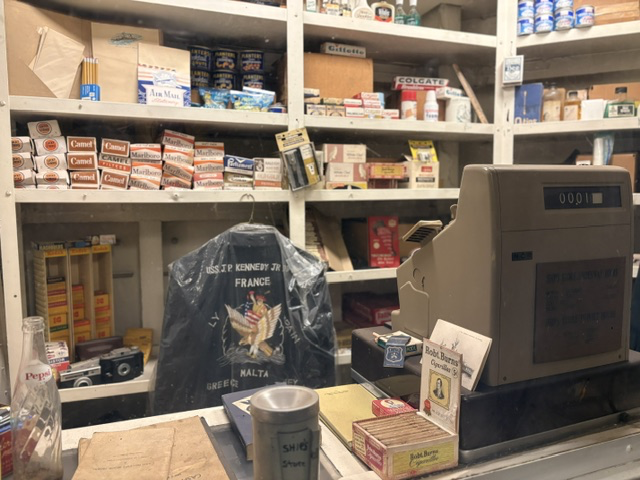
The ship’s store was a small piece of everyday life tucked inside a vessel built for war. Behind the counter are things we would recognize from any neighborhood store of the period—cigarettes, toothpaste, shaving supplies, candy, toiletries and other small necessities. For sailors who might spend weeks or months away from home, these weren’t insignificant conveniences. They were reminders of ordinary life.
A Navy ship had to function as its own small community. Hundreds or even thousands of sailors ate, slept, worked, received medical care, got haircuts, sent messages home and found whatever recreation was possible without leaving the vessel. The ship’s store helped provide the personal items that weren’t issued as part of a sailor’s standard equipment.
What I particularly like about this display is how familiar everything looks. The cash register sits on the counter. Merchandise fills the shelves. Small boxes and bottles wait behind the clerk just as they might have in a corner store ashore.
But this store could cross an ocean.
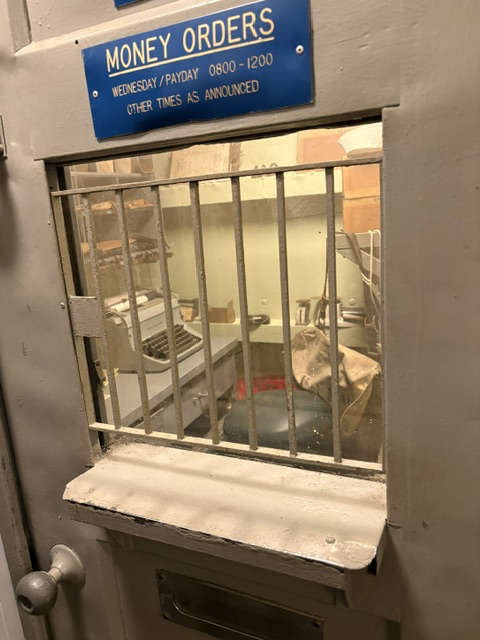
Nearby was another service that was particularly important to sailors far from home: the money-order window. Before electronic banking, ATMs and instant transfers, sailors needed a dependable way to send part of their pay home to wives, parents and families. The sign above the barred window announces that money orders were available on Wednesday—payday—from 0800 to 1200. Even that simple sign tells us something about life aboard ship. Military life was organized by schedules. There was a time to work, a time to eat, a time to sleep, a payday and even designated hours for sending money home.
It is easy to visit a historic battleship and concentrate on its size, weapons and wartime service. But sailors did not experience these vessels only during battle. For long stretches of time, this was where they lived. They still needed toothpaste. They wanted a candy bar or a pack of cigarettes. They collected their pay. They worried about people at home and sent money back to them. These preserved spaces at Battleship Cove helped me see the ship differently. Behind all that steel was an entire floating community—and within it were thousands of very ordinary moments of daily life.
Read More From Nancy
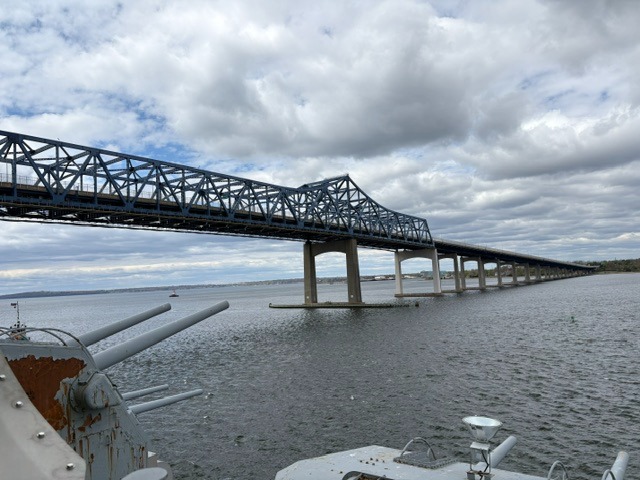
Charles M. Braga Jr. Memorial Bridge
Stretching across the Taunton River between Fall River and Somerset, the Charles M. Braga Jr. Memorial Bridge is one of the most recognizable structures on the city’s waterfront. Its steel framework carries Interstate 195 high above the water, connecting communities across southeastern Massachusetts. Opened in 1966, the bridge became an important part of the region’s […]
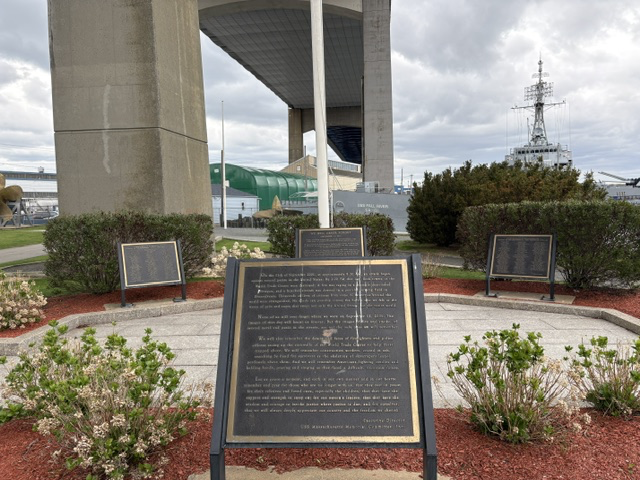
Tribute to “Fall River”
Along the waterfront near Battleship Cove, I came upon the solemn memorial dedicated to the crew of the USS Fall River, the heavy cruiser named in honor of the city. Positioned beneath the towering Braga Bridge and overlooking Mount Hope Bay, the memorial serves as a lasting tribute to the men who served aboard the ship […]
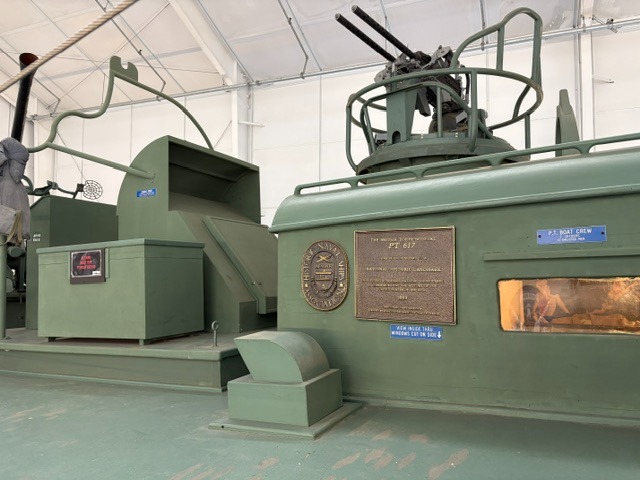
PT 617: A Small Boat with a Wartime Purpose
Preserved indoors at Battleship Cove, PT 617 represents a form of naval warfare built around small crews, speed, and heavily armed wooden boats. Its compact deck brings weapons, equipment, and crew stations close together, revealing how much fighting capability designers fitted into an eighty-foot hull. PT stood for “patrol torpedo.” Built by the Elco Naval […]

