The Guardian Building
While exploring downtown Detroit, we walked into what had once been one of the city’s great banking buildings. From the outside, the Guardian Building is an impressive Art Deco skyscraper, but it was the interior that stopped us. Brilliantly colored tile covers the vaulted ceilings, geometric patterns seem to fill every surface, and even the gates, clocks and walls were designed as works of art. This was clearly intended to be much more than an ordinary office building.
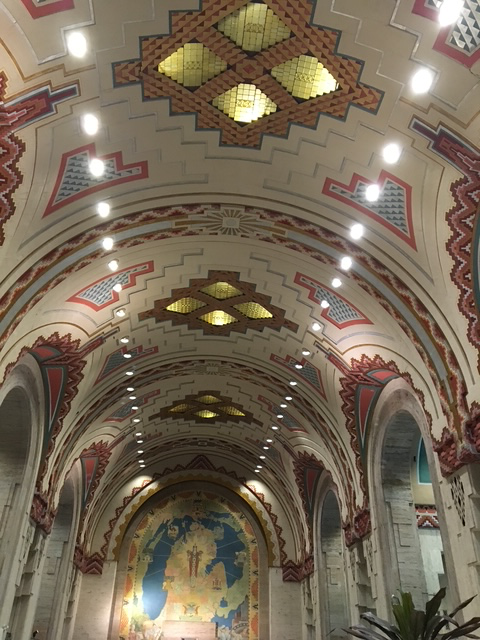
The building was created during an extraordinary period in Detroit’s history. During the 1920s, automobile manufacturing had helped transform Detroit into one of America’s great industrial and financial centers. The Union Trust Company wanted a headquarters that would reflect that prosperity and confidence, and it commissioned the prominent Detroit architectural firm Smith, Hinchman & Grylls to create it. The firm’s chief designer, Wirt C. Rowland, produced what became one of the masterpieces of American Art Deco architecture.
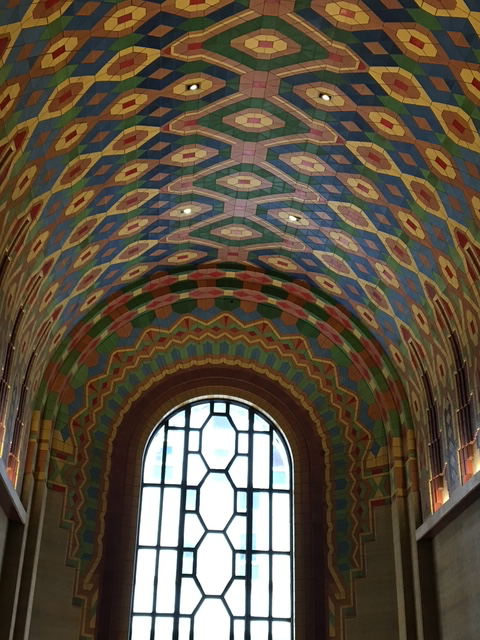
Completed in 1929, the Guardian rises 40 stories above Detroit’s Financial District. Its exterior is covered with nearly two million specially produced orange bricks, but Rowland saved some of his most remarkable work for the interior. He combined Art Deco geometry with influences drawn from Native American designs, Aztec forms and the Arts and Crafts movement, using color in a way that was unusually bold for a major commercial building of the period.
Detroit craftsmanship was incorporated throughout the building. Tiles from Mary Chase Stratton’s Pewabic Pottery were used in the decoration, while Michigan artist Ezra Winter created the enormous glass mosaic in the main lobby and a mural for the banking hall. Sculptor Corrado Parducci contributed architectural sculpture, and Rookwood pottery tiles were used across the soaring vaulted ceiling. Marble came from Italy, Belgium and Africa, while gold leaf and brightly colored tiles added to the extraordinary richness of the interior.
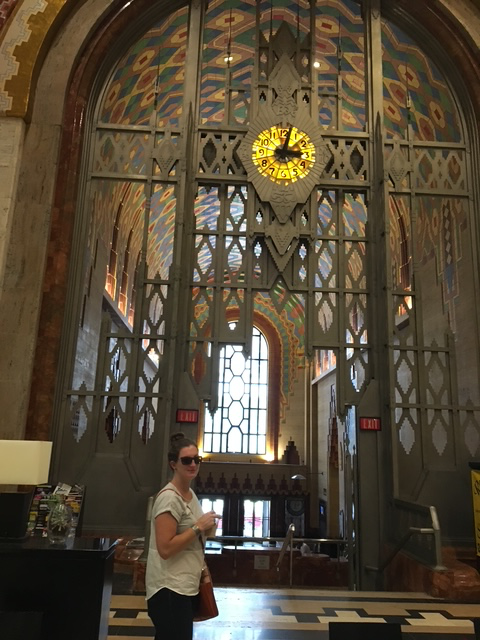
One of my photographs captures the great metal screen that once separated the main lobby from the banking hall. At its center is an illuminated Tiffany glass clock. Beyond it, the colorful vaulted ceiling stretches toward a large window. Even something as functional as the entrance to the banking room became part of the overall artistic design.
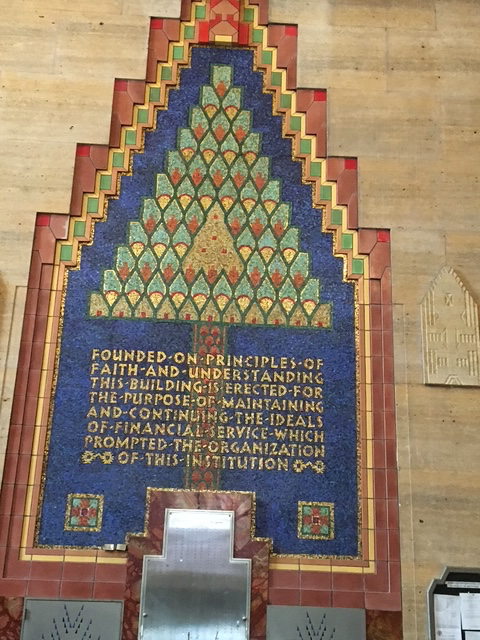
Another photograph shows the mosaic that explains the philosophy behind the building. Its inscription begins, “Founded on principles of faith and understanding,” and describes the building as having been erected to maintain and continue the ideals of financial service promoted by the institution. The elaborate mosaic surrounding those words transformed a statement about banking into something resembling an inscription in a cathedral.
That resemblance was intentional enough that the Guardian became known as the “Cathedral of Finance”. Its soaring spaces, vaulted ceilings, monumental decoration and almost overwhelming use of color gave banking an architectural grandeur normally associated with important civic or religious buildings. In the booming Detroit of the late 1920s, finance, industry and the future of the city were being celebrated through architecture.
There is an interesting historical irony in the timing. The Guardian Building opened in April 1929, only months before the stock market crash. The financial institution for which this extraordinary building had been created would struggle during the Great Depression, even though the building itself survived. During World War II, it was used by the U.S. Army as a command center connected with the enormous wartime production effort taking place in Detroit.
The Guardian Building was designated a National Historic Landmark in 1989. Today it is owned by Wayne County and continues to function as an office building, while its magnificent public spaces allow visitors to experience one of Detroit’s architectural treasures.
We had walked into a historic bank building while exploring Detroit. What we discovered was a building in which architecture, art, craftsmanship and the optimism of 1920s Detroit had all been brought together. “Cathedral of Finance” seems exactly the right name for it.