The Citadel of Acre
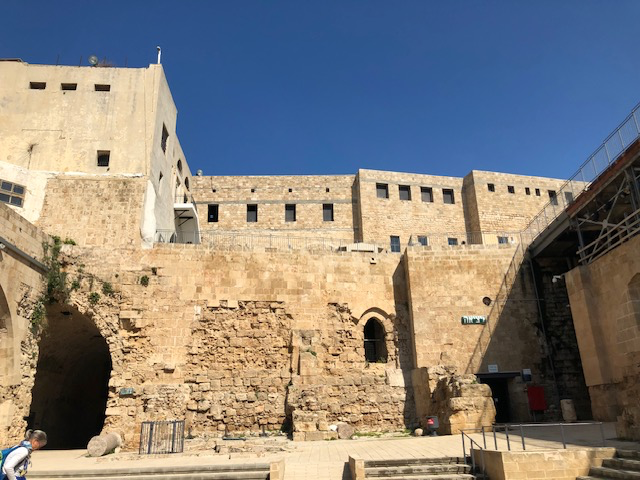
The Citadel of Acre rises above the northern section of the Old City, occupying a strategic position near the landward walls. Although the visible fortress dates primarily from the Ottoman period, it was constructed upon the remains of the medieval compound once occupied by the Knights Hospitaller. The result is a structure containing several distinct layers of Acre’s history.
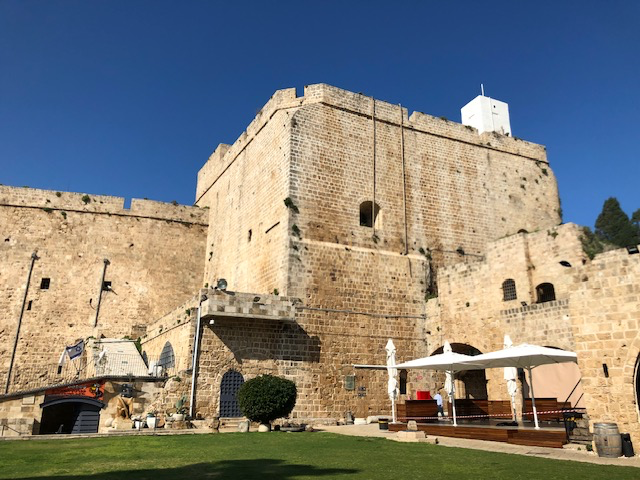
Acre experienced a period of renewed importance during the eighteenth century under the regional ruler Zahir al-Umar. He strengthened the city’s defenses and helped restore Acre as a commercial and administrative center. After his death in 1775, Ahmad Pasha al-Jazzar took control of the city and made it the center of his power.
Known as Jazzar Pasha, he expanded Acre’s fortifications and constructed public buildings, markets, religious structures and administrative facilities. The citadel was developed above the buried remains of the Crusader fortress and became part of the city’s military and governmental center. Its thick walls, protected position and connection to Acre’s defenses made it one of the most secure buildings in the city.
The strength of Acre’s fortifications was tested in 1799, when Napoleon Bonaparte invaded the region after his campaign in Egypt. French forces besieged Acre for approximately two months, but Jazzar Pasha’s defenders, assisted by British naval forces under Sir Sidney Smith, prevented them from capturing the city. Napoleon eventually abandoned the siege, marking an important setback in his attempt to expand farther into the Ottoman Empire.
The citadel served the Ottoman authorities in several capacities, including as government offices, military barracks, an armory and a prison. In 1868, Bahá’u’lláh, the founder of the Bahá’í Faith, arrived in Acre as an Ottoman prisoner. He and members of his family and community were initially confined within the prison complex under extremely harsh conditions. Acre and nearby Haifa later became the spiritual and administrative center of the Bahá’í Faith.
Following the First World War, Britain assumed control of Palestine and converted the citadel into Acre Central Prison. Both Arabs and Jews were incarcerated there during the British Mandate. Among them were Arab political prisoners and members of Jewish underground organizations, including the Haganah, Irgun and Lehi.
The prison became particularly associated with Jewish underground members who were sentenced to death by the British authorities. Prisoners awaiting execution were held near the gallows, and several were executed within the complex. Their imprisonment and deaths made Acre Prison an important symbol within the movement to establish a Jewish state.
On May 4, 1947, members of the Irgun attacked the prison from outside while inmates coordinated their escape from within. Explosives were used to breach one of the walls, allowing Jewish underground members and numerous Arab prisoners to escape. Some participants were killed or captured during the operation, but the attack damaged British claims that the prison was secure and became one of the most remembered events of the final years of the Mandate.
After the establishment of Israel in 1948, the citadel’s role as a prison ended. Part of the complex was eventually restored as the Museum of Underground Prisoners, preserving cells, prison corridors, the exercise yard, the gallows and exhibits describing the experiences of those confined there.
Below the Ottoman citadel, archaeological excavation revealed the vaulted chambers of the Knights Hospitaller. The two levels represent different eras: the medieval Crusader city beneath the ground and the later Ottoman and British complex above it.
The Citadel of Acre reflects the city’s repeated transformation. It served Ottoman rulers, resisted Napoleon’s army, confined the founder of the Bahá’í Faith and later became a British prison. Its surviving walls preserve the history of the many governments, religious communities and political movements that shaped Acre over several centuries.
Read More From Nancy
The Knights’ Halls and the Crusader City
The Knights’ Halls beneath the Old City of Acre preserve one of the most substantial surviving complexes from the age of the Crusades. Their vaulted chambers belonged to the Knights Hospitaller, one of the religious and military orders that became powerful forces in the Crusader states established along the eastern Mediterranean coast. The Crusades were […]
The Al-Jazzar Mosque
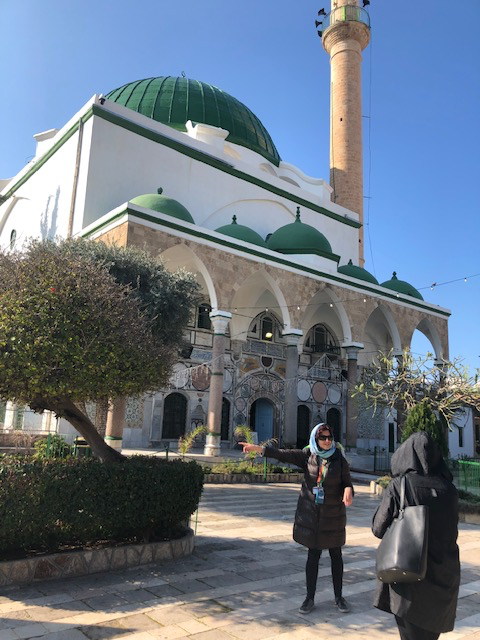
During our tour of the Old City of Acre, we visited the Al-Jazzar Mosque, one of the city’s most prominent landmarks. Its large green dome and tall minaret rise above Acre’s walls and tightly clustered buildings, making the mosque an unmistakable part of the city’s skyline. The mosque was constructed in 1781 by Ahmad Pasha […]
Baha’i Gardens
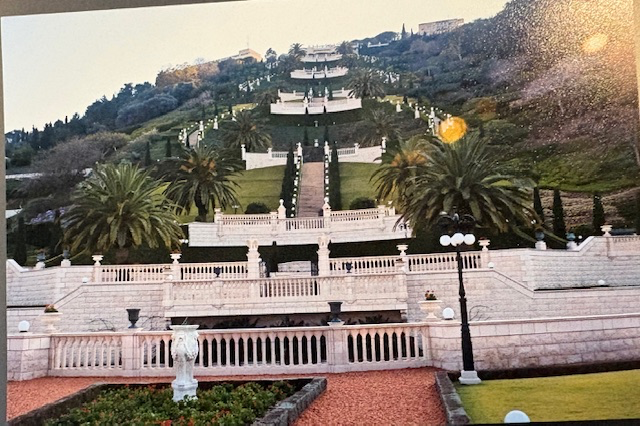
For Marty’s 65th birthday, we traveled to Israel, a journey filled with extraordinary places that I will write about in time. But the place I want to begin with is the Baha’i Gardens in Haifa. Our group was given special access to this sacred site, allowing us to walk the entire length of the gardens […]

