Presidential Campaigns
July 1944Dearest Reader,
My mother’s letter of July 11, 1944, contains a single line that instantly reveals just how different presidential campaigns were then compared to today:
“I see by tonight’s headlines that Roosevelt says he is going to run for a fourth term very reluctantly. Humph!”
There was no televised announcement, no rally, no choreographed campaign rollout. Instead, Americans opened their evening newspapers and discovered that Franklin D. Roosevelt had agreed to accept the Democratic nomination if it was offered. Earlier that day, he had sent a brief letter to Robert E. Hannegan, chairman of the Democratic National Committee. The letter was released to the press, and by nightfall, the headlines reached my mother in Concord, NH.
She was not a partisan voter. As she explained:
“I’m not registered as a Democrat or Republican. I’ve always voted for the man I thought best, whether he was a Democrat or Republican.”
Her words come from a time when voters learned political news from newspapers and radio, not from 24-hour coverage or social media.
When Roosevelt signaled on July 11 that he would run again, most Americans had no idea how ill he actually was. His doctors and close advisors were concerned about his hypertension, heart strain and fatigue. But this information was carefully guarded.
To the public, Roosevelt appeared tired but his physician reassured reporters that the president was in excellent health and the press of the era respected these boundaries. Most Americans had no way of knowing just how fragilehis health was.
The 1944 Democratic National Convention, held from July 19 to 21 in Chicago, made Roosevelts’ candidacy official. Conventions of that era were practical political gatherings. Roosevelt did not attend in person.
Delegates renominated Roosevelt decisively thus continuing the leadership that was viewed as essential during the Allied forces fighting in Europe and the Pacific. The convention also selected Harry S. Tryman as his running mate.
Reading the sentence in my mother’s letter to my father, has captured a snapshot of a very different political process and world. The 1944 campaign was at the intersection of war and news arrived in headlines. Campaigns were subdued and shaped by wartime responsibilities.
Today, presidential elections stretch on for months or years. Candidates announce early, raise enormous sums of money, appear in interviews and debates. The length, cost and intensity of modern elections would have been unimaginable in 1944.
By contrast, the entire 1944 campaign unfolded in what now feels compressed. Roosevelt’s decision became public on July 11, just eight days before the Democratic National Convention. Americans simply opened their evening newspapers and saw the headline: The President would run again.
Dr. Nancy Watson
Washington
Read More From Nancy
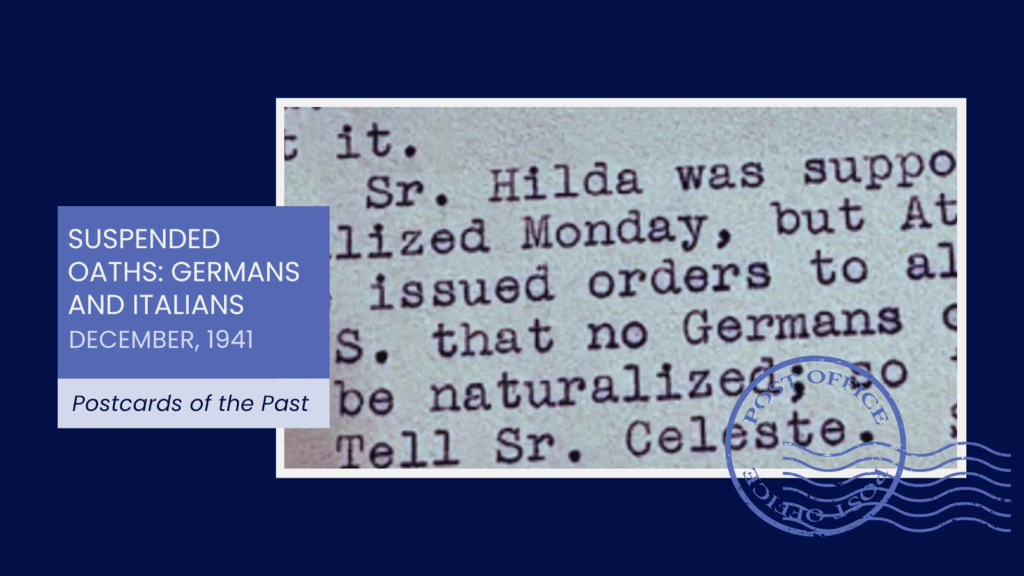
Suspended Oaths: Germans and Italians
In a letter dated December 13, 1941, just six days after the attack on Pearl Harbor, my grandmother recorded how quickly the war reached into ordinary lives. My father was living in Saginaw, Michigan at the time, having just turned twenty-one, and the country was still reeling from the shock of December 7. The United […]
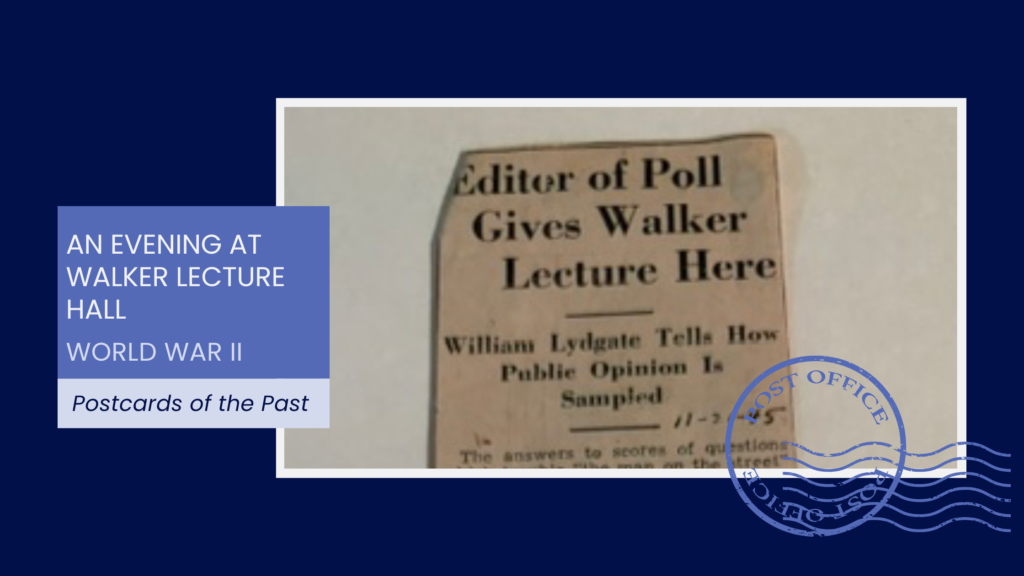
An Evening at Walker Lecture Hall
Several years ago, I wrote about Walker Lecture Hall in Concord and its long tradition of bringing nationally known speakers to New Hampshire. Finding this newspaper clipping brought that history to life. Rather than simply describing the hall, it preserves one evening when William Lydgate, an editor with the Gallup Poll, spoke about the emerging […]
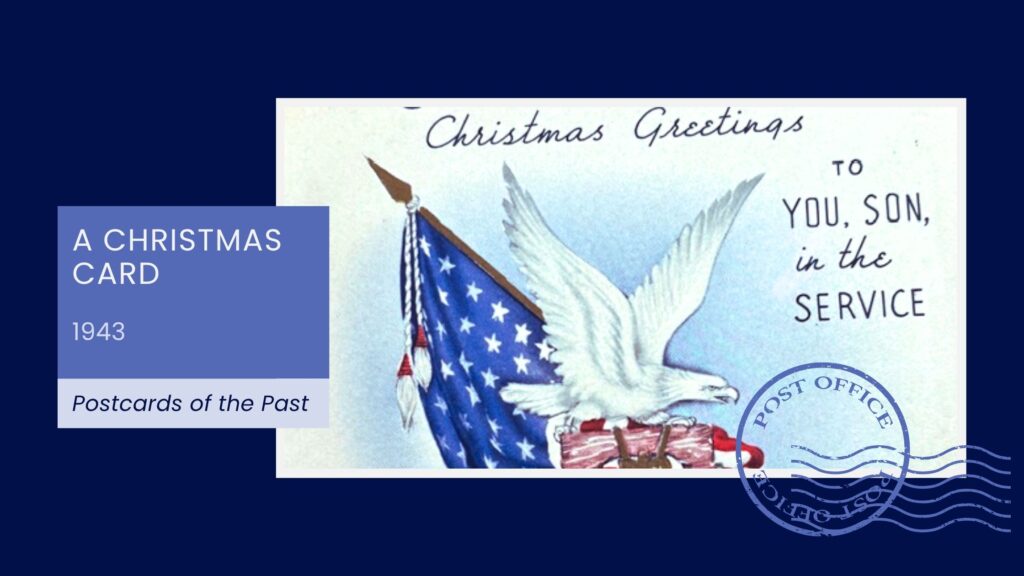
A Christmas Card
In a box of saved letters and photographs, I found a Christmas card my grandmother sent to my father in 1943. The front is not decorated with wreaths or candles. There is no snow, no manger scene, no holly. Instead, it bears an American flag, The Liberty Bell and a white eagle: symbols of a nation […]

