New Castle Common
As I continued exploring New Castle, I came upon another historic marker that tells a story few visitors know. At first glance, the New Castle Common appears to be a pleasant town green, but it represents one of the oldest examples of land set aside for the benefit of an entire community.
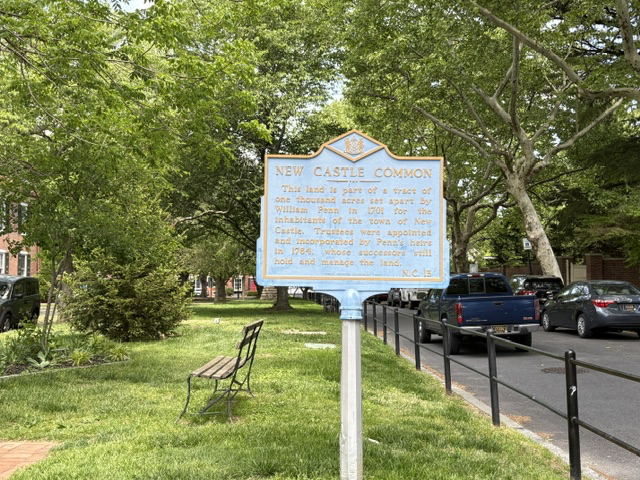
The marker explains that this land is part of a tract of more than one thousand acres given by William Penn to the inhabitants of New Castle in 1701. When New Castle was incorporated in 1784, Penn’s heirs confirmed the gift, allowing the town to continue holding and managing the land for the benefit of its citizens.
Unlike many colonial land grants that were divided and sold, the New Castle Common has remained community property for more than three centuries. Income generated from portions of the land has helped support public improvements, parks, historic preservation, and other civic projects. It is a remarkable example of Penn’s belief that a community should have shared resources that benefit everyone rather than a privileged few.
Standing beside this quiet green, I was reminded that William Penn’s legacy extends far beyond the founding of Pennsylvania. His vision included thoughtful planning, public spaces, and local self-government. This simple marker is another reminder that some of the most enduring gifts in American history are not buildings or monuments, but the foresight to preserve land for future generations.
I found New Castle to be filled with discoveries like this. Around nearly every corner was another plaque, monument, or historic building with a story to tell. It is one of those rare colonial towns where history is not confined to a museum but woven into the very fabric of the community.
Read More From Nancy
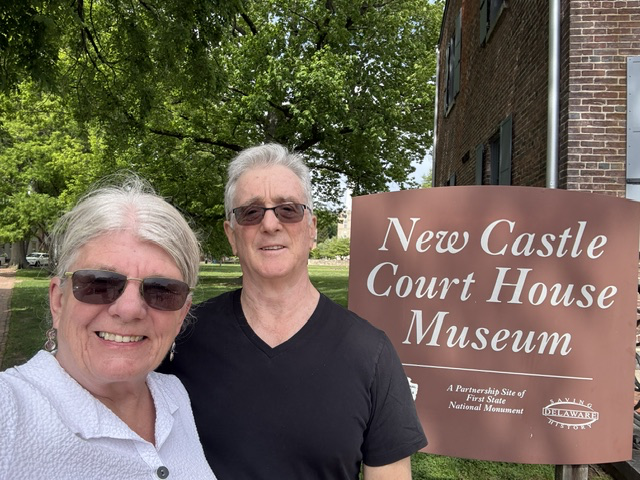
Court House Museum
One of the highlights of our visit to New Castle was the historic Court House, one of the oldest surviving courthouses in the United States. Standing before this building, it is easy to appreciate that it was much more than a courthouse. For nearly a century, it served as the center of government for Delaware, […]
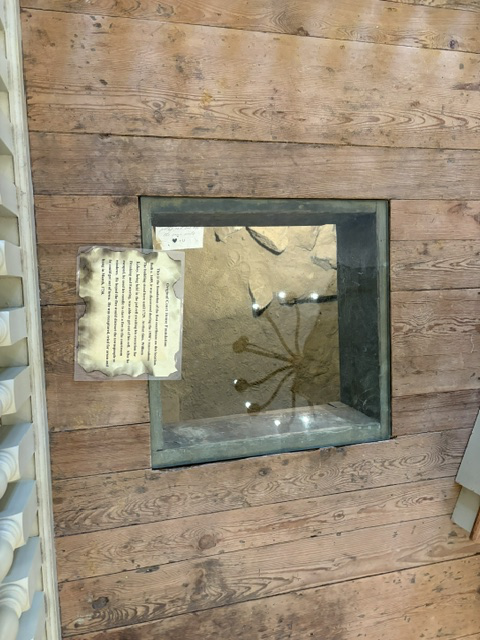
Beneath the Courthouse
Sometimes the most interesting history is literally beneath our feet. Inside the New Castle Court House, this small glass opening in the floor reveals part of the foundation of the first courthouse built on this site in 1689. The remains were discovered during renovations to the courthouse in the 1950s. Rather than covering them again, […]
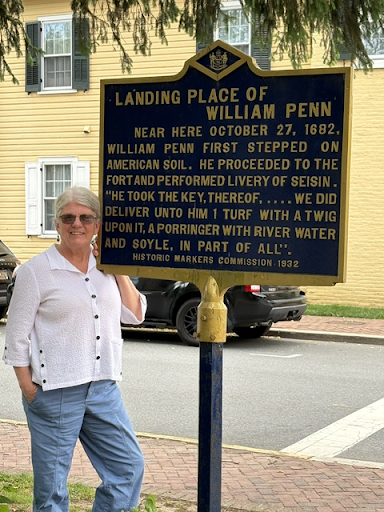
Landing Place of William Penn
Visiting New Castle in May of 2026 was so much more than I expected. It was my first time exploring this historic town, so everything was new to me. As I drove into town, my first impression was that I had arrived in Williamsburg, Virginia. It didn’t take long, however, to realize that unlike Williamsburg, […]

