Learning to Play Modern Swing Music
1936Dearest Reader,
Among my parents’ papers I found this $2 copy of Axel Christensen’s Instruction Book for Modern Swing Music. I don’t know whether it belonged to my mother or my father, or whether one of them actually learned to play from it. But the book tells us something about the music that surrounded their generation.
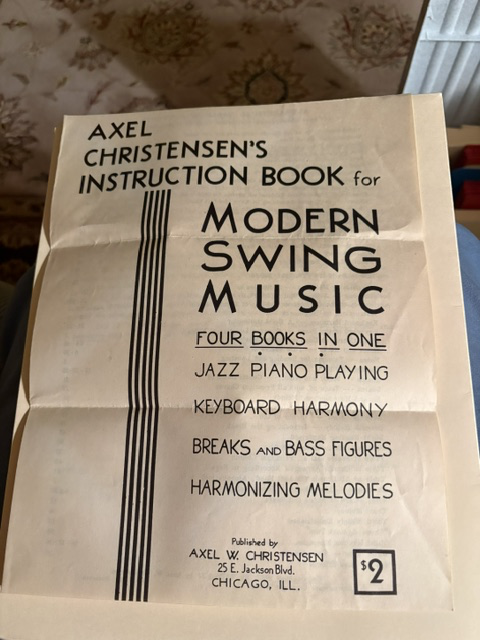
Axel W. Christensen was not simply publishing another collection of sheet music. He had been teaching Americans how to play popular piano since the ragtime era. Beginning in the early 1900s, he developed instruction books devoted to ragtime and later continually revised his approach as American popular music changed. His titles trace that evolution: ragtime, then rag and jazz, then “jazz and novelty” piano, and finally Modern Swing Music in 1936.
That progression is important. Christensen wasn’t teaching students simply to sit at the piano and reproduce every note exactly as printed. His methods were intended to teach people how popular pianists actually played by adding rhythm, chords, embellishments and their own style to a melody. Earlier advertisements for his system promised students that they could learn to take ordinary popular music and give it the rhythmic quality that made people want to dance.
By the time this book appeared, swing had become one of the defining sounds of American popular culture. The great swing era stretched through the 1930s and into the World War II years, when big-band music became closely associated with dancing, radio, records and the experiences of young Americans both at home and in the service.
The four subjects advertised on the cover tell us exactly what Christensen was offering:
“Jazz Piano Playing” taught the rhythmic style of popular piano.
“Keyboard Harmony” taught how chords worked with melodies.
“Breaks and Bass Figures” dealt with the short musical flourishes, rhythmic patterns and left-hand figures that could make an arrangement sound more like the popular music heard from professional musicians.
“Harmonizing Melodies” taught a particularly useful skill—taking a melody and supplying chords and accompaniment rather than depending entirely upon a written arrangement.
In other words, this was a book about learning to play with style. It was intended to move someone beyond simply reading notes toward understanding how to make a familiar song sound like contemporary popular music. Christensen continued publishing teaching material devoted to breaks, fill-ins, boogie effects and embellishments even into the 1940s.
Christensen had built quite an enterprise around this idea. His Christensen School of Popular Music in Chicago promoted instruction for adult beginners as well as experienced pianists, and his teaching system spread through affiliated instructors in cities around the country. Students who did not live near one of his schools could even study his system through the mail. A 1924 advertisement claimed that adult beginners could learn ragtime and jazz piano in twenty lessons.
That makes the $2 price printed on this book interesting as well. This was commercial music education designed for ordinary people who wanted to participate in the popular music they were hearing around them. Somewhere along the way, either my mother, my father, or someone close to them acquired this book because they wanted to do more than listen to swing music. They wanted to learn how to play it.
I may never know whose hands sat at the keyboard with this book open beside them. But the book survived, and that makes it another small piece of the world in which my parents were young, a time when swing was not old music. It was modern music.
Dr. Nancy Watson
Washington
Read More From Nancy

Obtains New Rating Now in Pacific
Among the newspaper clippings saved by my parents is this small wartime article about Navy serviceman Donald R. Edmonds. I have not discovered a connection between the Edmonds and my own, yet for some reason, this clipping was preserved through the years. The article, published during the final months of World War II, reports that Edmonds had […]
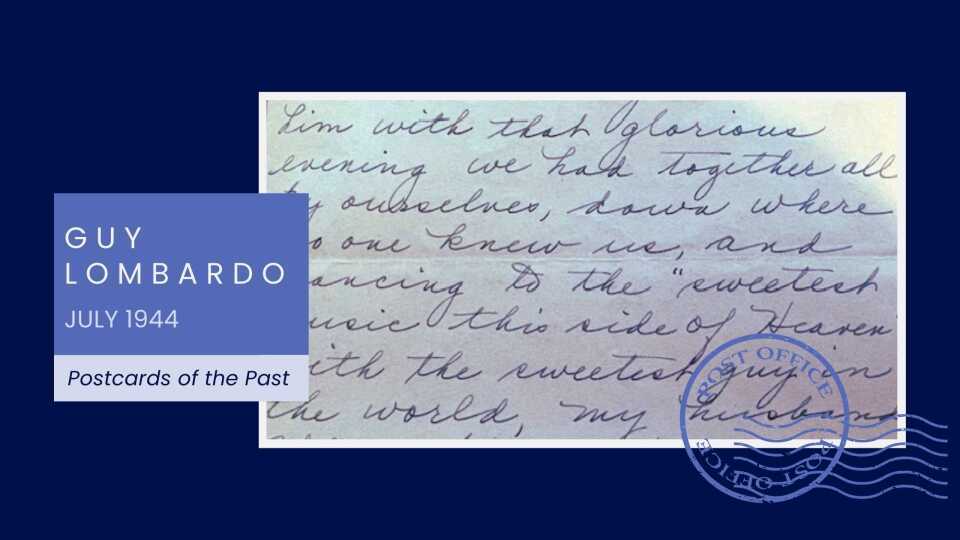
Guy Lombardo
By 1944, Guy Lombardo and His Royal Canadians, were more than a popular band, he was institutional. He was the soundtrack for weddings. honeymoons and dances. Even people who didn’t follow big-band music knew who Guy Lombardo was. In a world unsettled by war, Lombardo’s music offered something romantic and familiar. He was widely known for […]
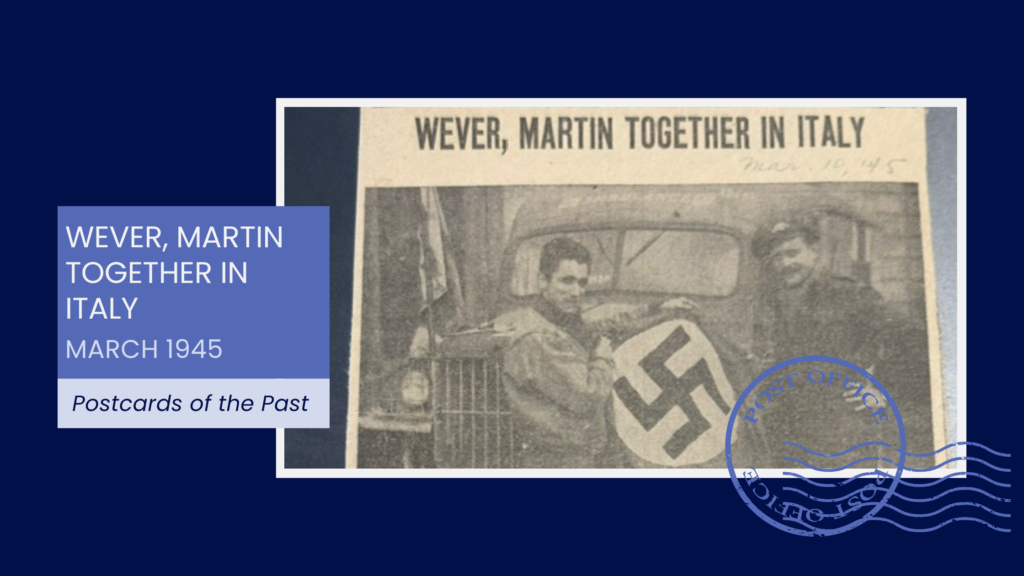
Wever, Martin Together in Italy
Among the newspaper clippings preserved through the years is a remarkable wartime photograph dated March 10, 1945. This hometown news item tells a larger story about World War II, the bonds of community and the unexpected encounters that occurred thousands of miles from home. These two young men are from Martinsburg, West Virginia, standing together in Italy […]

