John Stevens and the First American Steam Locomotive
Among the large locomotives at the Railroad Museum of Pennsylvania stands a machine that looks almost too small to belong beside them. It has tall, exposed wheels, a boiler, and a narrow platform, with little of the enclosed form we now recognize as a locomotive. It represents an experiment made before Americans knew whether steam power would become a practical way to travel by rail.
In the early nineteenth century, canals seemed to many people the answer to moving passengers and goods over long distances. John Stevens believed railroads could do more. Already experienced with steam-powered boats, he built a small locomotive in 1825 and ran it on a circular track at his estate in Hoboken, New Jersey. He offered rides to demonstrate that a machine could carry people along rails under its own power. It was an experiment, rather than a locomotive built to serve a working railroad.
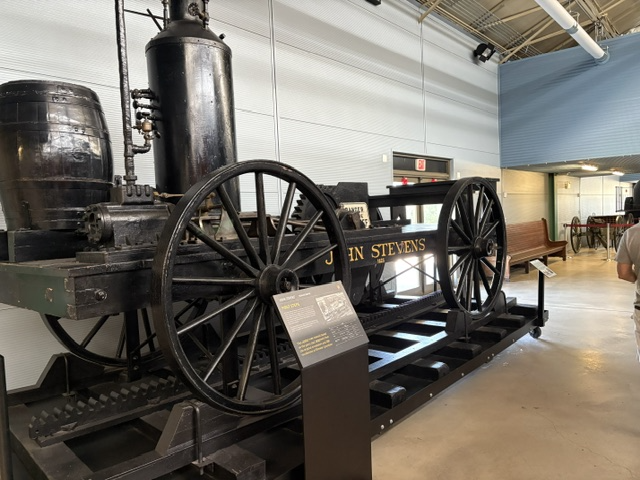
The machine eventually disappeared. It was disassembled after its years of testing, although its boiler and safety valve survived. The locomotive we saw in Strasburg is a replica, reconstructed from the surviving parts and an account later written by Stevens’s grandson. It allows visitors to see the scale and unusual form of an invention that otherwise would be known largely through descriptions.
Stevens did not settle every question about how a railroad should be built. His locomotive used a geared mechanism and a rail between the running rails to help move it around the track. What his demonstration offered was something more basic: people could watch steam move a vehicle on rails and begin to imagine where a longer track might lead. Within a few years, Stevens’s family was involved in the Camden and Amboy Railroad, which carried passengers and freight across New Jersey.
Seeing this modest machine among the museum’s later engines made that progression easier to grasp. The powerful locomotives that followed did not appear fully formed. They grew from experiments such as Stevens’s small circle of track in Hoboken, where an inventor invited people aboard to see a possibility in motion.
Read More From Nancy
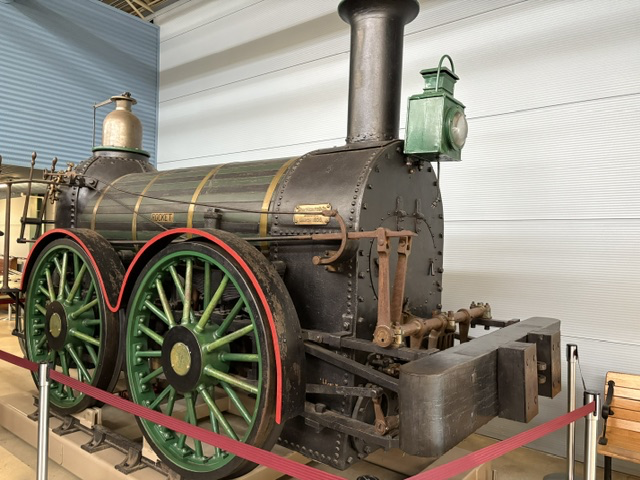
“Rocket”
The locomotive called “Rocket” is small enough that it might be easy to pass on the way to a larger engine. Its four green driving wheels, tall smokestack, and exposed machinery invite a closer look. Built in England in 1838, it crossed the Atlantic to help launch passenger service on a new stretch of Pennsylvania […]
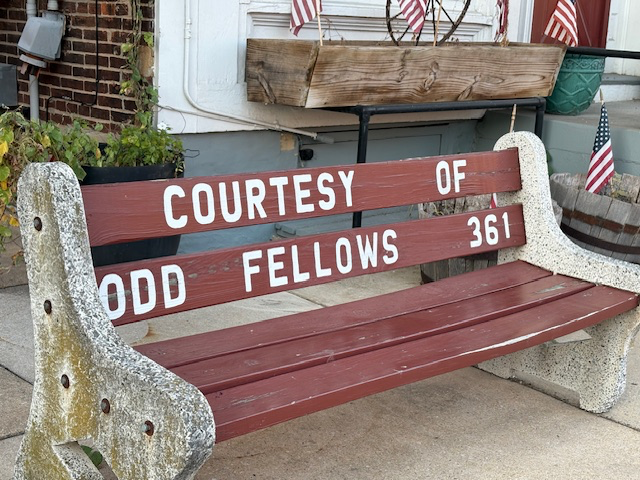
Odd Fellows
As we traveled through Lancaster County, PA, a simple bench caught my attention. I took this photo to remind myself to explore the Odd Fellows. Who were the Odd Fellows, why such an unusual name? My curiosity led me to explore more. The Independent Order of Odd Fellows is one of the oldest fraternal benefit […]
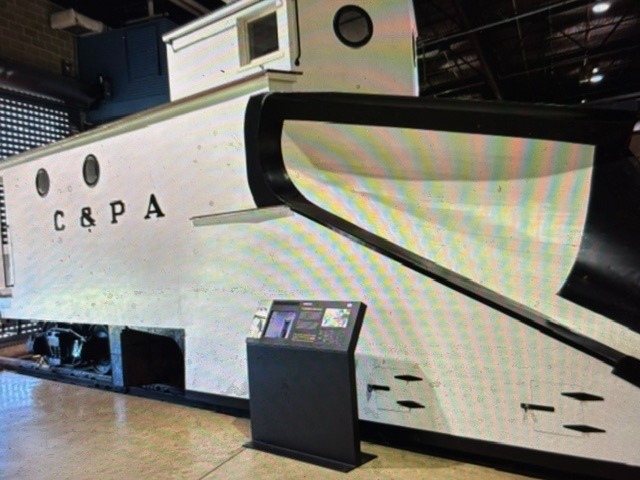
The Coudersport & Port Allegany Railroad Snowplow
Winter could stop a railroad as surely as a damaged bridge. Snow buried the rails, ice collected where train wheels needed to run, and a blocked line interrupted both passengers and freight. Railroads needed to clear the track before ordinary trains could pass. At the Railroad Museum of Pennsylvania in Strasburg, the Coudersport & Port […]

