Roman Ruins
We visited the Roman ruins of Jerash on a rainy day, just outside Amman. Jerash is often described as one of the most complete Roman cities still standing, and its Roman timeline is what gives the site its clarity.
The city came under Roman control in 63 BCE, when the region was incorporated into the Roman province of Syria. From that point forward, Jerash began its transformation from a regional settlement into a structured Roman city.
Its real growth came in the 1st and 2nd centuries CE, during a period of stability and expansion across the Roman Empire. This was when the city was formally organized with the features that still define it today: planned streets, monumental architecture and public gathering spaces.
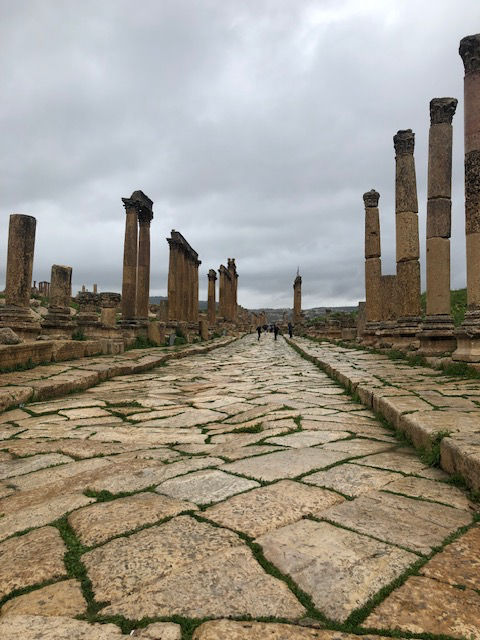
Jerash functioned as a thriving provincial city, Roman in design, but connected to the surrounding region. This long, wide road lined with columns on both sides is known as the Cardo Maximus. This was the main street of the city, running through its center, connecting daily life, commerce and movement.
The stones of the road are still in place, some worn smooth, and some uneven. We could see the grooves left by carts. The columns, on either side, still stand, marking the line of street.
This was not just a road, but the spine of the city during its most active centuries.