Helsinki Cathedral
Rising above Senate Square, Helsinki Cathedral is one of the most recognizable landmarks in Finland. Its white walls, green copper domes, and broad staircase dominate the historic center of Helsinki and were deliberately designed to do so.
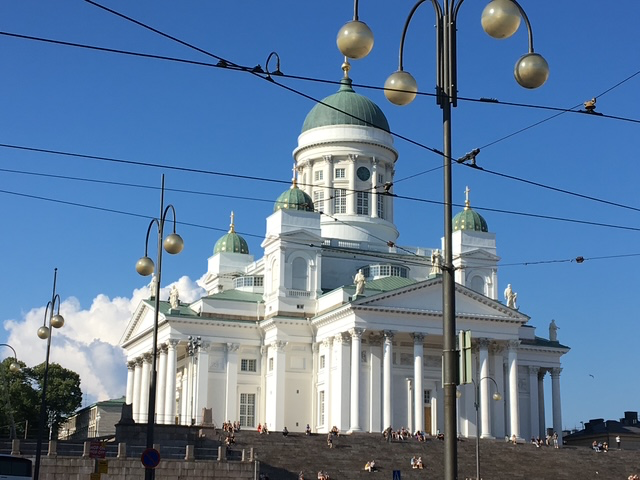
The cathedral was designed by German-born architect Carl Ludvig Engel as part of an ambitious rebuilding of Helsinki during the early nineteenth century. After Finland became an autonomous Grand Duchy within the Russian Empire in 1809, Helsinki was made the capital in 1812. The city needed buildings appropriate to its new status, and Engel was given an extraordinary opportunity to shape the monumental center that developed around Senate Square.
Construction of the cathedral began in 1830. Engel died in 1840 before seeing it completed, and the building was finished under architect Ernst Lohrmann in 1852. Lohrmann added the four smaller corner domes and other elements that contribute to the cathedral’s appearance today.
Originally it was called St. Nicholas Church, honoring both St. Nicholas and Russia’s Tsar Nicholas I, who helped finance its construction. Following Finnish independence in 1917, the name eventually changed, and since 1959 it has been known as Helsinki Cathedral. Today it is an Evangelical Lutheran cathedral and the principal church of the Diocese of Helsinki.
The building is a superb example of Neoclassical architecture. Engel placed a large central dome above a Greek-cross plan and created monumental columned façades on all four sides. On the roof stand statues of the Twelve Apostles, positioned high above the city. The enormous staircase descending toward Senate Square strengthens the impression that the cathedral is almost sitting on a platform above Helsinki.
I particularly like this photograph because it captures more than the cathedral. The tram wires stretching across the sky and the streetlights in the foreground place this monumental nineteenth-century building within the everyday life of modern Helsinki. People sit on the cathedral steps, trams travel through the surrounding streets, and the city continues to move around a building that has watched over Senate Square for more than 170 years.
Read More From Nancy
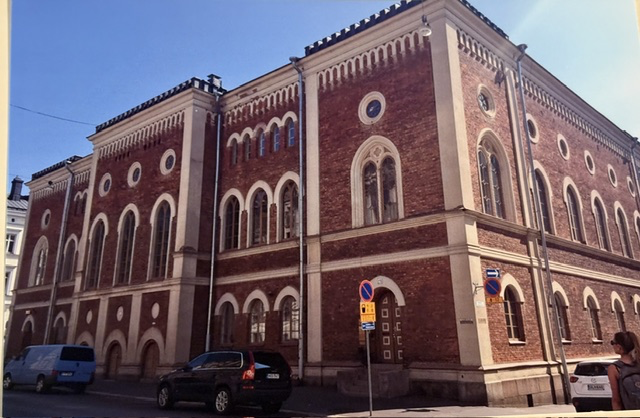
House of Nobility
The House of Nobility, known in Finnish as Ritarihuone, reflects an important period in Finland’s political and social history. Completed in 1862, it was built as the meeting place of the noble estate, one of the four groups represented in Finland’s historic Diet. The other estates represented the clergy, the townspeople, and the landowning peasants. […]
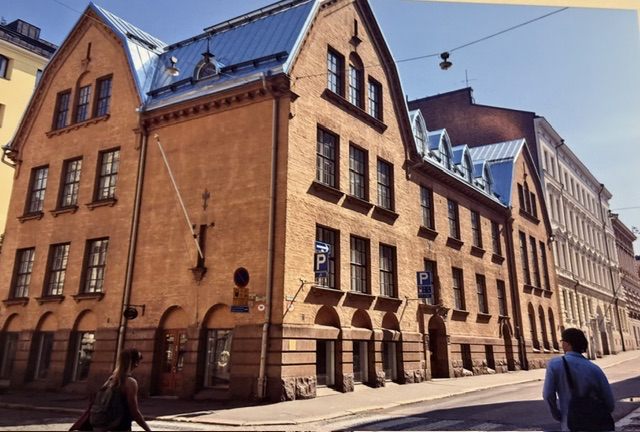
Design Museum
During our tour of Helsinki, we stopped at the Design Museum, an institution devoted to the objects and ideas that have helped make Finnish design internationally recognized. The museum was founded in 1873, making it one of the oldest design museums in the world. Its collections preserve the development of Finnish design through furniture, glass, […]
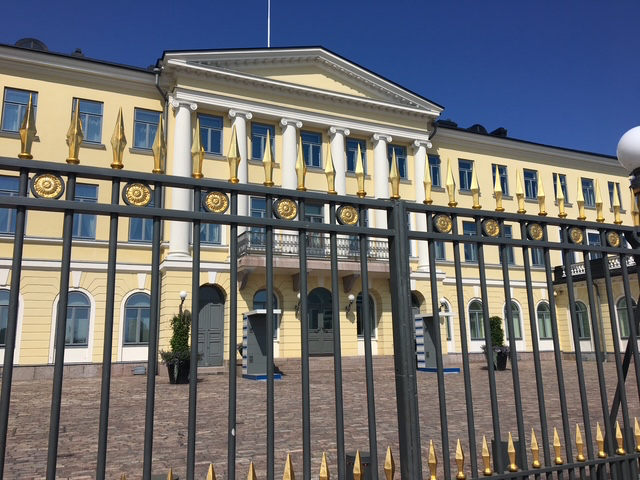
Government Palace
On our walking tour through Helsinki, we passed this stately yellow facade of the Government Palace. This building has been at the center of Finnish government for over two centuries. Designed in the early 1800s, the building was originally constructed when Finland was under Russian rule. It was first used by the Imperial Senate of Finland, making it one […]

