Alexander II Monument
Standing in front of the Alexander II Monument in Helsinki’s Senate Square is my daughter, Emily. During our visit to Finland, we found ourselves drawn to this impressive monument, not only because of its commanding presence in the center of the square but also because of the unexpected story it tells.
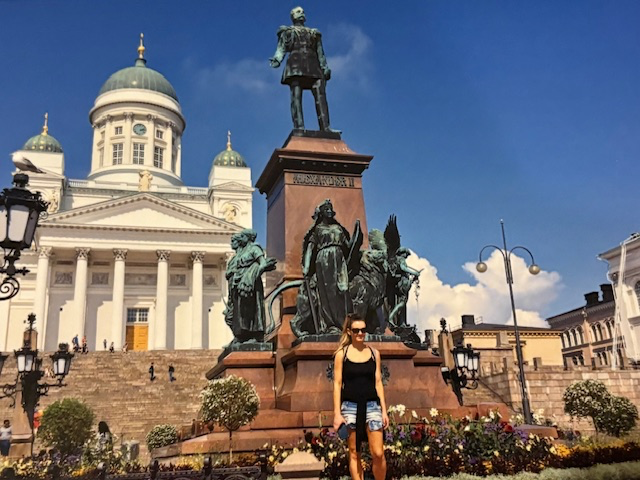
At first glance, it seems unusual that Finland would honor a Russian emperor with one of its most prominent public monuments. The explanation lies in Finland’s history. From 1809 until 1917, Finland was an autonomous Grand Duchy within the Russian Empire. During his reign from 1855 to 1881, Alexander II introduced reforms that allowed Finland greater self-government, restored the Finnish Diet after more than fifty years, encouraged economic development, and gave the Finnish language official status alongside Swedish. His policies helped strengthen Finland’s national identity during a critical period in its history.
The monument was unveiled in 1894, and its meaning soon grew beyond honoring the emperor himself. As later Russian rulers sought to reduce Finland’s autonomy, the statue became a symbol of the freedoms many Finns wished to preserve. Rather than simply commemorating a ruler, it came to represent Finland’s determination to protect its language, culture, and institutions.
Surrounding the pedestal are four allegorical figures representing Law, Peace, Light, and Labor. Together they reflect the principles that many associated with Alexander II’s reforms, and the progress Finland experienced during his reign.
One of the things I enjoy most about exploring historic places is discovering stories that challenge my expectations. I never expected to find one of Finland’s most important national monuments dedicated to a Russian emperor. Learning why it stands here provided a fascinating glimpse into Finland’s journey toward independence and reminded me that history is often far more complex, and far more interesting, than it first appears.

