Giant’s Causeway
When Erin and I visited Northern Ireland, we decided to hire a private guide to take us along the spectacular Causeway Coastal Route. Driving on the opposite side of the road from what we were accustomed to, I wanted us to relax and enjoy the experience rather than worry about unfamiliar roads, directions, and navigating narrow country lanes. It proved to be one of the best decisions we made. Instead of concentrating on the drive, we could fully appreciate the dramatic coastline, charming villages, and fascinating history that unfolded throughout the day. One of the highlights of our journey was the Giant’s Causeway.
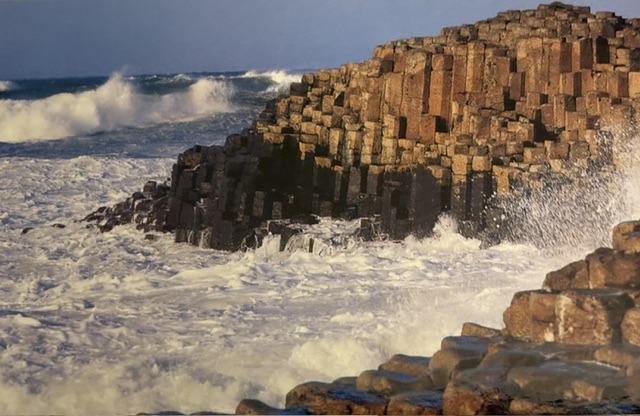
Along the rugged coast of County Antrim lies one of the most extraordinary landscapes in the world. At first glance, the Giant’s Causeway appears almost impossible. More than 40,000 interlocking basalt columns rising from the sea with such remarkable precision that they seem to have been carefully carved by hand. In reality, they were created nearly sixty million years ago when volcanic lava cooled and fractured into the distinctive hexagonal columns that have fascinated visitors ever since.
According to Irish legend, the Causeway was built by the giant Finn McCool (Fionn mac Cumhaill). Challenged by the Scottish giant Benandonner, Finn constructed a stone pathway across the North Channel so the two could meet. When Finn discovered that his rival was much larger than he had imagined, his clever wife disguised him as a baby. Seeing the enormous “infant”, Benandonner concluded that if the child was that large, the father must be truly enormous. He fled back to Scotland in fear, tearing up the causeway behind him as he escaped. Even today, similar basalt formations on the Scottish island of Staffa keep the legend alive.
Standing beside these remarkable columns, with the Atlantic waves crashing against the rocks, it was easy to understand why generations of people created stories to explain what they saw. The landscape feels almost otherworldly. The sea is constantly changing, yet these ancient columns have stood firm through millions of years of storms, tides, and changing climates.
The Giant’s Causeway became Northern Ireland’s first UNESCO World Heritage Site in 1986, recognized not only for its extraordinary geology but also for the cultural traditions and folklore that have grown around it. It is one of those rare places where science and storytelling complement one another rather than compete. The geology explains how the columns were formed, while the legend reminds us how people have always sought meaning and wonder in the natural world.

Read More From Nancy
Bishop’s Gate
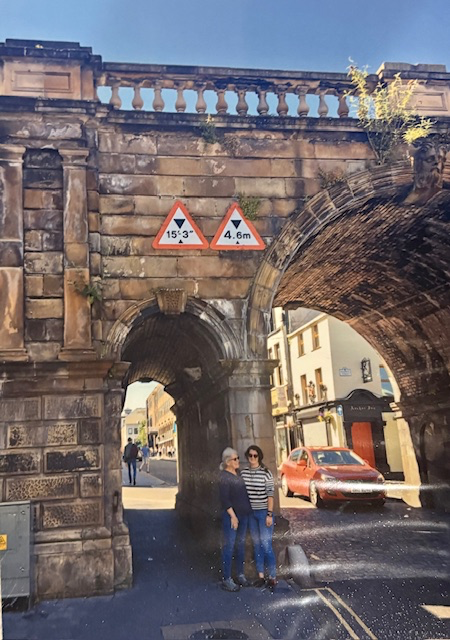
Standing beneath Bishop’s Gate, it is easy to think of it as simply another old stone archway. But for more than four centuries, this gateway has marked one of the principal entrances into one of the best-preserved walled cities in Europe. The walls of Derry were constructed between 1613 and 1619 after the Plantation of […]
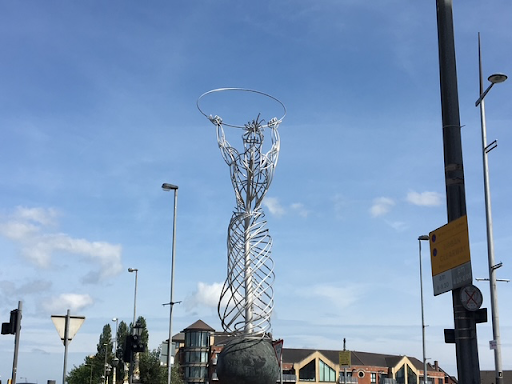
Beacon of Hope / Thanksgiving Square
On our trip to Belfast, Erin and I visited Thanksgiving Square, a meaningful space along the River Lagan. Thanksgiving Square is a recent addition to the city, developed in the early 2000s as part of Belfast’s broader waterfront regeneration. This was a time when the city was actively reshaping itself following The Trouble, moving away from decades of […]
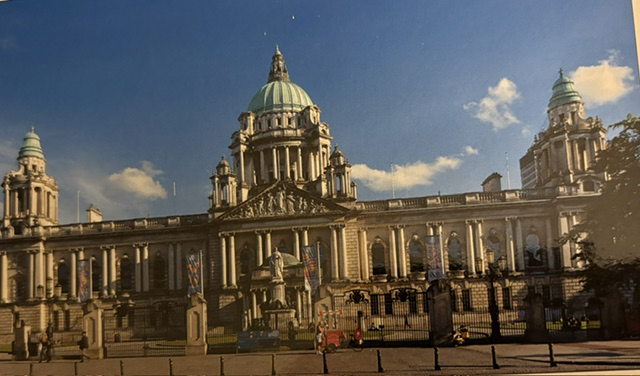
Town Hall
Standing in the center of Belfast is this enormous Baroque Revival building, crowned by its great green copper dome. Belfast City Hall seems almost oversized for a municipal building, but its scale tells an important story about what was happening in Belfast when it was created. Belfast had expanded dramatically during the nineteenth century. Linen […]

