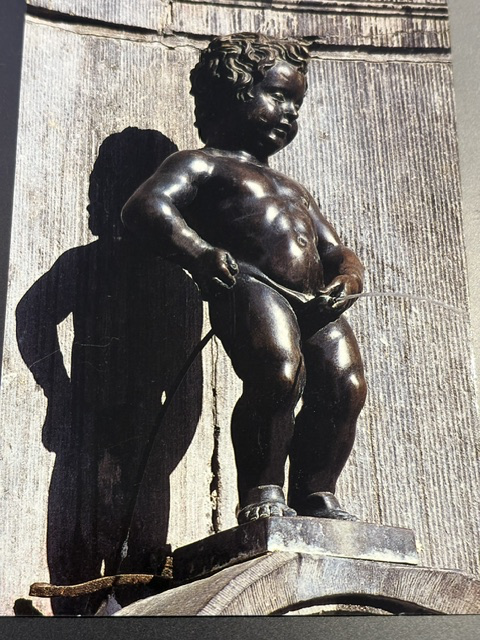
Brussels Town Hall
While in Brussels, I enjoyed far more than its remarkable architecture. I sampled some of Belgium’s famous chocolates, tasted locally brewed Belgian beer, and, of course, couldn’t resist enjoying a freshly made Belgian waffle. Between its culinary traditions and its beautifully preserved historic center, Brussels proved to be a city that appealed to all the senses.
As I wandered through the city’s streets, I eventually found myself in the Grand-Place, the historic heart of Brussels and one of the most beautiful public squares in Europe. Surrounded by ornate guildhalls, elegant merchants’ houses, and centuries of history, one building immediately commanded my attention. Rising above the square with its graceful Gothic tower was Brussels Town Hall, an architectural masterpiece that has been the symbol of the city for nearly six hundred years.
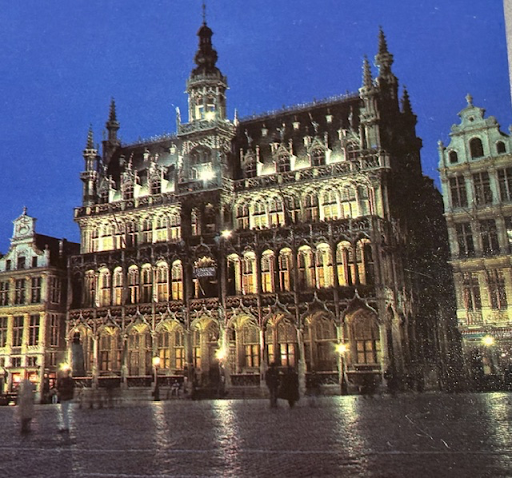
Construction of the Town Hall began in 1402, with the oldest section completed in 1420. As Brussels grew in wealth and importance, additional sections were added between 1444 and 1455, culminating in the soaring 315-foot tower designed by architect Jan van Ruysbroeck. At its summit stands a gilded statue of Saint Michael, the patron saint of Brussels, defeating a dragon.
The Town Hall served as the center of civic government during the height of Brussels’ prosperity. From within its walls, city officials regulated trade, governed the influential craft guilds, welcomed foreign merchants, and administered justice. The wealth generated through commerce is reflected in the extraordinary detail of the building. Delicate tracery, pointed arches, elaborate carvings, and hundreds of statues decorate the façade. While many of the sculptures visible today are nineteenth-century replacements, they faithfully preserve the appearance of the medieval originals.
One of the Town Hall’s greatest moments came during one of Brussels’ darkest days. In August 1695, French forces under King Louis XIV bombarded the city during the Nine Years’ War. Fires destroyed much of the Grand-Place and the magnificent guildhalls that surrounded it. Remarkably, the Town Hall survived with relatively limited damage. Its survival allowed the square to be rebuilt around it, preserving the historic character that visitors continue to enjoy today. In 1998, UNESCO recognized the Grand-Place as a World Heritage Site, citing it as one of Europe’s finest examples of a medieval market square.
There is also an interesting detail that many visitors overlook. At first glance, the Town Hall appears perfectly symmetrical, but a closer look reveals that it is not. The tower is slightly off-center because the left wing was completed years before the right wing was added. Rather than demolishing the original structure to create perfect balance, the builders chose to preserve their earlier work, leaving behind a subtle architectural quirk that has become one of the building’s most distinctive features.
Brussels Town Hall is more than an impressive Gothic building. It is a witness to the city’s growth, prosperity, destruction, and renewal and a reminder that great cities are shaped not only by the people who build them, but also by their determination to preserve what matters most for future generations.