Bennington Battle Monument
During our camping trip to the Berkshires, we visited the Bennington Battle Monument in nearby Vermont. The tall stone shaft rises above Old Bennington, commemorating a Revolutionary War victory that helped change the course of the British campaign of 1777. From its observation level, we looked out across the surrounding town, wooded hills, and distant mountains.
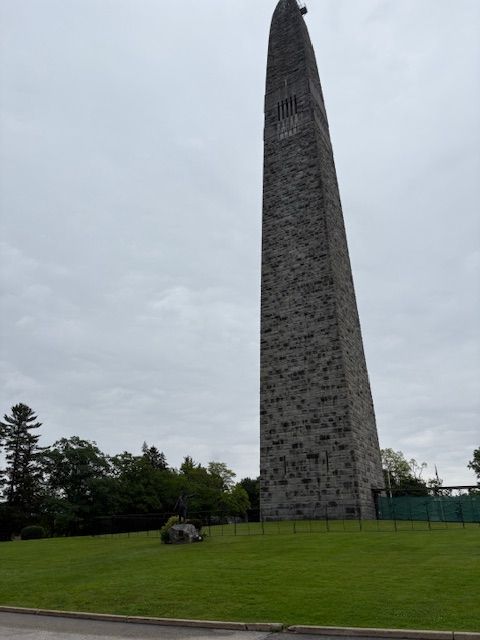
The monument marks the location of a military supply storehouse that British forces intended to capture. General John Burgoyne’s army was advancing south from Canada, and it needed provisions, horses, and other supplies. An expedition sent toward Bennington was meant to replenish those resources and support the army’s continuing advance.
Although remembered as the Battle of Bennington, the fighting occurred across the present-day state line at Walloomsac, New York. On August 16, 1777, American forces led by General John Stark attacked the expedition, which included German troops serving in the British army, Loyalists, and other allies. A second engagement followed when reinforcements arrived. Colonel Seth Warner’s regiment helped secure a decisive American victory.
The defeat denied Burgoyne the supplies he sought and cost his army hundreds of men. It was an important setback during the campaign that ended with his surrender at Saratoga that October. Bennington’s significance extended beyond the protection of one storehouse: the victory weakened the invading army and strengthened American resistance.
More than a century later, the community gave that history a permanent landmark. Construction began in 1887, and the monument was dedicated on August 19, 1891, with President Benjamin Harrison participating in the ceremony. Rising just over 306 feet, the obelisk was built from Sandy Hill dolomite, a type of limestone. Its simple, tapering form gives it a striking presence above the village.
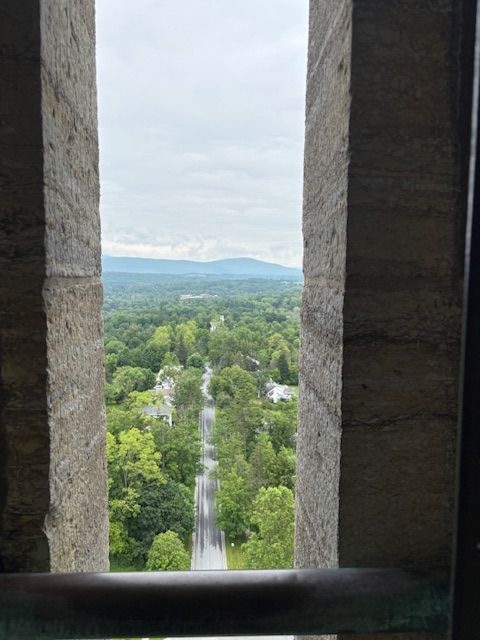
The observation level offers views into Vermont, Massachusetts, and New York. Looking through the narrow openings in its thick stone walls brings the surrounding landscape into focus, a reminder of how closely connected these places were to the movement of soldiers and supplies.
Our visit added a historical stop to our time camping in the region. We encountered both the story of a wartime victory and the later effort to commemorate it. The monument brought those two periods together, while the view from within connected them to the landscape around us.