Aboriginal Art
When we traveled into the Australian Outback, one of the things that fascinated me was Aboriginal art. I had seen the distinctive patterns before but being in Australia gave me an opportunity to learn that these were far more than decorative designs. They could be part of a visual language connecting people with Country, ancestors, ceremony and stories that had been passed from generation to generation.
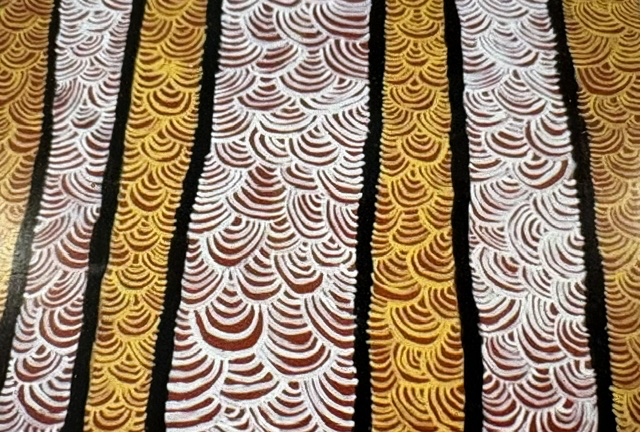
Aboriginal Australian art is not a single style. Australia contains many Aboriginal nations and language groups, each with its own artistic traditions and systems of knowledge. Designs can appear in rock art, sand and ground paintings, ceremonial body painting, carved objects, bark painting and, more recently, paintings on boards and canvas.
The art we encountered in the Outback was particularly associated with the traditions of Central and Western Desert peoples. For thousands of years, designs were created on the ground and on people’s bodies as part of ceremonies. They helped communicate knowledge about Country, ancestral journeys, water, plants, animals and important places.
A major change occurred in 1971 when Aboriginal artists began transferring designs associated with traditional sand and body painting onto more permanent surfaces such as boards and later canvas. The movement grew into what became internationally known as the Western Desert art movement.
One of the most recognizable characteristics is the use of repeated dots, circles, arcs and lines. But I learned that it is dangerous to treat these as a simple code in which one symbol always means one thing. A concentric circle, for example, might represent a waterhole, camp, spring, tree, mountain or another significant place depending upon the artist and story. A single image can also contain different levels of meaning, some of which are known only to people entitled to that cultural knowledge.
What stayed with me from our time in the Outback was the realization that I wasn’t simply looking at attractive patterns. I was seeing an artistic tradition in which land, story, memory and identity could all be connected.