The Ready Rooms
During a hike through the Sagamore Hill area of Sandwich, we came upon this earth-covered entrance hidden among the grass and trees. What appears at first to be a small bunker is one of the Ready Rooms belonging to the former Sagamore Hill Military Reservation, a World War II coastal-defense installation overlooking Cape Cod Bay and the eastern entrance to the Cape Cod Canal.
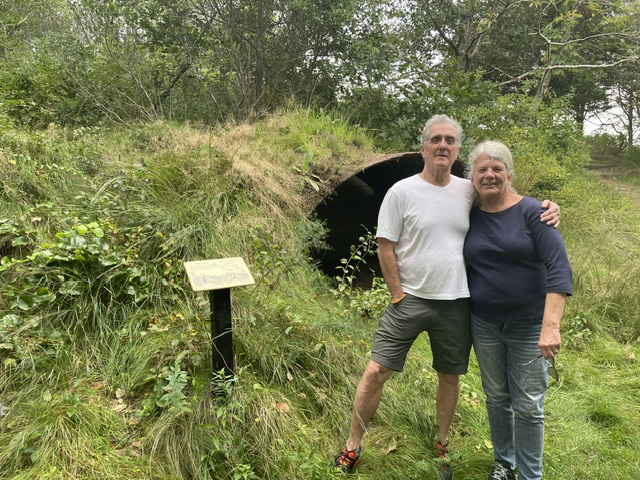
The reservation was constructed in 1941 and 1942, shortly after the Japanese attack on Pearl Harbor brought the United States into the war. It was occupied by Battery C of the 241st Coast Artillery Regiment, a Massachusetts National Guard unit assigned to protect the canal from a possible attack by enemy ships or submarines.
The Cape Cod Canal was strategically important because it allowed military and commercial vessels to travel between Cape Cod Bay and Buzzards Bay without making the longer and more dangerous voyage around the outer Cape. Protecting both entrances to the canal became part of the larger defense of the New England coastline. Sagamore Hill guarded the eastern entrance, while the Butler Point Military Reservation in Marion helped protect the canal’s western approach.
Two 155-millimeter artillery guns were positioned on Sagamore Hill. Each gun stood on a circular concrete platform known as a Panama mount, which allowed the weapon to be turned toward targets approaching from different directions. From the elevated position, soldiers could watch the waters of Cape Cod Bay and respond if an enemy vessel threatened the canal.
The Ready Rooms were part of the system that supported those guns. Underground tunnels connected the plotting rooms and ammunition-storage areas behind the hill with the observation and battery command station above. Side tunnels allowed heavy ammunition to be moved closer to the gun positions. It was then kept in the Ready Rooms so it would be protected but immediately available to the artillery crews if an attack occurred.
The earth covering the rooms was an important part of their design. It helped conceal the structures from aerial observation while also providing protection against explosions and enemy fire. Only the entrances needed to remain exposed, allowing soldiers to move ammunition and equipment between the underground rooms and the nearby gun emplacements.
The plotting room was another essential part of the operation. Information gathered by observers was used to calculate a target’s location, distance, speed, and direction of travel. Those calculations were then communicated to the gun crews. The entire installation depended upon coordination among observers, commanders, plotting-room personnel, ammunition crews, and the soldiers operating the guns.
Although the artillery at Sagamore Hill was never fired against an enemy, the threat it guarded against was real. German submarines operated off the American East Coast during World War II and attacked shipping in Atlantic waters. The men stationed here had to remain prepared even though the anticipated assault on the canal never came.
The Sagamore Hill Military Reservation was deactivated on April 1, 1945. Its guns and military equipment were eventually removed, but several elements of the installation survived, including the Panama mounts, the battery command station, underground passages, and Ready Rooms such as the one behind us.
Today, this former military position has returned to woodland and meadow as part of the Sagamore Hill and Scusset Beach area. The Ready Room entrance is slowly disappearing into the landscape, but it remains evidence of a time when this quiet hill played a role in defending one of New England’s most important waterways. Our hike brought us past something that could easily be mistaken for an abandoned tunnel, yet it was once part of a carefully coordinated system built to protect the Cape Cod Canal and the ships that depended upon it.
Read More From Nancy
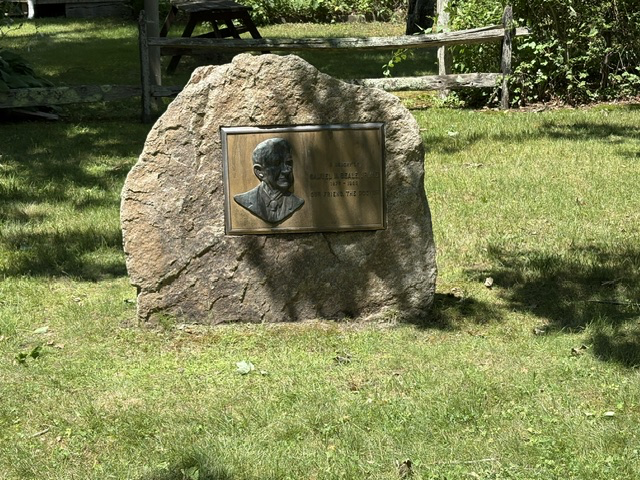
Dr. Samuel Beale Jr.
While exploring another part of Sandwich, I came across this simple memorial to Dr. Samuel M. Beale Jr. The words on the plaque caught my attention: “Our Friend the Doctor.” I wanted to know what kind of physician would be remembered by an entire town in such personal terms. Dr. Beale came to Sandwich in […]
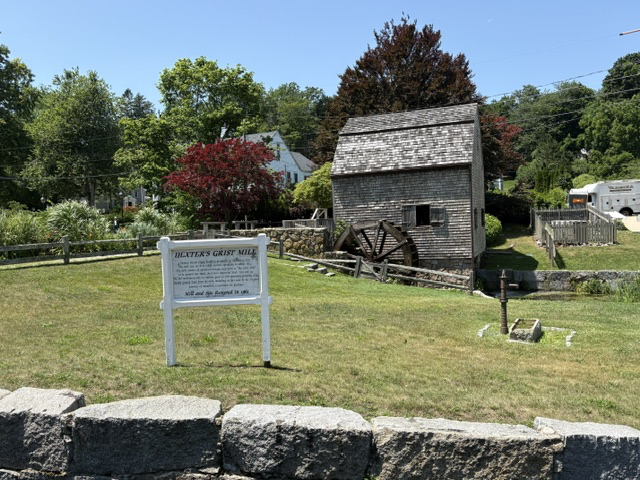
Dexter’s Grist Mill
Standing beside Lower Shawme Pond, Dexter’s Grist Mill preserves the story of one of the earliest and most essential industries in Sandwich. Thomas Dexter began developing a mill at this location soon after the town was settled in 1637. The mill seen here began operating around 1654, using the flowing water from Shawme Pond to […]
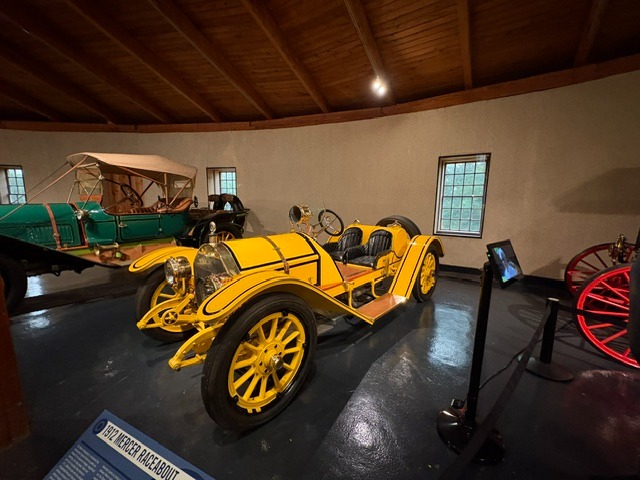
The 1912 Mercer Raceabout
With its bright yellow body, exposed seats, and minimal protection from the weather, the 1912 Mercer Raceabout at Heritage Museums & Gardens makes its purpose clear. This was a car designed around the experience of driving, with little separating its occupants from the road. Manufactured in Trenton, New Jersey, the Raceabout earned a reputation for […]

