Replica of David Thoreau’s Cabin
Just outside the replica of Henry David Thoreau’s cabin at Walden Pond stands this bronze statue of Thoreau, depicting him much as we might imagine him during his years here. He is simply dressed and seemingly caught in the act of walking through the landscape he observed so carefully.
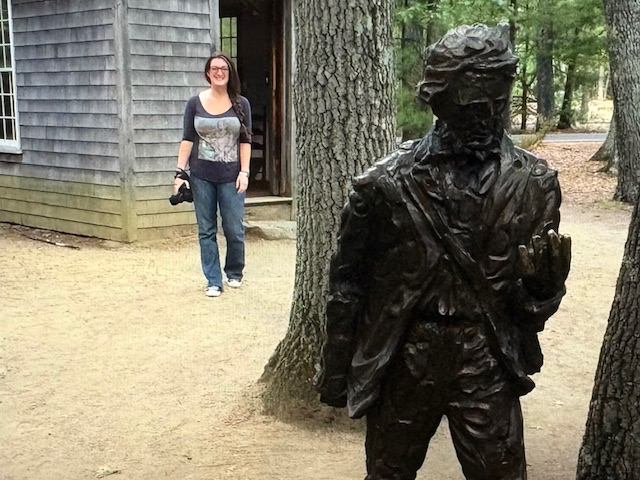
Thoreau came to Walden Pond in July 1845 and built a small cabin on land owned by his friend Ralph Waldo Emerson. He remained there for two years, two months and two days. His purpose was not to isolate himself completely from society but to experiment with living more deliberately and simply. His observations and experiences eventually became the basis for Walden, published in 1854.
The statue has an interesting history of its own. Sculptor Jo Davidson conceived his image of Thoreau in the early 1940s after writer and critic Van Wyck Brooks encouraged him to consider how few public monuments America had created for its great writers and thinkers. Davidson based his Thoreau on the well-known 1856 daguerreotype made by Benjamin Maxham. Plans to place the sculpture at Walden did not move forward at the time because the Thoreau Society could not afford the approximately $10,000 needed for the project.
Davidson died in 1952 without seeing his Thoreau installed here. The bronze figure was finally placed beside the cabin replica in 1995, commemorating the 150th anniversary of Thoreau beginning his stay at Walden in 1845. It is interesting to realize that a statue that now seems so naturally connected to the site has only been part of the Walden landscape since 1995.
The pose seems particularly appropriate. Thoreau was a great walker, spending considerable time exploring the woods, fields and waterways around Concord. He did not simply write about nature from a desk; observation came from being outside, moving through the landscape and paying close attention to the ordinary things around him.
Walden Pond is a place I return to every year. No matter how many times I visit, there is something about walking these same paths, seeing the pond through the trees and remembering that Thoreau once observed this same landscape that keeps drawing me back.
The statue has become part of that experience. Standing near the simple cabin, Thoreau appears almost ready to continue down the path. It is a fitting memorial to a man whose ideas grew from walking, observing and questioning how we choose to live and a reminder that Walden is not simply a place connected to a famous book, but a landscape that continues to invite us to stop, look and pay attention.

Read More From Nancy
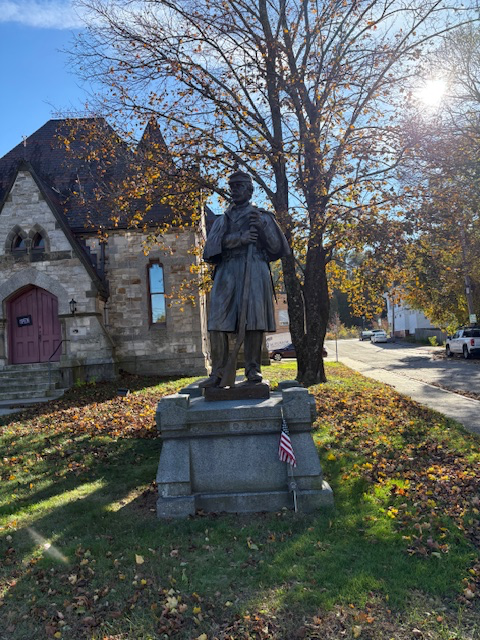
Millmore’s Confederate Statue
Standing outside the Framingham History Center is a powerful piece of the town’s history: a Civil war memorial sculpture created by the noted nineteenth century artist Martin Millmore. Millmore, an Irish-born sculptor who became one of Massachusetts’ more prolific creators of war memorial, is known for honoring ordinary citizens who answered extraordinary calls to service. His works appear in communities across […]
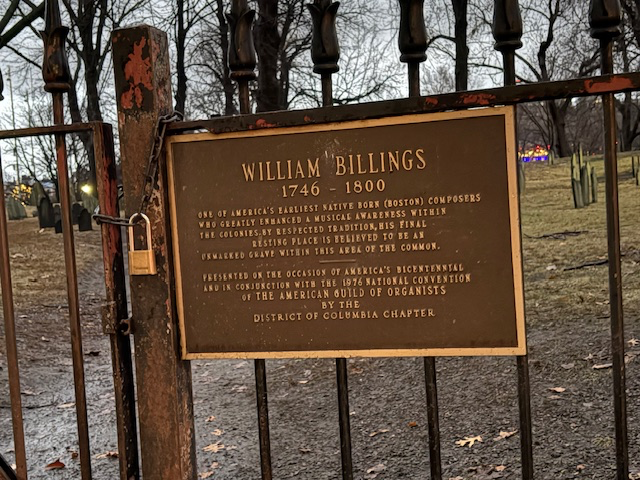
William Billings Plaque
Walking along the Boston Common, there are a number of plaques that quietly mark the lives of people who helped shape the early character of the city. One of them is for Willian Billings, listed as one of America’s earliest native-borncomposers. Billings was born and lived in Boston at a time when the country was just beginning to define its […]
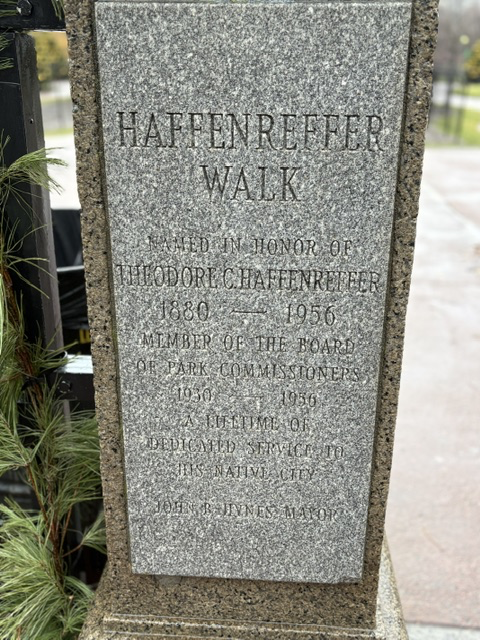
Haffenreffer Walk
While walking through the Boston Public Garden, I noticed this granite marker identifying Haffenreffer Walk. The inscription says that the walkway was named for Theodore Haffenreffer, 1880–1956, who served on Boston’s Board of Park Commissioners from 1930 until his death in 1956—a remarkably long period of service to the city’s parks. Haffenreffer was also part […]

