Mary McLeod Bethune Memorial
During our visits to Washington, D.C., we often came across monuments that introduced us to people whose stories deserved to be better known. Mary McLeod Bethune was certainly one of them. Born in South Carolina in 1875, the fifteenth of seventeen children and the daughter of parents who had been enslaved, she built an extraordinary life around education, opportunity and public service.
Education was not something Bethune took for granted. She was the first child in her family to attend school and eventually trained to become a teacher. She came to believe deeply that education offered a path toward independence and opportunity, particularly for Black children growing up in the decades after emancipation.
In 1904, with very little money, she opened a school for Black girls in Daytona Beach, Florida. It began with just a handful of students. That small school eventually developed into Bethune-Cookman College, today Bethune-Cookman University. What began in a rented house became one of her most enduring contributions to American education.
Bethune’s influence eventually extended far beyond the classroom. She founded the National Council of Negro Women in 1935 and became an important adviser to President Franklin D. Roosevelt. As part of Roosevelt’s informal group of Black advisers sometimes called the “Black Cabinet”, she advocated for greater opportunities for African Americans within New Deal programs and the federal government. She also developed a close friendship with Eleanor Roosevelt.
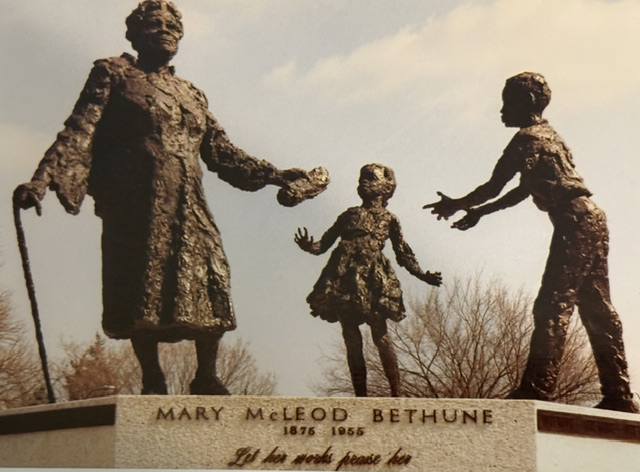
The memorial captures another part of her legacy. Sculptor Robert Berks portrayed an elderly Bethune extending a scroll toward two children. The children are not simply standing beside her; they represent the generations who would inherit the work she had begun. On the scroll is part of Bethune’s “Last Will and Testament”, in which she described what she hoped to leave behind, not wealth or possessions, but values such as love, hope, faith, education and responsibility to young people.
When the memorial was dedicated in Lincoln Park in 1974, it was significant. It was the first monument on public land in Washington, D.C., honoring an African American and a woman. Bethune had died in 1955, but nearly twenty years later her likeness took its place in the nation’s capital.
There is also something meaningful about its location. Across Lincoln Park stands the older Emancipation Memorial, dedicated in 1876. Bethune herself had been born only eleven years after emancipation, the child of formerly enslaved parents. Yet within a single lifetime she became a college founder, presidential adviser and national leader.