Passion Play on the Eve of War
Among my father’s papers is this program from the Black Hills Passion Play, presented by the Saginaw County Council of Churches at the Auditorium in Saginaw, Michigan. There is no year printed on the program, but my father was living in Saginaw in 1941, and the dates printed on the program: December 10 through 14, place this close to one of the most pivotal weeks of his young life.
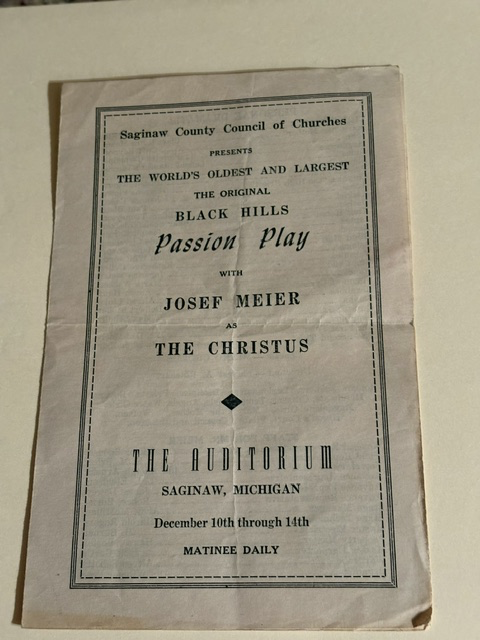
The production starred Josef Meier as the Christus and presented the final days of Jesus, from the entry into Jerusalem through the Last Supper, the trial before Pilate, the Crucifixion, the Resurrection, and the Ascension. This was a substantial theatrical production with a large cast, chorus, musicians, elaborate scenery, and a touring company that brought the Passion story to audiences throughout the country.
The Black Hills Passion Play had an unusual history. Josef Meier came from a family associated with the centuries-old tradition of European Passion plays. Born in Germany, he brought a version of the Passion Play to the United States in the 1930s. The production eventually found a permanent American home in Spearfish, South Dakota, where it became known as the Black Hills Passion Play. For decades, the company performed in the Black Hills during the summer and toured cities throughout the United States during the rest of the year. The program my father saved records one of those touring appearances in Saginaw.
For my father, however, this would have been more than simply an afternoon at the theater. He was Catholic, and the story being presented on that stage was at the center of the faith in which he had been raised. The Passion of Christ: the suffering and Crucifixion followed by the Resurrection, would have been a story he knew intimately through the Mass, Holy Week, the Stations of the Cross, and the traditions of his Church.
What interests me most is when my father was sitting in that auditorium.
In December 1941, he was a young man living away from his home state of West Virginia and still exploring what direction his life might take. Then, on December 7, Pearl Harbor was attacked. The United States declared war on Japan the following day, and within days America was also at war with Germany and Italy. On December 16, my father turned twenty-one.
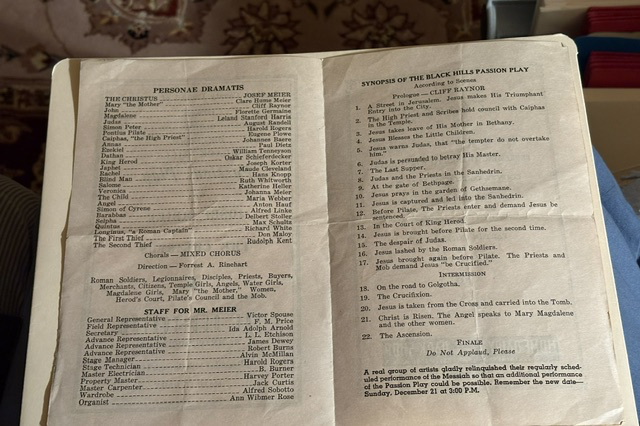
The program says that the Passion Play ran from December 10 through December 14, with a matinee every day. My father attended the Passion Play during an extraordinary seven-day period, after Pearl Harbor and before his twenty-first birthday. Soon he would leave Michigan and return to his home state of West Virginia to enter military service. Whatever plans he had been considering were overtaken by events far larger than himself. Yet somewhere within that pivotal period, he went to a matinee performance of the Passion Play—and for some reason he kept the program.
We often reconstruct wartime lives from enlistment records, military orders, photographs of men in uniform, and accounts of battles. This little program captures something different. Before my father became a serviceman, he was a young Catholic man going about his life, working, considering his future, receiving mail, going places, and practicing a faith that was already part of who he was.
In December 1941, he walked into that Saginaw auditorium at twenty years old. Pearl Harbor had just been attacked. America had just entered World War II. His twenty-first birthday was only days away, and soon he would be heading home to West Virginia and into the military. I cannot know what went through his mind as he watched the story of the Passion unfold that afternoon. But I do know that the story itself mattered to him. And perhaps that is why this fragile program traveled with him through everything that came afterward and remained among his papers all these years. It is more than a souvenir from a performance. It is a small surviving piece of my father’s life at the moment just before everything changed.
Read More From Nancy
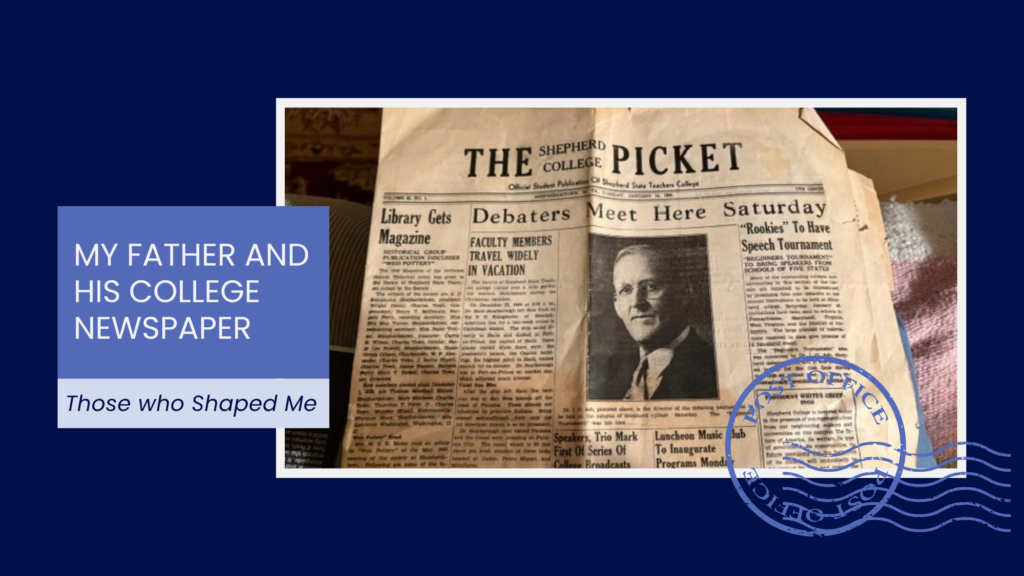
My Father and His College Newspaper
My parents kept these copies of The Shepherd College Picket from the time my father, Roger, attended Shepherd College in Shepherdstown, West Virginia. Looking through them now gives me another way to consider his life before he became my father. These pages preserve something of the community around him during his college years. The issues […]
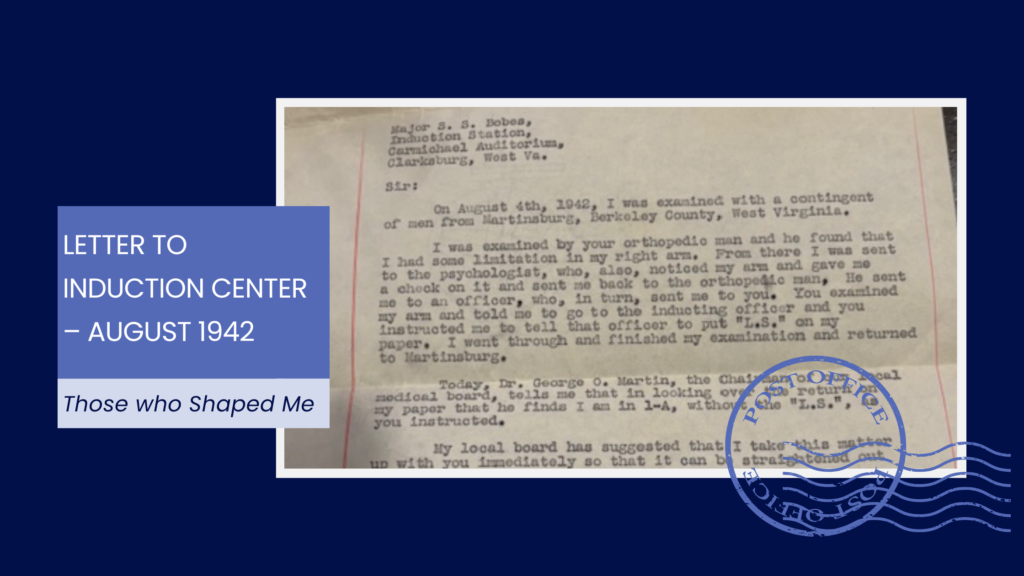
Letter to Induction Center – August 1942
In August of 1942, my father found himself in a place that marked a turning point, not just in his life, but in the lives of millions of young men across the country. His letter, addressed to Major S,S. Bobes at the induction station in Clarksburg, WV, brings that moment into sharp focus. The examination took […]
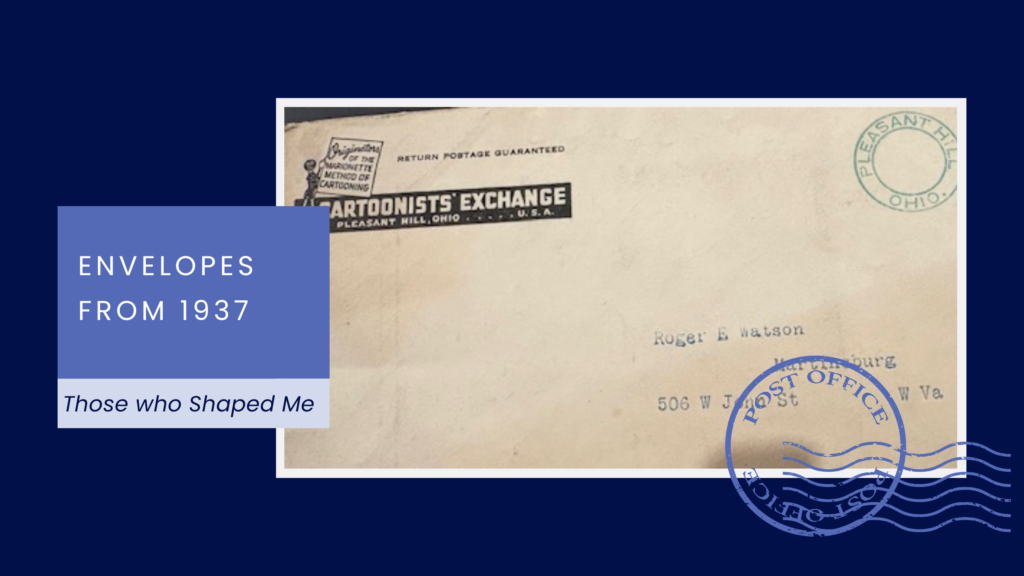
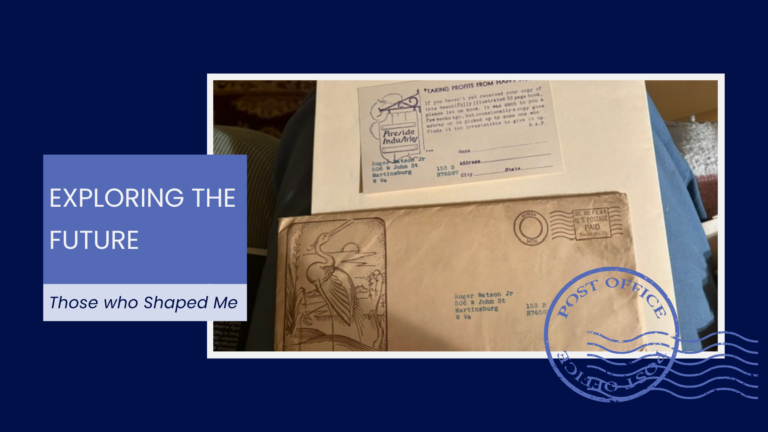
Envelopes from 1937
There is a different address that appears on several envelopes in the fall of 1937, all addressed to my father in Martinsburg, WV. He would have been just about seventeen at the time. I am puzzled by the address. These envelopes were not sent to his mother’s home. Instead, they carry a different street in […]

