Charles W. Morgan
No visit to Mystic Seaport feels complete without spending time aboard the Charles W. Morgan. Towering above the waterfront with her three masts and black hull, she immediately captures your attention. More than simply a beautiful sailing ship, she is the last surviving wooden whaleship in the world and one of the greatest treasures of America’s maritime history.
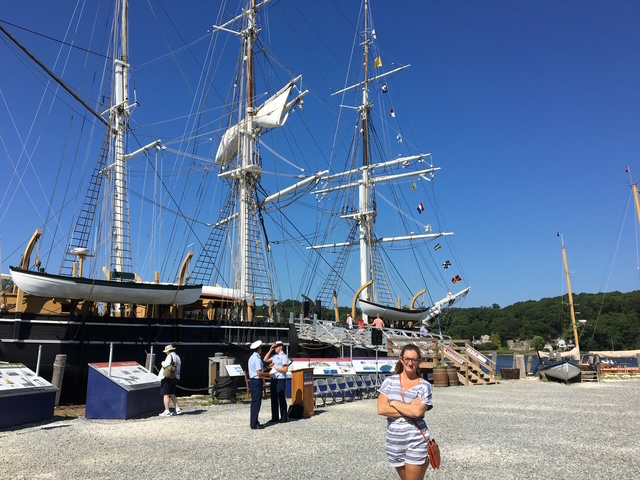
Built in New Bedford, Massachusetts, in 1841, the Morgan was constructed during the height of New England’s whaling industry. For the next eighty years she sailed the Atlantic, Pacific, Arctic, and Indian Oceans on thirty-seven whaling voyages. Her crews often spent three or four years at sea, enduring storms, dangerous seas, isolation, and the constant hazards of hunting whales. The oil they brought home illuminated cities, lubricated machinery during the Industrial Revolution, and became one of the nation’s most valuable natural resources before the widespread use of petroleum.
Standing beside the Morgan, it is difficult to imagine the lives of the men who sailed her. The ship carried captains, mates, sailors, cooks, cabin boys, and craftsmen from many different countries and cultures. Living in cramped quarters, they worked together under demanding conditions, knowing that success depended upon discipline, teamwork, and perseverance. Every voyage represented both tremendous opportunity and significant risk.
By the early twentieth century, the age of commercial whaling had come to an end. Most whaleships were abandoned, dismantled, or lost at sea. The Charles W. Morgan was one of the few to survive. In 1941 she found a permanent home at Mystic Seaport, where generations of visitors have been able to experience a vessel that otherwise might have disappeared forever. After an extensive restoration, she even returned to the sea in 2014, making her thirty-eighth voyage more than 170 years after she was launched.
Our family visited Mystic Seaport several times during our homeschooling years because we wanted history to be something our daughters could experience, not simply read about. Walking the decks of the Charles W. Morgan, looking up into her towering rigging, and imagining life aboard a nineteenth-century whaleship brought that history to life in a way no textbook ever could.
Years later, Erin and I returned to Mystic Seaport and found ourselves drawn once again to the Morgan. Although we had seen her before, the experience was different. This time I appreciated not only the history of the ship itself but also the dedication of the people who have preserved her. Maintaining a wooden vessel of this size requires extraordinary craftsmanship and commitment, ensuring that future generations can continue to walk her decks and better understand America’s maritime past.