Colonial Pemaquid
On our drive home from Halifax, Marty and I were looking for somewhere in Maine that we had not already explored. Maine has always been one of our favorite places, and over the years we have visited many of its better-known historic sites. Colonial Pemaquid was one place we had somehow missed.
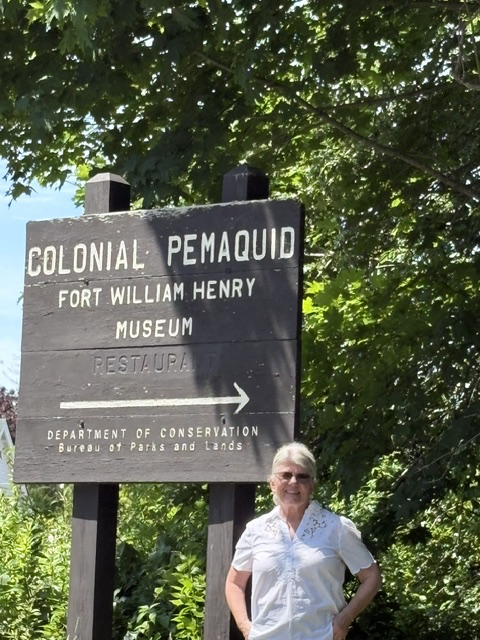
Here was a site whose English colonial history reaches back to the same generation as Plymouth, yet it felt almost undiscovered. There were no crowds moving us from one attraction to another. Instead, we could walk across the grounds, explore the remains of buildings and try to imagine the community that had existed here nearly four centuries ago.
The history of this small peninsula actually begins thousands of years before the arrival of Europeans. Native peoples lived in the region for at least 7,000 years, and a substantial Wabanaki community was present on the Pemaquid Peninsula into the early seventeenth century. English fishermen and traders began using the region in the early 1600s, and a permanent English settlement was established here during the 1620s.
That immediately put Pemaquid into perspective for me. Plymouth was established in 1620. Pemaquid followed only a few years later, between about 1625 and 1628, making this one of the earliest permanent English settlements in what would eventually become the United States.
By 1631, two merchants from Bristol, England, had acquired rights to 12,000 acres here, along with additional land for every settler they brought from England. By 1665 there were approximately thirty houses at Pemaquid, and by the early 1670s the population may have reached 150 to 200 people. This was not simply an isolated fishing station. It had become a small colonial community.
Its location, however, placed it on a contested frontier. Pemaquid stood near the northeastern limits of English settlement and close to territory claimed by France. The Wabanaki peoples had occupied this region long before either European power arrived, and the struggle among Native peoples, English settlers and the French would repeatedly determine Pemaquid’s fate.
The village was attacked and burned in 1676 during the regional conflict associated with King Philip’s War. Fort Charles was built the following year, only to be destroyed along with the rebuilt settlement in 1689. The Massachusetts Bay Colony responded by constructing the enormous stone Fort William Henry in 1692. It too fell, in 1696, following an attack by French and Wabanaki forces. The English then abandoned Pemaquid for approximately thirty years.
Another attempt at settlement began in 1729 when Colonel David Dunbar constructed Fort Frederick on the ruins of Fort William Henry and recruited settlers, including Scots-Irish immigrants, to establish a new community. That settlement also struggled to survive. Fort Frederick remained in use until 1759 and was later largely dismantled during the American Revolution so that British forces could not occupy it.
Archaeologists have uncovered foundations and cellar holes from the seventeenth- and eighteenth-century settlements. At least fourteen foundations of early structures have been excavated, along with remains associated with the officers’ quarters of Fort William Henry and Fort Frederick. The artifacts recovered here include coins, pottery, musket balls, metal objects and ordinary household utensils—the small things that help reconstruct what everyday life was like in this remote settlement.
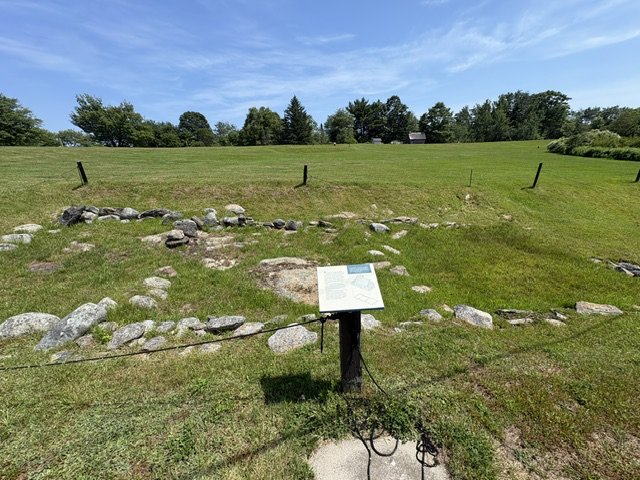
Perhaps what struck me most was how accessible all of this felt. We were able to wander across ground occupied by Native peoples for thousands of years and later by some of New England’s earliest European settlers, stopping at the excavated foundations and exploring the remains at our own pace.
Colonial Pemaquid does not have the recognition of Plymouth, yet the stories of these places unfolded at almost the same moment in early New England history. Instead, we found one of the oldest chapters of colonial New England waiting quietly along the Maine coast.