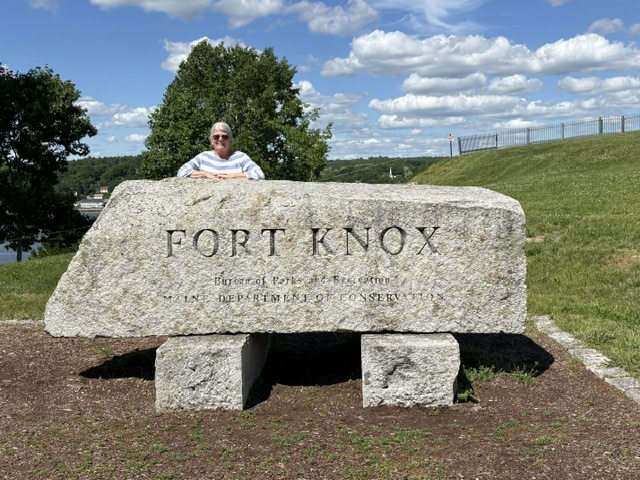
Fort Knox State Historic Site
Some historic forts are remembered because great battles were fought within their walls. Fort Knox, overlooking the Penobscot River in Prospect, Maine, is remembered for something quite different. It stands today as one of the finest preserved granite coastal fortifications in the United States precisely because the attack it was built to repel never came. Its story is not one of warfare, but of preparation, engineering, and the determination of a young nation to protect its growing coastline.
To understand why Fort Knox was built, we must begin long before the first granite block was laid. Hundreds of millions of years ago, geological forces shaped the granite and schist that form the rugged landscape of the Penobscot Narrows. Glaciers later carved the river valley, and rising sea levels created one of the finest natural harbors on the Maine coast. Nature provided a protected waterway that would eventually become vital to the region’s economy. The harbor determined everything that followed.
Long before European ships entered these waters, the Penobscot people lived along this river, using it as a source of food, transportation, and trade. The river connected communities throughout the region and provided access to the rich natural resources of the interior. For Indigenous peoples, this was already an important place centuries before maps gave it an English name.
By the seventeenth and eighteenth centuries, the Penobscot River had become one of the most valuable waterways in New England. Timber from Maine’s vast forests floated downstream to Bangor, where it was processed and shipped to markets around the world. During periods of conflict between Britain, France, and later the United States, whoever controlled this river controlled one of the region’s greatest economic assets.
The War of 1812 exposed just how vulnerable America’s coastline remained. British forces had sailed into Penobscot Bay, occupied Castine, and demonstrated how easily an enemy fleet could threaten inland communities. Determined never to allow that to happen again, the United States launched an ambitious program of coastal defense known as the Third System of Fortifications. Fort Knox became one of its most important projects.
Military engineers selected this location because of the narrow bend in the river. Any hostile ship attempting to reach Bangor would be forced to pass directly beneath the fort’s guns. The geography itself became part of the defense. The fort’s massive granite walls and carefully positioned artillery could command the channel from multiple directions, making passage extremely dangerous for any attacking fleet.
Construction began in 1844, but progress was anything but smooth. Congress appropriated money only a little at a time, and work often slowed or stopped while engineers waited for additional funding. What was expected to take only a few years stretched into nearly two decades.
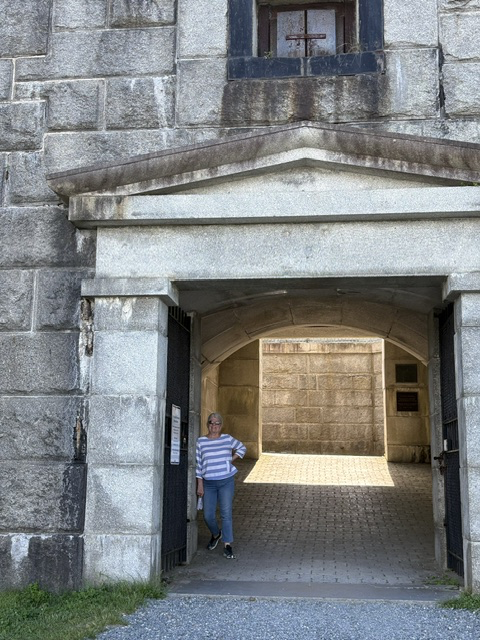
One of the aspects of Fort Knox that impressed me most was learning about the people who actually built it. Hundreds of Maine laborers found employment here as quarrymen, stonecutters, masons, carpenters, blacksmiths, teamsters, and general laborers. They worked twelve-hour days cutting enormous granite blocks from nearby quarries, hauling them by oxen and wagons, transporting them across the river on barges, and lifting stones weighing several tons into place using massive wooden derricks. Long before diesel engines, hydraulic cranes, or modern construction equipment, these craftsmen created walls that remain remarkably sound more than 160 years later.
Everything changed in 1861 when the Civil War erupted. Suddenly the unfinished fort took on new urgency. Fearing Confederate naval raids along the Maine coast, Congress released the money necessary to complete construction. By 1862, Fort Knox was essentially finished. Ironically, the Confederate attack everyone feared never occurred.
Perhaps the greatest irony of Fort Knox is that its success is measured by what never happened. No hostile fleet ever attempted to force the Penobscot Narrows. No bombardment shattered its walls. No battle scarred its parade ground. Because the fort fulfilled its purpose through deterrence rather than combat, it remains one of America’s best-preserved nineteenth-century coastal fortifications.