The Massachusetts Historical Society
I have passed countless historic buildings in Boston, but on this visit I had a particular reason for walking through the doors of the Massachusetts Historical Society. I had come to see a special exhibition devoted to the history of the Irish in Boston. A story that is inseparable from the history of the city itself.
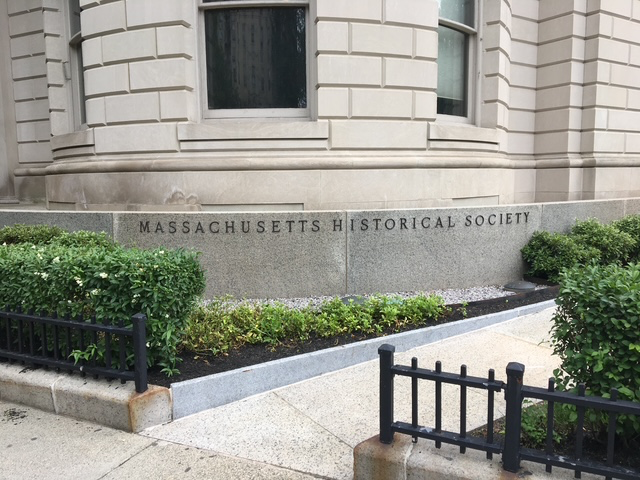
Even before considering the exhibition, the institution has a remarkable history of its own. The Massachusetts Historical Society was founded in Boston on January 24, 1791, when the Reverend Jeremy Belknap and a small group of others came together with the goal of collecting and preserving materials documenting the history of the young nation. It is the oldest organization in the United States devoted to collecting materials for the study of American history. Their stated purpose was wonderfully straightforward: to “collect, preserve, and communicate” the materials needed to record the country’s history.
Over more than two centuries, that original effort developed into an extraordinary research library and archive. The Society preserves millions of manuscript pages, letters, diaries and other documents, along with newspapers, maps, photographs, prints, works of art and historical artifacts. Its holdings include important personal papers connected with John Adams, John Quincy Adams and Thomas Jefferson, as well as records documenting the experiences of generations of less famous Americans.
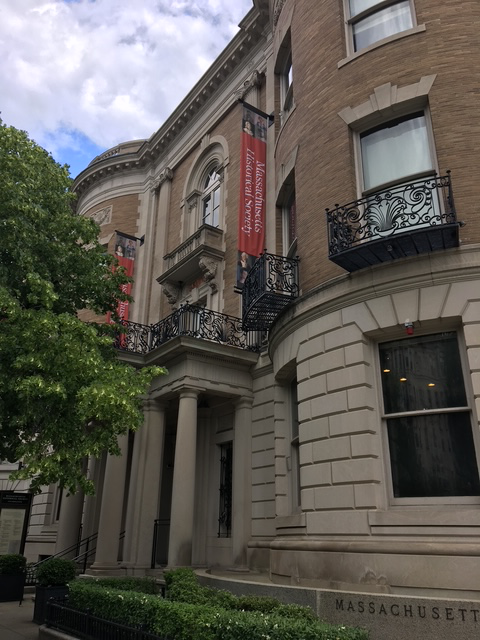
The building in my photographs is itself part of that story. Located at 1154 Boylston Street, not far from the Back Bay Fens, it was designed by prominent Boston architect Edmund March Wheelwright and dedicated in 1899. Created specifically as a home for the Society and its collections, its dignified façade and formal interiors reflected the importance its founders and supporters placed on preserving the documentary record of the past.
But it was a temporary exhibition that brought me here.
In 2017, the Society presented “The Irish Atlantic: A Story of Famine, Migration, & Opportunity.” The exhibition opened on March 10 and remained on view through September 22, so the exhibit I remember was indeed a special exhibition rather than a permanent one. It was presented in partnership with the Forbes House Museum in Milton. The exhibition began with one of the defining events in Irish and Irish American history—the Great Famine of the 1840s.
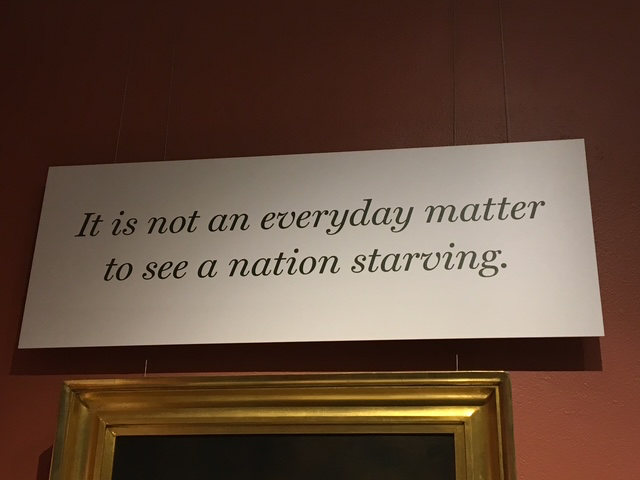
One of its stories connected Boston directly with Ireland. In 1847, as people in Ireland were suffering through the devastating famine, the USS Jamestown sailed from Boston carrying relief supplies. Captain Robert Bennet Forbes commanded the voyage, which became an important expression of American humanitarian assistance to Ireland. The exhibition used that voyage as a starting point for exploring the enormous migration that followed and the growth of Boston’s Irish population during the second half of the nineteenth century.
Boston’s Irish faced intense anti-immigrant and anti-Catholic prejudice. One of the objects displayed was an 1854 broadside attacking Irish members of a local militia during the controversy surrounding the capture of Anthony Burns, a man who had escaped slavery. The document revealed how deeply nativist attitudes toward Irish immigrants had become embedded in the political and social conflicts of the period.
Over time, however, the Irish became an increasingly important part of Boston. They created churches, charitable organizations and other community institutions, entered the workforce and military, became involved in politics, and gradually transformed the cultural and political character of the city. “The Irish Atlantic” followed that development through the final decades of the nineteenth century.
I had gone to learn more about the Irish in Boston, but the visit also reminded me of the importance of places like the Massachusetts Historical Society. For more than two centuries, people have been bringing pieces of the past through its doors so they would not disappear.
Read More From Nancy
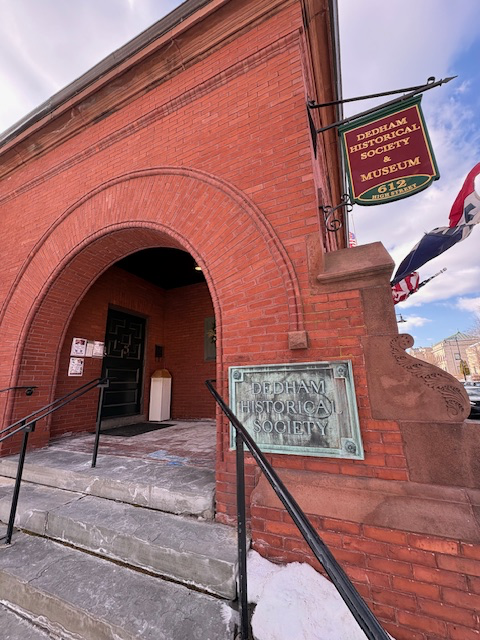
Dedham Historical Museum
I went to visit the town green in Dedham, Massachusetts for its colonial markers and instead found myself stepping into the Dedham Historical Society and Museum. Almost immediately, I felt I had encountered a kindred spirit in the woman who greeted me at the door. Here was a whole museum designed and dedicated to the […]
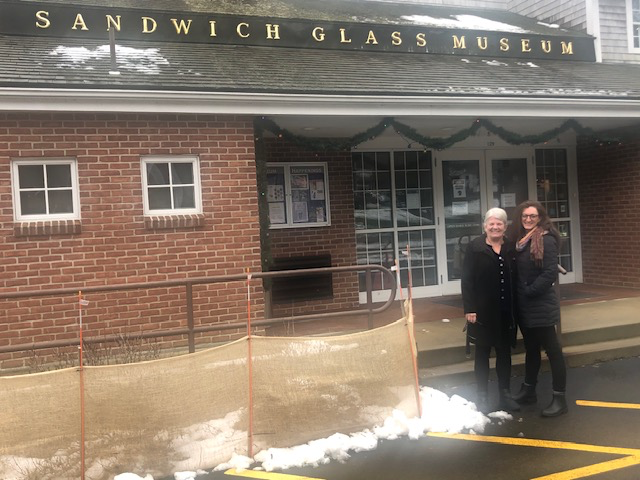
Glass Museum
In December 2020, I was searching for something meaningful to do for my birthday. COVID-19 had brought much of the MetroWest Boston area to a standstill, and nearly everything was closed. After months of restrictions and canceled plans, even a simple day trip felt like a welcome escape. When I learned that the Sandwich Glass […]

Hancock Shaker Village
When you visit Hancock Shaker Village, you are not simply touring historic buildings—you are stepping into one of the most successful communal societies in American history. The village tells the story of the Shakers, whose commitment to faith, innovation, and craftsmanship transformed this corner of the Berkshires into a thriving community that still inspires visitors […]

