The Lehigh Coal & Navigation Building
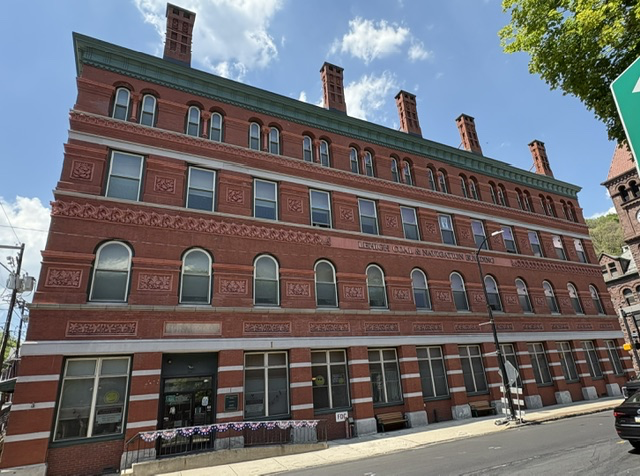
Standing prominently near the center of Jim Thorpe is the former headquarters of the Lehigh Coal & Navigation Company. After seeing the enormous piece of anthracite displayed nearby, this building helps complete the story. The coal beneath the mountains created the opportunity, but the Lehigh Coal & Navigation Company developed the transportation system that helped turn Mauch Chunk into one of the important industrial communities of nineteenth-century Pennsylvania.
The company emerged in the early 1800s through the efforts of Josiah White and Erskine Hazard, who recognized both the value of the region’s anthracite and the enormous difficulty of getting it to market. They improved navigation on the Lehigh River and developed the Lehigh Canal, allowing coal to move south toward Philadelphia and other growing cities. In 1827, the company also constructed the gravity railroad between the mines at Summit Hill and Mauch Chunk, allowing loaded coal cars to descend the mountain largely by gravity.
The company became much more than a coal-mining operation. It controlled mines, canals, railroads and other transportation infrastructure, helping shape the development of Mauch Chunk and communities throughout the Lehigh and anthracite regions.
The building in my photograph was designed in 1882 by Philadelphia architect Addison Hutton. Interestingly, it was originally commissioned and begun by the Lehigh Valley Railroad. Before it was completed, however, the railroad sold it to the Lehigh Coal & Navigation Company, which finished the building and made it its headquarters.
Hutton designed the structure to be fire-resistant, incorporating cast- and wrought-iron structural elements. Its red brick façade, carved sandstone and terra-cotta ornamentation made it one of the most imposing commercial buildings in Mauch Chunk.
The building survived even after the industrial world that created it changed. The Lehigh Coal & Navigation Company eventually disappeared, but its former headquarters was preserved and later rehabilitated for residential use.
What I find particularly interesting is how much of the story of old Mauch Chunk can be understood simply by standing in this part of town. The mountains provided the anthracite. The company found ways to move it. The wealth generated by that enterprise helped create the railroads, businesses, hotels and impressive homes that still line the streets.
The Lehigh Coal & Navigation Building is therefore more than an impressive nineteenth-century office building. It represents the company whose activities helped transform a narrow mountain settlement into the prosperous community of Mauch Chunk.

Read More From Nancy
A Town Built into the Mountain
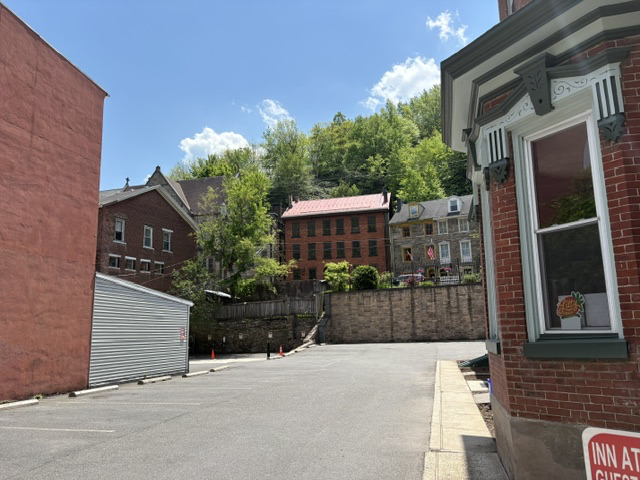
As we walked through Jim Thorpe, I found myself looking not only at individual historic buildings, but at how the entire town had been fitted into the landscape. This view captured that relationship particularly well. What was once Mauch Chunk developed in an unusually confined setting. The Lehigh River runs through a narrow valley surrounded […]
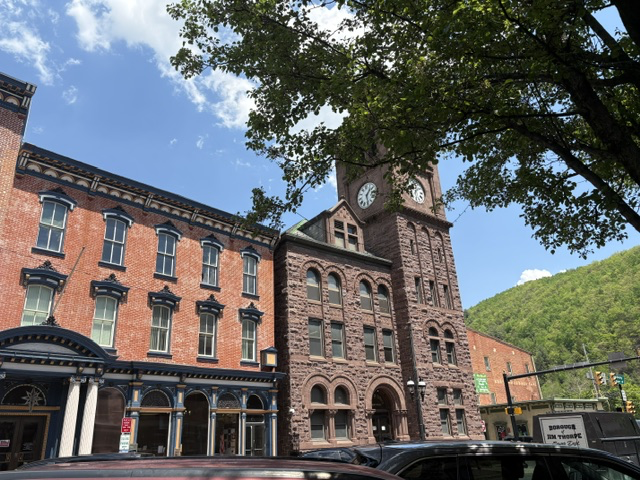
The Carbon County Courthouse
Standing prominently at the corner of Broadway in Jim Thorpe, the Carbon County Courthouse is one of the buildings that immediately draws your eye. Its massive stone walls and tall clock tower seem perfectly suited to the narrow valley and steep mountains surrounding the town. The courthouse we see today is the third to occupy […]
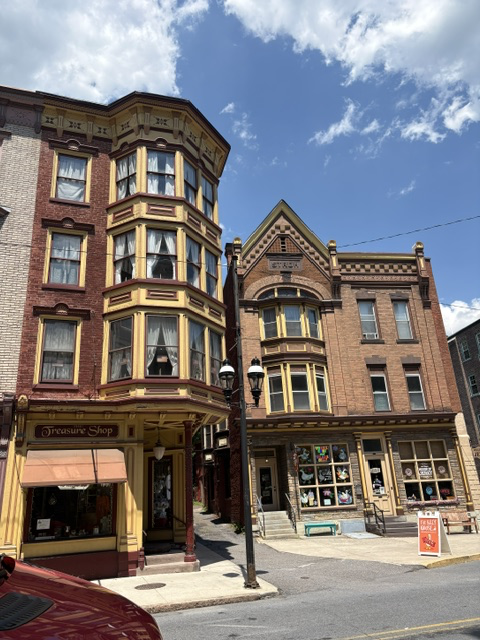
The Stroh Building
Walking through Jim Thorpe, I kept noticing names carved into the façades of buildings. High above the windows of this handsome brick building is one of them: STROH. The name leads back to a family that was part of the commercial and industrial life of old Mauch Chunk during the nineteenth century. The Stroh family’s […]

