Olmsted Park
Olmsted Park is one of the places that helps tell the story of how Brookline developed differently from the growing city beside it. Although the park crosses the Boston-Brookline boundary, I think of it as particularly connected to Brookline because Frederick Law Olmsted chose Brookline as his home and made the town the center of his extraordinary landscape design practice.
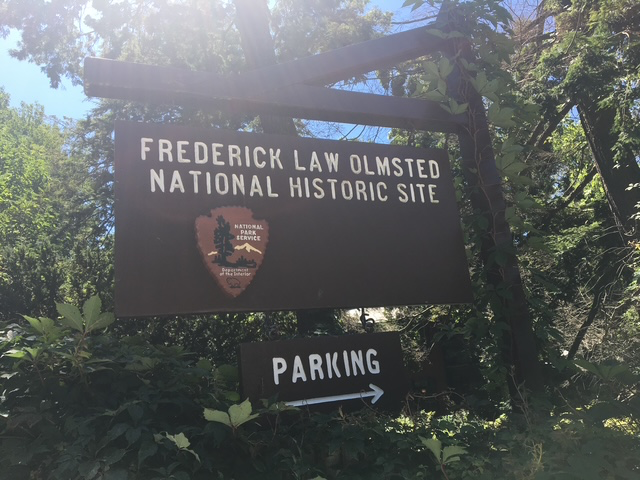
Olmsted moved to Brookline in 1883 and established his home and office at Fairsted on Warren Street. From there, he and the landscape architecture firm that continued his work designed parks, estates, campuses, communities, and public landscapes throughout the country. Brookline therefore became an important center in the development of American landscape architecture.
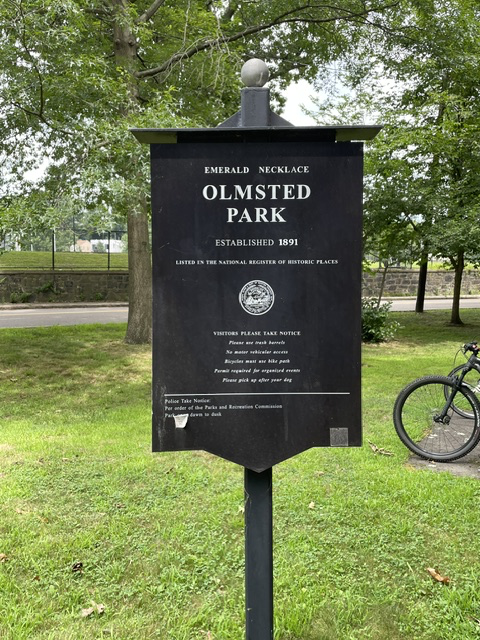
Olmsted Park was established in 1891 as part of the Emerald Necklace, the interconnected system of parks and waterways Olmsted designed through Boston and Brookline. Originally called Leverett Park, it was renamed Olmsted Park in his honor in 1900.
For Brookline, the park was about more than preserving a pretty piece of countryside. Olmsted was working with the Muddy River and a landscape that suffered from drainage, flooding, and sanitation problems. His solution combined engineering with landscape design. Waterways were reshaped, ponds and wetlands were incorporated into the plan, and trees, pathways, bridges, and open spaces were arranged to create the appearance of a natural landscape.
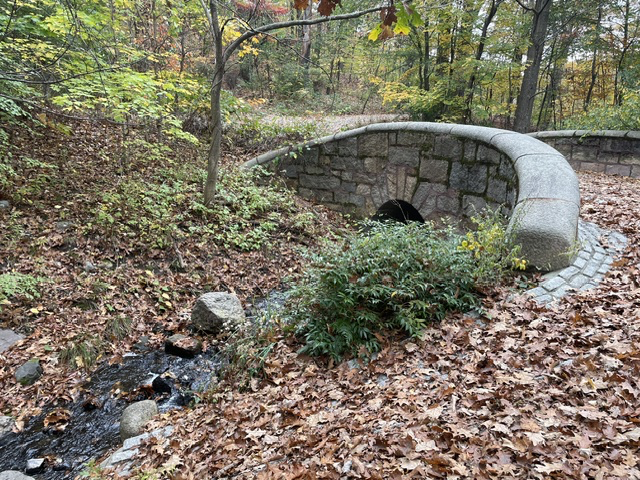
The stone bridge in my photograph is one of the details I particularly enjoy. Constructed of rough stone and curving gently across the small stream, it looks as though it simply belongs there. That was very much part of Olmsted’s approach. The bridges, paths, waterways, trees, and views were designed to work together without making visitors constantly aware that someone had designed them.
Olmsted’s influence can be found elsewhere throughout Brookline. He was involved in the transformation of Beacon Street into a broad, landscaped boulevard, and his ideas influenced the development of residential neighborhoods that incorporated trees, open spaces, and the natural contours of the land. His presence helped reinforce something that became central to Brookline’s identity: remaining closely connected to Boston while preserving a more open, landscaped suburban character.
That is one of the reasons I find Olmsted Park particularly meaningful when thinking about Brookline. The town is often described as one of America’s earliest suburbs, but its development was not simply about building houses outside Boston. There was also a conscious effort to preserve green space and create an environment different from the increasingly dense city nearby.
Today we can walk beneath mature trees, follow the paths along the Muddy River, cross these small stone bridges, and easily assume that this landscape simply survived as Brookline grew around it. Much of what we see was deliberately created.
Read More From Nancy
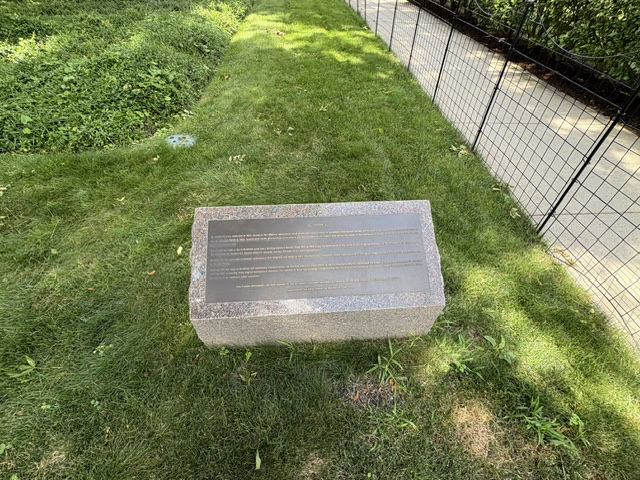
The Original St Aidan’s Church
I have visited John F. Kennedy’s birthplace several times, so today, I decided to walk through the neighborhood to find St. Aidan’s Church, where he had been baptized. I knew it was only a few blocks away, so I expected it would be easy to find. Instead, I found myself wandering the quiet streets of […]
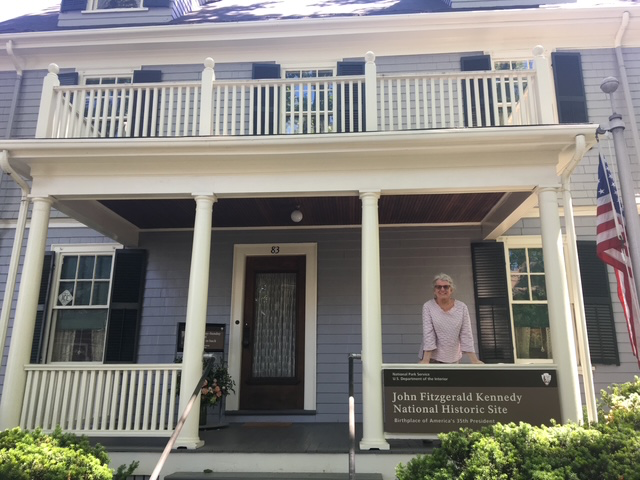
John F. Kennedy’s Birthplace
The John Fitzgerald Kennedy National Historic Site in Brookline, Massachusetts offers the opportunity to step into the earliest chapters of that life that would shape world history. Touring this modest home, you are greeted by the recorded voice of Rose Kennedy. She calmly recounts the rhythms and rituals of family life. Through her reflections, the house […]
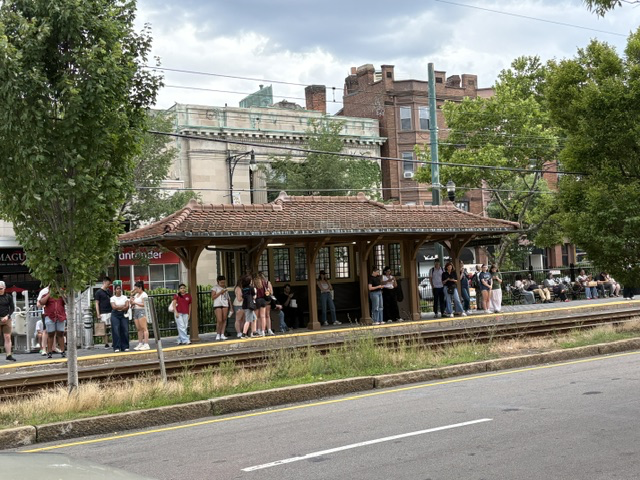
Trolley Stop on Beacon Street
One of the features that gives Brookline its distinctive character is the Green Line trolley running directly down the center of Beacon Street. Unlike a subway hidden underground, the trolley remains part of the streetscape, with passengers waiting on platforms in the middle of one of the town’s busiest roads. The trolley and Beacon Street […]

