Coolidge Corner Theatre
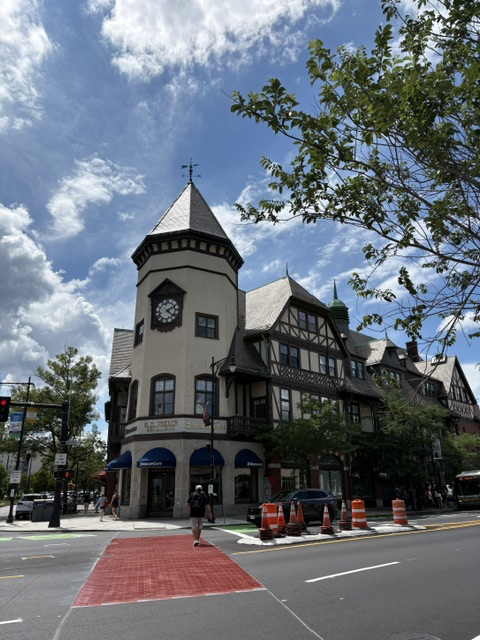
The Coolidge Corner Theatre has been part of the landscape of Brookline for so long that it is easy to think of it simply as the neighborhood movie theater. But the building has a more interesting history than its marquee suggests.
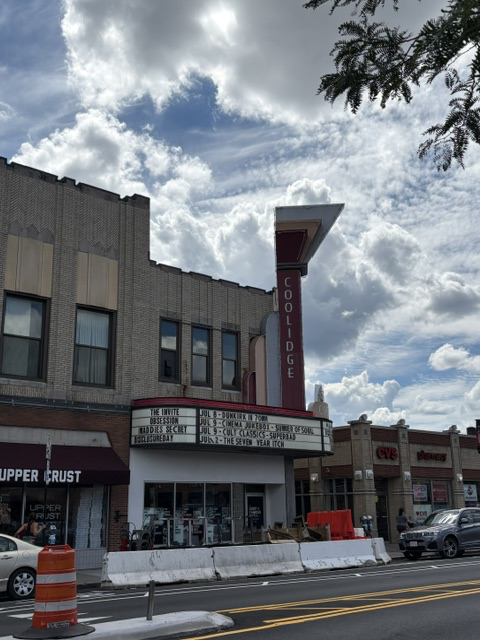
The structure did not begin as a theater at all. It was built in 1906 as the Beacon Universalist Church, designed by Brookline architect C. Howard Walker. The original Romanesque Revival building contained the church sanctuary, a hall, Sunday school classrooms, and four stores. The congregation held its first service there on November 25, 1906.
For years, Brookline resisted allowing a movie theater in town. There was genuine concern that motion pictures might have a negative influence, particularly on young people. It took 17 years before the town finally approved a movie theater. During the Depression, the former church was dramatically transformed into an Art Deco movie palace with approximately 1,500 seats. The Coolidge Corner Theatre opened in December 1933.
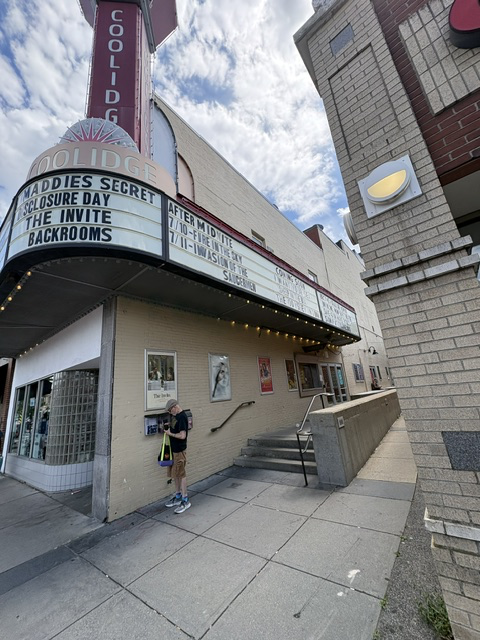
That transformation explains the unusual building we see today. Beneath the distinctive 1930s façade is the earlier 1906 church. The herringbone brickwork along the upper façade and the vertical marquee belong to its Art Deco incarnation and disguise much of the building’s original religious architecture.
During Hollywood’s golden age, generations of Brookline residents came here to see stars such as Katharine Hepburn, Humphrey Bogart, Cary Grant, Ingrid Bergman and later Marilyn Monroe and James Dean. By its third anniversary in 1936, the theater was describing itself as a community gathering place that offered both culture and an escape from the worries of everyday life during the difficult Depression years.
By the 1970s and 1980s, however, The Coolidge was struggling. Multiplex theaters, television, and home video changed the movie business. Under Justin Freed, beginning in 1977, the Coolidge reinvented itself as an art-house cinema specializing in independent, foreign, classic, and unusual films. Even that was not enough to guarantee its survival. In 1988, an agreement was reached to sell the property to a developer who considered either demolishing it or converting it to commercial space.
That possibility galvanized the community. Residents organized the Friends of the Coolidge, distributed leaflets, raised money, and even formed a huge human circle around the theater to symbolically “hug” the building. The Brookline Historical Commission recognized its historic importance, temporarily preventing redevelopment while supporters searched for a solution.
Ultimately, Brookline resident and developer Harold Brown stepped in. His charitable foundation purchased the building and arranged a 99-year lease with the newly established nonprofit Coolidge Corner Theatre Foundation. The theater reopened in November 1989, its marquee announcing, “WE DID IT – ON WITH THE SHOW.”
More than ninety years after the first movie was shown here, the lights are still on and the marquee is still changing.
Read More From Nancy
The Original St Aidan’s Church
I have visited John F. Kennedy’s birthplace several times, so today, I decided to walk through the neighborhood to find St. Aidan’s Church, where he had been baptized. I knew it was only a few blocks away, so I expected it would be easy to find. Instead, I found myself wandering the quiet streets of […]
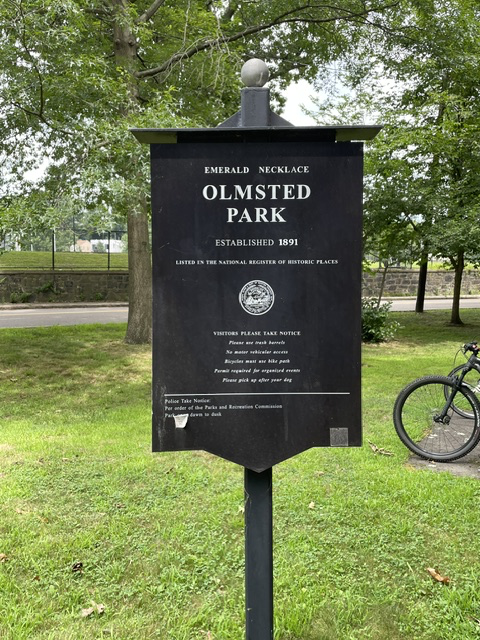
Olmsted Park
Olmsted Park is one of the places that helps tell the story of how Brookline developed differently from the growing city beside it. Although the park crosses the Boston-Brookline boundary, I think of it as particularly connected to Brookline because Frederick Law Olmsted chose Brookline as his home and made the town the center of […]
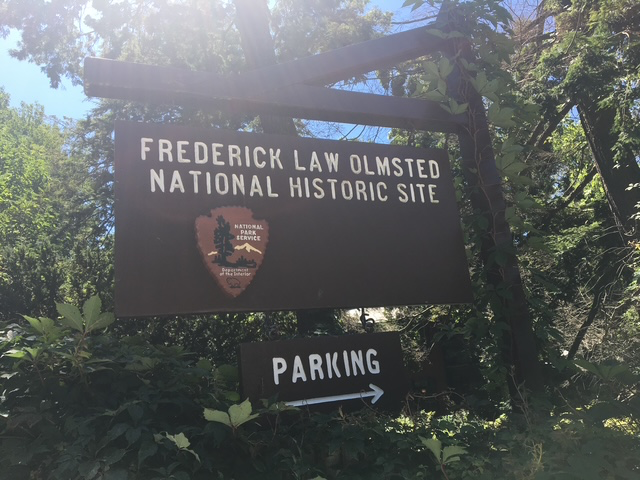
Frederick Law Olmsted National Historic Site
The first time I visited the Frederick Law Olmsted National Historic Site in Brookline, everything was new to me: his name, his work, even the realization that so many landscapes I had walked through carried the imprint of one mind. I did not grow up knowing who Frederick Law Olmsted was. I knew about parks. […]

