Quarry Workers Union
This small card represents far more than membership in a labor union. It tells the story of an industry that shaped Concord, New Hampshire, and unexpectedly connected both sides of my family.
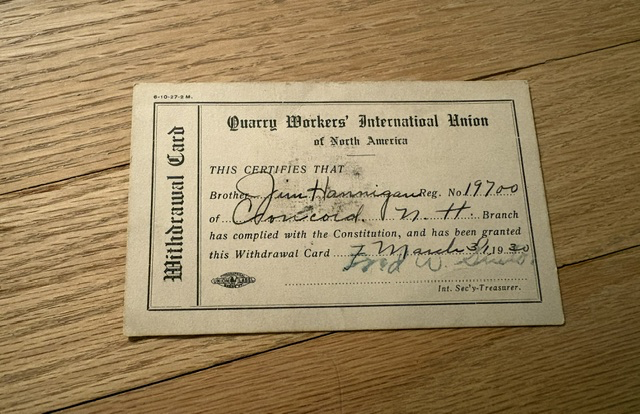
Issued in 1930, this withdrawal card belonged to my maternal grandfather, James Hannigan. It certified that he was leaving the Quarry Workers’ International Union, Branch 77, in good standing. Although it is only a few inches wide, it preserves an important chapter in his life.
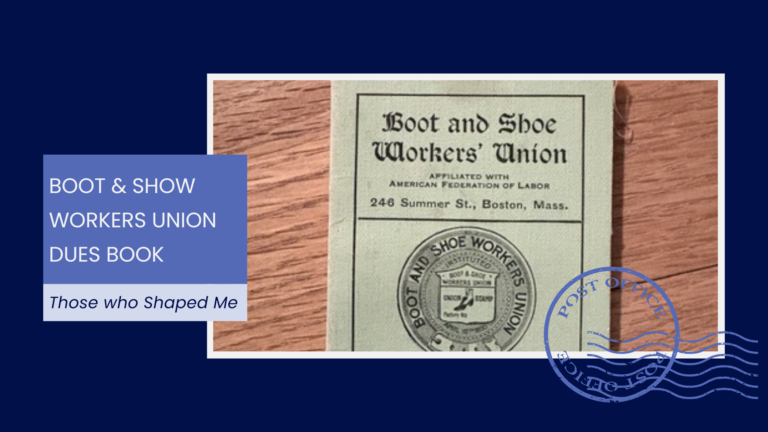
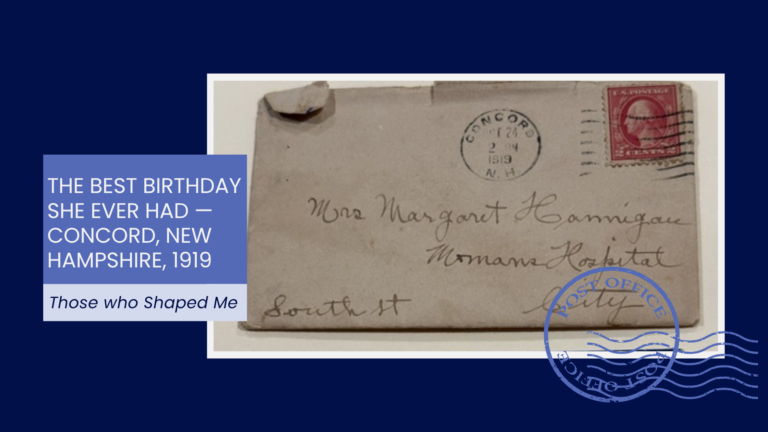
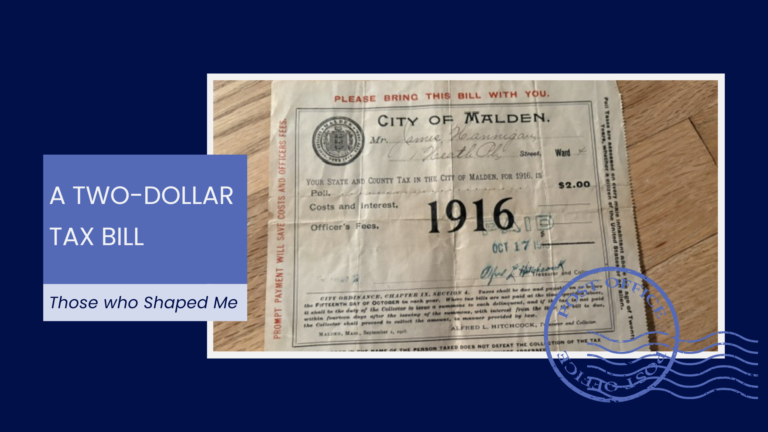
By 1930, James had already spent many years building his life in America. After immigrating from Ireland, he first found work in the Massachusetts shoe industry, joining the Boot and Shoe Workers’ Union in 1915 while living in Malden. There he met and married my grandmother, Margaret Dawson, another Irish immigrant. Soon afterward, they moved to Concord, where my mother was born in 1919.
Somewhere during those years, James entered another profession that had long attracted Irish immigrants—the granite industry.
Concord was known throughout the United States for its exceptional granite. Beginning in the mid-nineteenth century, enormous quarries opened throughout the city and surrounding towns, producing what became known as “Concord Granite.” It was prized for its strength, durability, and fine grain. Buildings, bridges, public monuments, and cemetery memorials across the country were constructed from stone quarried and finished in Concord.
Working granite demanded skill, patience, and physical endurance. Quarrymen drilled, blasted, split, lifted, and shaped massive blocks of stone using techniques that had changed little over generations. Stone cutters then transformed those rough blocks into precisely finished building stone, monuments, and architectural details. It was dangerous work, but it was also highly respected craftsmanship.
To protect those craftsmen, the Quarry Workers’ International Union of North America was organized in 1903. Unlike many early labor organizations that represented only local workers, the Quarry Workers’ Union united granite workers throughout the United States and Canada. The union negotiated wages, promoted safer working conditions, assisted injured workers, and provided a sense of solidarity among men whose work carried daily risks. Membership also reflected a pride in one’s craft. Quarrymen understood that they were not simply laborers; they were skilled tradesmen whose work would endure for generations.
This card is not a membership card but a withdrawal card. That distinction is important. It certified that James left Local 77 in good standing. Such cards were commonly issued when a member retired, changed occupations, moved to another locality, or transferred to another local. It preserved his standing within the union should he later seek to rejoin.
As I learned more about this document, another remarkable connection emerged.
My paternal great-grandfather, John Mulligan, was also part of Concord’s granite industry. His occupation is listed as “Stone Cutter” on the birth certificate of his son, Thomas Edward Mulligan, in 1902. Decades before James joined the Quarry Workers’ International Union, John had already been helping shape Concord’s reputation as one of America’s great granite cities.
I cannot say whether John Mulligan and James Hannigan ever worked together. There is no evidence of that. But I do know that both men earned their living in the same industry, belonged to the same community of skilled craftsmen, and shared the experience of being Irish immigrants who built new lives in Concord through honest work.
That realization makes this card deeply personal.
Looking at this small withdrawal card today, I no longer see it as a simple union document. I see a reminder that family history often unfolds in unexpected ways. Sometimes the connections between our ancestors are not found in birth or marriage records alone. Sometimes they are found in the work they did and the communities they built.