The Little Red Shop
Every great enterprise must begin somewhere. In Hopedale, one of America’s most successful industrial companies began in a simple wooden workshop known as the Little Red Shop.
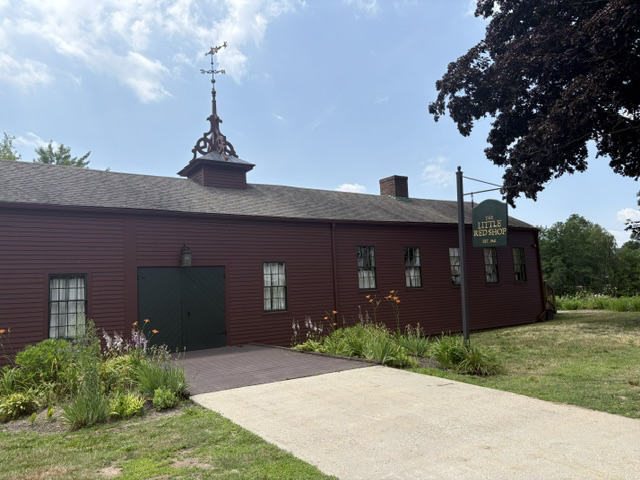
Built in 1841, this unassuming building became the first permanent home of the Draper business. At the time, Hopedale was still a young utopian community founded by Reverend Adin Ballou, where residents sought to build a society based on cooperation, equality, and shared responsibility. It was within this unique environment that the Draper family’s remarkable story began.
George Draper established his machine shop here to build and repair equipment for the Hopedale Community. As the American textile industry expanded during the nineteenth century, so did his business. What began in this modest workshop evolved into the Hopedale Machine Company, an internationally recognized manufacturer of textile machinery.
The Draper Company specialized in designing and manufacturing machinery used throughout the textile production process. Their products included spinning frames, spoolers, winders, warp preparation equipment, and, most notably, automatic power looms. One of the company’s greatest innovations was the Northrop automatic loom, which could automatically replace an empty shuttle with a full one without stopping the machine. This invention dramatically increased efficiency, reduced labor costs, and revolutionized textile manufacturing around the world. By the early twentieth century, Draper machinery was operating in mills throughout New England, the American South, Europe, Asia, and South America, making Hopedale a name recognized across the global textile industry.
The success of the Draper Company transformed Hopedale. As the utopian community gradually gave way to an industrial town, the Draper family became not only successful manufacturers but generous philanthropists. They invested their success back into the town by funding schools, churches, parks, the Community House, the Bancroft Memorial Library, and numerous civic improvements that continue to define Hopedale today.
Yet standing before the Little Red Shop, it is difficult to imagine that such a global enterprise began within these simple walls. There is nothing elaborate about the building. Its weathered clapboards and modest size speak to a time when craftsmanship mattered more than appearance. Inside this small workshop, ideas were tested, machines were refined, and problems were solved one innovation at a time. Like so many of America’s great success stories, the beginnings were humble.
In 1951, recognizing its importance to both the town and the nation, the Little Red Shop was preserved as the Draper Museum. Today it serves as a reminder of Hopedale’s industrial heritage and the ingenuity that helped shape one of the world’s most important manufacturing industries.
As I stood outside this small red building, I couldn’t help but think about the remarkable story it represents. Only a short walk away is the home of Adin Ballou, where one man imagined a community built on peace, equality, and cooperation. Here, another visionary began building machines that would transform textile manufacturing across the world. One dreamed of changing society through ideals; the other changed industry through innovation.
Together, these two modest buildings tell the story of Hopedale. One gave the town its purpose. The other gave it its prosperity. Both began with a single idea, pursued with determination, and both left a legacy that continues to define this extraordinary Massachusetts community.
Read More From Nancy
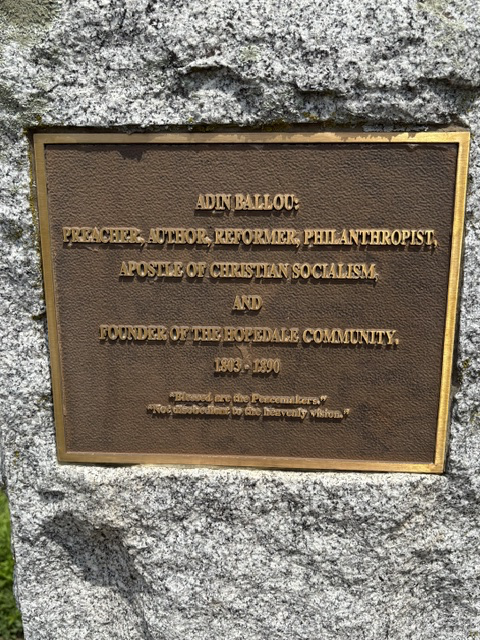
The Founder
The first plaque introduces us to the man whose vision gave birth to Hopedale. It identifies Adin Ballou as a preacher, author, reformer, philanthropist, “Apostle of Christian Socialism,” and founder of the Hopedale Community. Those titles reflect a remarkable life devoted not simply to preaching, but to putting faith into practice. Ballou believed Christianity should […]
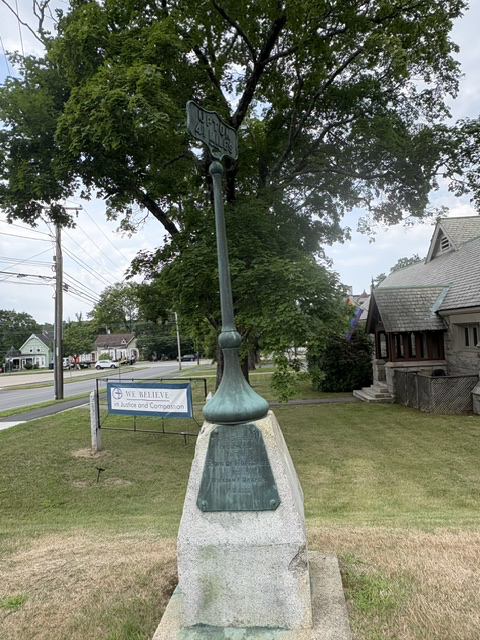
Historic Street Markers
Sometimes the smallest details reveal the most about a community. As I explored Hopedale, one of the features that caught my attention was this beautifully crafted bronze street marker. Mounted on a granite base and topped with a directional sign pointing travelers toward Upton, four and a half miles away, it reflects a time when […]
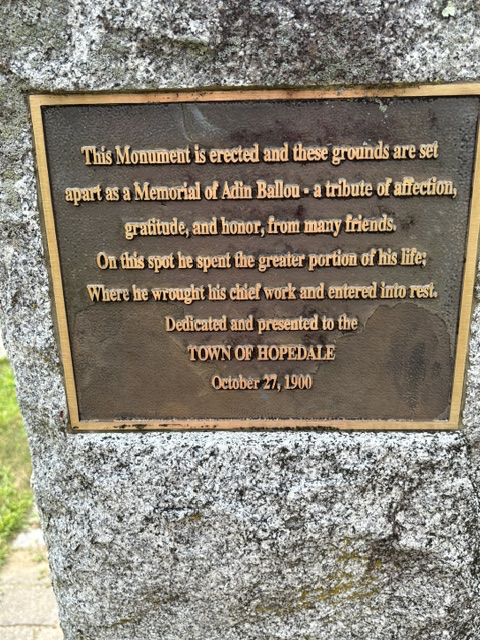
A tribute from those who knew him
Many monuments are erected decades or even centuries after a person’s death. This one was different. Dedicated to the Town of Hopedale on October 27, 1900, only ten years after Ballou’s death, it was presented not by government officials but by friends and admirers. The inscription describes it as “a tribute of affection, gratitude, and […]

